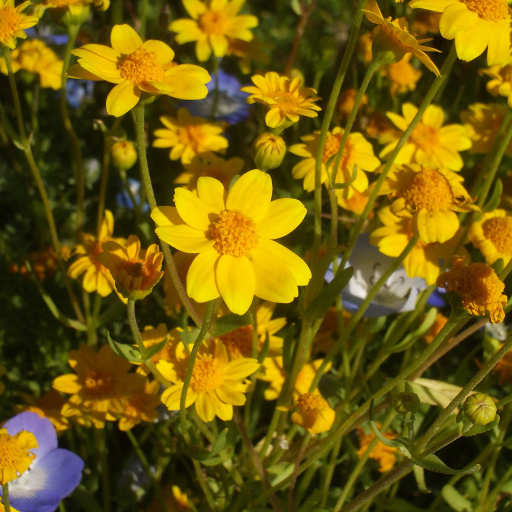
Plant Overview
Known affectionately as the Yellowray Goldfields, Lasthenia glabrata is a vibrant California native that paints coastal wetlands and vernal pools in shades of brilliant lemon. While many wildflowers retreat from soggy or salty soil, this resilient beauty thrives in the heavy clays and salt marshes where others might struggle. It is a favorite for restoration projects, acting as a beacon for native pollinators during the bright spring months.
🔍 How to Identify
- 🌼 Sunny Rays: The flower heads are bright yellow and daisy-like, with distinct "ray" petals surrounding a central disk of tiny florets.
- 🌿 Smooth Foliage: Unlike some of its fuzzy relatives, the stems and narrow, strap-shaped leaves are "glabrous" (smooth and hairless), often feeling slightly succulent to the touch.
- 🌱 Growth Habit: It typically grows in an upright, branching fashion, reaching anywhere from 12 to 24 inches in height depending on moisture levels.
🏡 In Your Garden
- 💧 Water Management: This isn't your average drought-tolerant wildflower; it actually prefers "wet feet." In a garden setting, it excels in low spots that collect winter rain or in heavy clay soils that hold moisture.
- 🧂 Coastal Resilience: If you live near the ocean, this is a perfect choice. It is naturally adapted to alkaline and slightly saline conditions, making it much tougher than its delicate appearance suggests.
⚠️ Safety & Toxicity
- ✅ Generally Safe: Lasthenia glabrata is considered non-toxic and is not known to pose a threat to curious cats, dogs, or children.
- 🧤 Contact Caution: While safe, the sap of many plants in the Aster family can cause very mild skin irritation for people with specific plant allergies. Wearing gloves during heavy pruning is always a good practice.
✨ Fun Fact
The genus name Lasthenia is a tribute to Lasthenia of Mantinea, an ancient Greek woman who was so determined to study philosophy that she dressed as a man to attend Plato’s lectures!

Detailed Care Instructions
To grow Lasthenia glabrata, also known as goldfields, follow these steps:
- Climate requirements: Lasthenia glabrata is native to California and it thrives in Mediterranean climates. Ensure that your planting location has mild winters and long, dry summers.
- Soil preparation: The plant prefers well-draining soils. Prepare the soil by removing any weeds or debris and loosen it with a garden fork or tiller. Incorporate organic matter, such as compost, to improve soil fertility and drainage.
- Seed selection: Obtain Lasthenia glabrata seeds from a reputable source. Choose fresh seeds for better germination rates.
- Sowing seeds: Sow the seeds in early spring, as the weather starts to warm up. Scatter the seeds on the prepared soil surface, ensuring even distribution. Lightly press the seeds into the soil but don't cover them completely, as they require light for germination.
- Watering and care: Keep the soil consistently moist but avoid overwatering, as the plant prefers dry conditions. Water deeply and infrequently, allowing the soil to dry between waterings. Once established, Lasthenia glabrata requires minimal watering.
- Sunlight: Provide full sun exposure to the plant. Make sure it receives at least 6-8 hours of direct sunlight daily.
- Weed control: Regularly weed the area to prevent competition for resources. However, ensure that you do not disturb the seedlings during this process.
- Fertilization: Lasthenia glabrata does not require heavy fertilization. If needed, use a balanced, slow-release fertilizer in early spring. Follow the package instructions for application rates.
- Maintenance: After the flowers fade and the plant starts to dry out, you can collect the seeds for future propagation. To promote reseeding, allow the plant to drop its seeds naturally.
- Pests and diseases: Lasthenia glabrata is generally resistant to pests and diseases. However, it may occasionally be susceptible to aphids or powdery mildew. Monitor the plant regularly and address any issues promptly.
With proper care and suitable growing conditions, your Lasthenia glabrata plant should thrive and provide beautiful yellow blooms in late spring and early summer.
To water this plant, thoroughly saturate the soil around the base of the plant until water begins to drain from the bottom. Allow the soil to dry out slightly before watering again, as this plant prefers well-draining soil and can be sensitive to overwatering. Monitor the plant for signs of wilting or drooping, which may indicate that it needs to be watered more frequently. Avoid getting water on the leaves or flowers, as this can increase the risk of fungal diseases. If the plant is in a container, ensure that there are drainage holes at the bottom to allow excess water to escape.
- Choose a balanced, slow-release fertilizer with an NPK ratio of 10-10-10 or lower.
- Apply the fertilizer in the early spring, before the plant begins to grow vigorously.
- Use a lightweight, granular fertilizer and apply it around the base of the plant.
- Water the fertilizer in well, being careful not to get any on the foliage.
- Repeat the application of fertilizer every 4-6 weeks during the growing season, depending on the needs of the plant.
The soil should be well-draining and sandy with a pH level of 6 to 7.5. It should also be nutrient-rich and have a good amount of organic matter. Regular watering is necessary, but the soil shouldn't be waterlogged or too wet. The plant prefers a sunny location with good air circulation. Adding a slow-release fertilizer during the growing season can help support healthy growth and bloom.
The propagation of this plant can be achieved through both seeds and cuttings. For seed propagation, the seeds should be collected from the mature plant and sown directly in the soil in late fall or early winter. The soil should be well-draining and kept moist until the seedlings emerge in the spring.
For cutting propagation, take a stem cutting from a strong and healthy plant with a sharp, sterilized knife, ensuring it is a few inches long. Strip the leaves from the lower half of the stem and dip the cut end in rooting hormone powder. Plant the cutting in a pot filled with a well-draining potting mix and keep it well-watered.
Place the pot in a bright, but shaded area and cover it with a plastic bag or a cloche to keep the humidity levels high. After a few weeks, new roots will begin to form, and the plant will start to grow. Gradually, over a few weeks, the covering can be removed to acclimate to the new environment.
Both methods should be regularly checked and monitored until the plant is established and ready for repotting or transplanting to a permanent location.








