Plant Overview
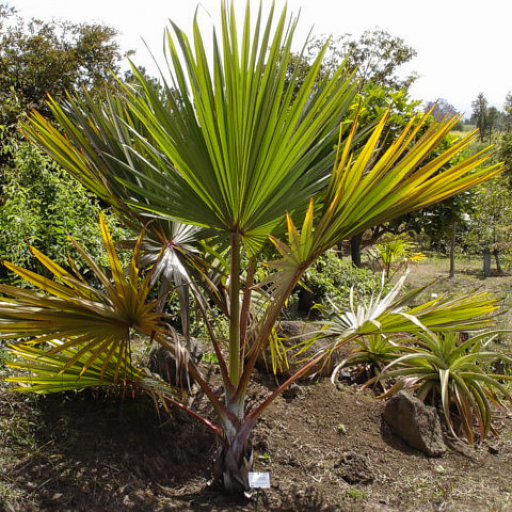
Known as the Red Latan Palm, this stunning native of the Mascarene Islands is the ultimate architectural statement for a tropical landscape. It is widely celebrated for its "growing pains"—a unique phase where juvenile plants display a fiery, crimson glow on their leaves and stems before maturing into a dignified, silver-blue giant. Often nicknamed the "Sunset Palm," it brings a touch of prehistoric drama to any sun-drenched garden.
🔍 How to Identify
- 🌿 Fan-Shaped Fronds: The leaves are massive, stiff, and "palmate" (shaped like a hand), forming a nearly perfect circle that can reach over 6 feet in diameter.
- 🔴 Crimson Accents: When young, the leaf margins, veins, and stems are a brilliant, saturated red. As the plant ages, this color transitions into a waxy, glaucous blue-grey.
- 📏 Textured Trunk: It grows a solitary, clean trunk that is light grey and marked with horizontal rings where old leaves once lived.
🏡 In Your Garden
- ☀️ Sun Seeker: This palm lives for the light. To maintain the intense red coloration in younger specimens, it needs full sun; in the shade, the colors often fade to a duller green.
- 🌊 Coastal Warrior: It is exceptionally resistant to salt spray and high winds, making it a perfect choice for beachfront properties or coastal gardens where other palms might struggle.
- 🪴 Patience Required: Because it has a deep taproot, it dislikes being moved once established. It is a slow-growing species, so treat it as a long-term investment in your landscape’s "bones."
⚠️ Safety & Toxicity
- 🟢 Non-Toxic: The Red Latan Palm is generally considered safe for households with pets and children.
- ⚔️ Physical Hazards: While not poisonous, the leaf edges and stems are very stiff and can be quite sharp. Handle with care during pruning to avoid skin abrasions or "leaf cuts."
✨ Fun Fact
In its native home on Reunion Island, the Latania lontaroides is actually an endangered species. While it is thriving in gardens and nurseries across the globe, its wild population is restricted to a few rocky cliffs near the ocean!

Detailed Care Instructions
| Lighting | Full Sun |
| Hardiness Zones | 10A - 11 |
To grow the Latania lontaroides plant, also known as the Red Latan Palm or Latanier Rouge, follow these steps:
- Climate and Location:
- Ensure you have the appropriate climate for the plant. It thrives in tropical or subtropical regions.
- It requires full sunlight, so choose a location with direct sun exposure, preferably with protection from strong winds.
- Ensure you have the appropriate climate for the plant. It thrives in tropical or subtropical regions.
- Soil and Pot:
- Use well-draining soil enriched with organic matter.
- For container gardening, choose a large pot with drainage holes to accommodate the plant's growth.
- Use well-draining soil enriched with organic matter.
- Watering:
- Keep the soil consistently moist but not waterlogged. Watering frequency will depend on the climate and season.
- During hotter months, you may need to water more frequently to avoid dehydration.
- Keep the soil consistently moist but not waterlogged. Watering frequency will depend on the climate and season.
- Fertilization:
- Apply a slow-release palm fertilizer during the growing season, typically from spring to autumn, following the instructions on the product package.
- Additionally, you can supplement with liquid fertilizer every one to two months to promote healthy growth.
- Apply a slow-release palm fertilizer during the growing season, typically from spring to autumn, following the instructions on the product package.
- Pruning and Maintenance:
- Remove any dead or damaged fronds regularly to maintain the plant's appearance.
- Ensure there is enough space between neighboring plants to prevent overcrowding and promote better airflow.
- Remove any dead or damaged fronds regularly to maintain the plant's appearance.
- Temperature and Protection:
- The Latania lontaroides plant can tolerate temperatures down to around 25°F (-4°C), but it's best to protect it from prolonged freezing conditions.
- Consider moving the plant indoors or providing frost protection during winter in colder climates.
- The Latania lontaroides plant can tolerate temperatures down to around 25°F (-4°C), but it's best to protect it from prolonged freezing conditions.
- Repotting:
- As the plant grows, you may need to repot it into a larger container every 2-3 years.
- Choose a pot that is one size larger and use fresh potting soil during repotting.
- As the plant grows, you may need to repot it into a larger container every 2-3 years.
- Propagation:
- Red Latan Palms can be propagated through seeds.
- Soak the seeds in water for a day or two before planting them in potting soil, keeping them warm and moist until germination occurs.
Remember to research specific regional factors and consult local horticultural experts to ensure the best growing conditions for your Latania lontaroides plant.
- Red Latan Palms can be propagated through seeds.

Place in a bright room that is sun drenched almost all day. Or directly in a south-facing window.

1. Observe the plant's soil moisture level: The first step in watering the plant is to observe the soil moisture level. Check if the soil is dry to the touch or still moist.
2. Ensure proper drainage: Make sure that the plant pot has proper drainage and excess water can flow out. This will prevent waterlogging and root rot.
3. Water thoroughly: When watering, make sure to water thoroughly until the water runs out through the bottom of the pot. This will ensure that the roots are evenly hydrated.
4. Avoid overwatering: Overwatering can be harmful to the plant and can lead to root rot. It is important to let the soil dry out a bit between watering.
5. Water according to the season: During the summer months, when the temperature is hot and dry, the plant may require more frequent watering. In the winter months, when the temperature is cooler, the plant may require less frequent watering.
6. Use room-temperature water: Use room-temperature water when watering instead of cold water. This will prevent shock to the plant's roots.
7. Water in the morning: It is recommended to water the plant in the morning when there is sunlight. This way, any excess water on the leaves will dry out before nighttime, reducing the risk of fungal diseases.
To fertilize Latania Lontaroides, also known as the specific name of this plant, follow these instructions:
- Choose a balanced, slow-release fertilizer formulated for palm trees or tropical plants.
- Apply the fertilizer during the growing season, which is typically from late spring to early fall.
- Dilute the fertilizer according to the package instructions, usually using a ratio of 1 tablespoon per gallon of water.
- Water the plant thoroughly before applying the fertilizer to ensure the soil is moist.
- Use a watering can or sprayer to evenly distribute the fertilizer solution over the soil around the base of the plant.
- Avoid directly applying the fertilizer onto the leaves, as this may cause burn or damage.
- After applying the fertilizer, water the plant again to help the nutrients penetrate the soil.
- Do not over-fertilize, as excessive nutrients can lead to salt accumulation or other issues. Follow the recommended dosage and frequency specified by the fertilizer manufacturer.
- Monitor the plant for any signs of nutrient deficiencies or excesses, such as yellowing leaves or stunted growth. Adjust the fertilization schedule as needed.
- Additionally, supplementing with organic matter, such as compost or well-rotted manure, can help improve soil fertility and provide additional nutrients naturally. Consider incorporating organic amendments during the planting and yearly maintenance of the plant.
The ideal soil for Latania Lontaroides plant is well-draining and rich in nutrients. It should have a pH level ranging from neutral to slightly acidic. A mix of peat moss, sand, and perlite or vermiculite is commonly used for this plant. The soil should be loose and aerated to allow proper root growth, and should not hold too much moisture. Additionally, adding organic matter to the soil can help improve its quality and fertility.
To propagate Latania lontaroides plants, you can follow these steps:
- Start by selecting a healthy and mature plant with well-developed roots. This will ensure better chances of success in propagation.
- Prepare a clean and sharp pruning tool, such as a pair of gardening shears or a sharp knife. This will help create clean cuts, minimizing damage to the plant.
- Choose a stem or offshoot that is about 6 to 8 inches long and has several healthy leaves. Make a clean cut just below a leaf node or an offshoot to encourage new root growth.
- Remove any excess leaves from the lower part of the stem or offshoot, leaving only a few at the top to support photosynthesis.
- Prepare a propagation medium or potting mix that is well-draining. A mixture of peat moss, perlite, and sand works well for this purpose.
- Make a hole in the propagation medium using your finger or a stick, deep enough to accommodate the lower end of the stem or offshoot.
- Dip the cut end of the stem or offshoot into a rooting hormone powder to promote root development. This step is optional but can improve the success rate.
- Carefully insert the stem or offshoot into the prepared hole in the propagation medium, ensuring that it is upright and stable.
- Gently press the medium around the stem or offshoot, providing support and promoting contact between the stem and the medium for better root formation.
- Place the potted cutting in a warm and humid environment, away from direct sunlight. Using a propagator or covering the pot with a clear plastic bag can help create a mini greenhouse effect, maintaining high humidity levels around the cutting.
- Mist the cutting occasionally to keep the humidity levels high. However, make sure the propagation medium is not overly saturated to prevent rotting.
- Keep the cutting in these conditions for several weeks or until new roots start to form. This can take anywhere from a few weeks to a couple of months depending on the plant and environmental conditions.
- After the roots have developed, you can gradually expose the plant to more light and decrease the humidity levels. This will help the plant acclimate to its new growing conditions.
- Once the roots are well-established and the plant has adapted to its new environment, you can transplant it into a larger pot or outdoor location if desired.
By following these steps, you can successfully propagate Latania lontaroides plants and expand your collection.








