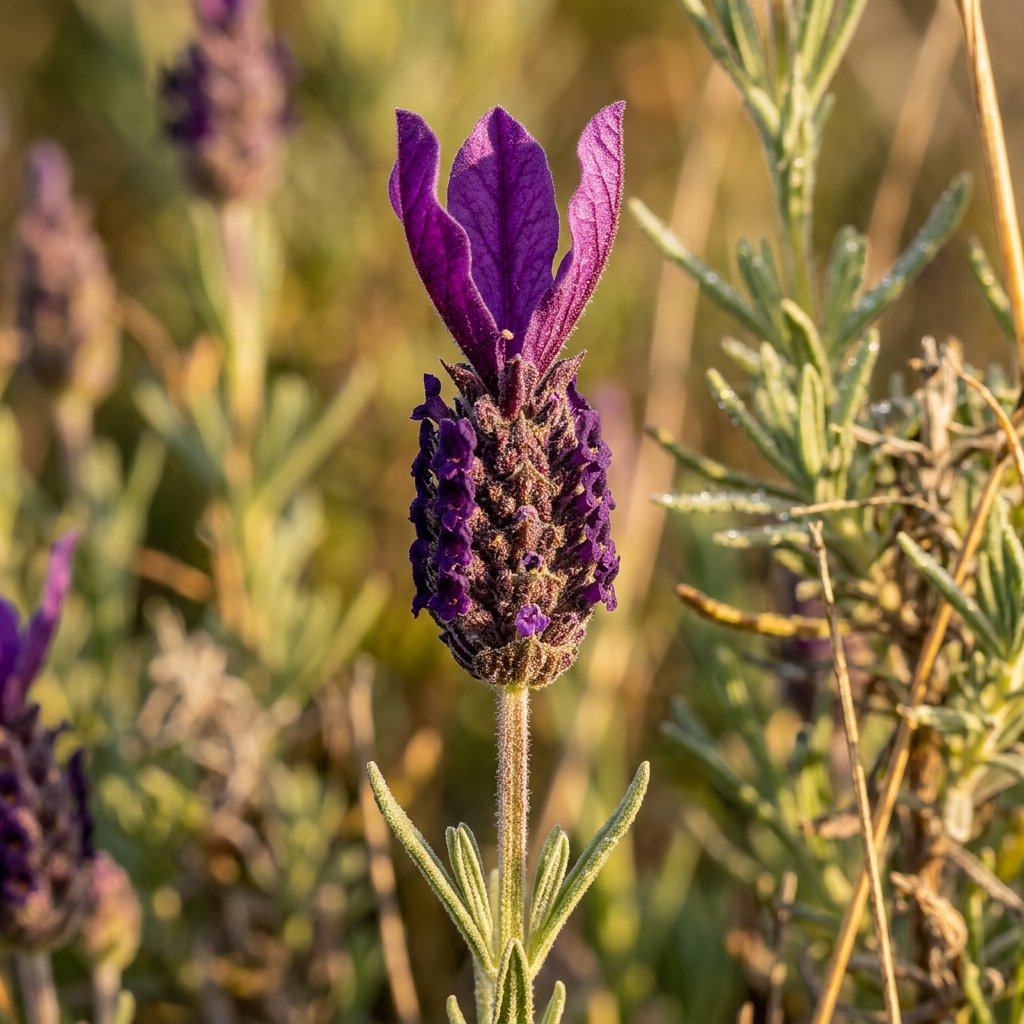
Plant Overview
Often called "Butterfly Lavender" or "Spanish Lavender," this Mediterranean beauty is instantly recognizable by the whimsical, ear-like tufts crowning its flower spikes. Unlike its English cousins, it thrives in intense heat and adds a wild, structural elegance to any sunny corner. It is a favorite for those wanting a "dry garden" aesthetic that attracts every bee in the neighborhood.
🔍 How to Identify
- 🦋 The "Rabbit Ears": Look for distinct, upright bracts (sterile petals) perched on top of the flower head like colorful wings or rabbit ears.
- 🍍 Pinecone Flower Heads: The tiny, fertile flowers are packed tightly into a dense, oval-shaped spike that resembles a small, purple pineapple.
- 🩶 Velvety Foliage: The narrow, needle-like leaves are soft to the touch and sport a silvery-grey coating designed to reflect harsh sunlight.
🏡 In Your Garden
- 🏜️ The Drainage Rule: This plant has a "feet dry" policy. It thrives in poor, sandy, or rocky soil and will rapidly decline or succumb to root rot if kept in heavy, waterlogged clay.
- ✂️ Pruning Habits: To keep it from becoming "leggy" or woody, give it a light haircut after the first flush of flowers. Be careful not to cut back into the old, brown wood, as it rarely regrows from the base.
- ☀️ Sun Worship: It requires at least 6 to 8 hours of direct light. Without enough sun, those iconic "ears" will look pale and floppy.
⚠️ Safety & Toxicity
- 🐾 Pet Warning: While beautiful, Lavandula stoechas contains high levels of camphor and linalool. It is considered toxic to cats, dogs, and horses if ingested, potentially causing localized dermatitis or digestive upset.
- 👶 Child Safety: Generally safe for curious hands, though the intense scent can be overwhelming for some. It is not commonly used in cooking because its flavor is much more "soapy" and medicinal than English lavender.
✨ Fun Fact
🏺 The name Stoechas comes from the ancient Greek name for the Îles d'Hyères, where this species grew in abundance. The Romans used it so frequently in their communal baths that the name "Lavender" eventually evolved from the Latin lavare, meaning "to wash."

Detailed Care Instructions
| Color | Pink, Purple, White |
| Soil Ph | 6.5-8.0 |
| Humidity | Normal |
| Toxicity | Toxic |
| Soil Type | Sandy, Moist, Well-Drained |
| Bloom Time | Late Spring To Early Summer |
| Difficulty | Medium |
| Plant Type | Herbaceous Flowering Perennial |
| Mature Size | 18 To 36 Inches Tall |
| Native Area | Africa, Europe, Mediterranean |
| Temperature | 18°C - 28°C |
| Sun Exposure | Full Sun |
| Hardiness Zones | 8-9 |
To grow Lavandula Stoechas (also known as Spanish lavender), you can follow these steps:
- Choose a suitable location: Spanish lavender thrives in full sun and well-draining soil. Ensure the planting area receives at least six to eight hours of direct sunlight each day.
- Prepare the soil: Amend the soil by adding organic matter like compost or well-rotted manure to improve its drainage and fertility. Spanish lavender prefers slightly alkaline soil with a pH level of 7 to 8.
- Planting: Dig a hole that is slightly wider and deeper than the nursery pot. Remove the plant from the pot and place it in the hole. Backfill with soil, gently firming it around the base of the plant. Add a layer of mulch around the plant to help retain moisture.
- Watering: Initially, water the plant deeply and thoroughly to help establish the root system. However, avoid over-watering as Lavandula Stoechas prefers drier conditions. Water deeply but infrequently, allowing the soil to dry out between watering sessions.
- Pruning: Prune your lavender plant regularly to maintain its shape and promote healthy growth. In late spring or early summer, remove spent flower stalks by cutting them back to a healthy set of leaves. Pruning stimulates new growth and helps the plant remain compact and bushy.
- Fertilizing: Spanish lavender typically does not require heavy fertilization. However, you can provide a slow-release, low-nitrogen fertilizer in early spring or use a well-balanced organic fertilizer according to the product instructions.
- Pests and diseases: Lavandula Stoechas is relatively resistant to pests and diseases. However, keep an eye out for common issues like root rot, aphids, or spider mites. If necessary, use organic pest control methods or consult a professional.
- Winter care: In areas with harsh winters, protect your Lavandula Stoechas from freezing temperatures by covering it with burlap or a frost cloth. Remove the cover once the danger of frost has passed.
Remember to check the specific care instructions that come with the plant, as different varieties may have slightly different requirements.

Place in a bright room that is sun drenched almost all day. Or directly in a south-facing window.

To water this type of plant, it is important to first assess the soil moisture. The soil should be moist but not saturated. Overwatering can lead to root rot and other fungal diseases. It is recommended to water deeply but infrequently, allowing the soil to dry out slightly between waterings. It is also important to avoid getting water on the foliage and flowers, as this can lead to sunburn and other damage. Watering early in the morning or late in the evening can help prevent water evaporation and allow the plant to absorb moisture efficiently.
To fertilize Lavandula Stoechas, use a well-balanced fertilizer with equal amounts of nitrogen, phosphorus, and potassium. Apply the fertilizer once every two months during the growing season. Avoid over-fertilizing, as this can lead to excessive foliage growth and reduce flowering. Water the plant deeply after fertilizing to help the nutrients penetrate the soil.
Lavandula Stoechas prefers well-draining soil. Loamy or sandy soils are preferable, as they tend to drain more effectively. Heavy clay soils should be avoided or amended with sand and organic matter to improve drainage. The soil pH should be neutral to slightly alkaline, with a range between 6.5 and 8.0 being ideal. Adding lime to acidic soils can help raise pH levels. It is also important to ensure that the soil is free of rocks and debris to prevent soil compaction and improve water flow. Lastly, it is recommended to add a slow-release fertilizer to the soil before planting to provide essential nutrients and encourage strong root development.
To propagate this plant, you will need to take stem cuttings from a healthy and mature plant. Use a clean and sharp pair of scissors or pruning shears to cut a 2-3 inch-long stem from the parent plant, making sure to include a few leaves along with it.
Next, remove the leaves from the lower half of the stem and dip the cut end in rooting hormone powder. This will help to encourage root growth. Then, plant the stem cutting in a well-draining soil mixture, making sure to keep the soil moist but not waterlogged.
Place the cutting in a warm and bright location, but out of direct sunlight. It will take a few weeks for the roots to develop and for new growth to appear. Once the plant has established itself and has grown new leaves, it can be transferred to a larger pot or planted outdoors.
It is important to note that Lavandula Stoechas plants are sensitive to overwatering and do not thrive in areas with high humidity. Make sure to water the plant only when the top inch of soil is dry and to provide adequate air circulation around the plant.
Common pests of the topped lavender include Spider mites, thrips, whiteflies. Make a habit of checking your topped lavender frequently for pests so that any infestations can be caught and managed early.








