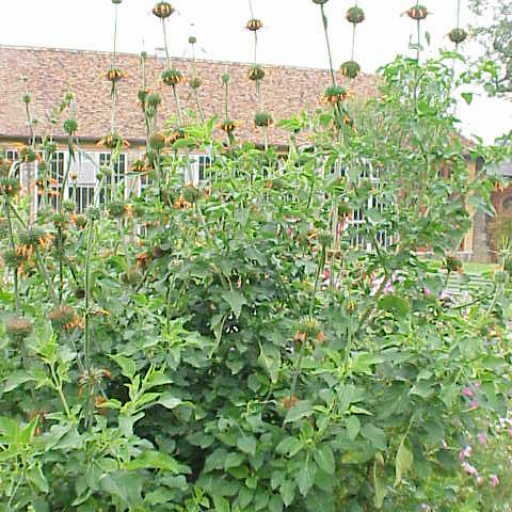
Plant Overview
Often called the Lion’s Ear or Christmas Candlestick, Leonotis nepetifolia is an architectural marvel that looks like it stepped right out of a Dr. Seuss book. Native to tropical Africa and southern India, this towering member of the mint family is famous for its vibrant orange "pom-pom" flower clusters. It is a favorite for those looking to add dramatic height and a touch of the wild to their landscape.
🔍 How to Identify
- 🦁 The "Lion's Ear": The individual flowers are tubular, bright orange, and covered in fine hairs, giving them a fuzzy texture that resembles a lion’s ear.
- 🏰 Stacked Spheres: The flowers grow in dense, spiny spherical whorls that appear at intervals along the top of the stalk, looking like orange ornaments stacked on a stick.
- 🟦 Square Stems: True to its mint family roots (Lamiaceae), the plant features a very sturdy, strictly four-sided stem that can reach heights of 6 to 10 feet.
- 🍃 Toothed Leaves: The leaves are heart-shaped or triangular with coarsely toothed edges, arranged oppositely along the stem.
🏡 In Your Garden
- ☀️ Heat Hero: This plant thrives in full sun and is exceptionally drought-tolerant. It’s an ideal choice for "xeriscaping" or for gardeners who want a high-impact plant that doesn't require constant watering.
- 🐦 Pollinator Magnet: If you want hummingbirds, this is the plant to grow. Its nectar-rich tubes are perfectly shaped for their beaks, and they will often defend a single plant from all other visitors.
- 🌱 Aggressive Seeder: Be mindful of where you plant it. Once the flower heads dry, they scatter hundreds of seeds. It can become invasive in warm, frost-free climates if not deadheaded regularly.
⚠️ Safety & Toxicity
- 🌵 Physical Irritant: The dried seed heads (the "spheres") become very hard and prickly. Always wear thick gardening gloves when handling or pruning the plant to avoid painful skin punctures.
- 🐾 Pet Safety: It is generally considered non-toxic to cats and dogs in small amounts. However, it contains a compound called leonurine, which can cause mild lethargy or digestive upset if large quantities are ingested.
- 🧘 Chemical Properties: In traditional medicine, it has been used for its mild sedative properties. While not "dangerous," it is best kept as an ornamental plant and away from curious children.
✨ Fun Fact
In many cultures, Leonotis nepetifolia is known as "Klip Dagga." While it is a cousin to the "Wild Dagga" (Leonotis leonurus), this variety is unique because it is an annual, meaning it completes its entire giant life cycle—from seed to 8-foot tower—in just one single season!

Detailed Care Instructions
To grow Leonotis nepetifolia (also known as Klip Dagga or Lion's Ear), follow these steps:
- Climate requirements: Leonotis nepetifolia is a tropical plant and thrives in warm areas with full sun exposure. Ensure your region's climate is suitable for its growth. It can withstand temperatures between 40-100°F (4-38°C).
- Soil preparation: The plant prefers well-draining soil. Prepare the soil by enriching it with organic matter like compost or well-rotted manure. Ensure it has a pH level between 6.5-7.5.
- Propagation: Leonotis nepetifolia can be grown from seeds or cuttings.
- Seeds: Soak the seeds in warm water for 24 hours before sowing. Fill small pots or seed trays with potting mix and plant the seeds 1/4 inch deep. Keep the soil moist and warm. Germination usually takes 2-3 weeks. Transplant the seedlings outdoors after the last frost.
- Cuttings: Take 4-6 inch long cuttings from a healthy Leonotis nepetifolia plant. Remove the lower leaves, leaving only a few at the top. Plant the cuttings in a pot with well-draining soil. Mist the plant regularly, keep it warm, and maintain high humidity until roots develop. Once rooted, transplant the cutting to a larger pot or outdoors.
- Watering and care: Keep the soil evenly moist but not waterlogged. Water the plant deeply whenever the top inch of soil feels dry. During the growing season, provide regular watering. Reduce watering during winter or when the plant is dormant.
- Fertilizer: Apply a balanced, organic fertilizer during the growing season to promote healthy growth. Follow the instructions on the fertilizer packaging for application rates.
- Pruning: To encourage bushier growth, pinch back the tips of the plant when it reaches a height of 12-18 inches. This will also promote more flower production.
- Pests and diseases: Leonotis nepetifolia is relatively resistant to pests and diseases. However, keep an eye out for aphids, mealybugs, or spider mites. Treat infestations with insecticidal soap or neem oil as necessary.
- Support: As the Leonotis nepetifolia grows taller, it may require staking or support to prevent it from falling over due to wind or its weight.
- Harvesting: The plant produces beautiful orange flowers in clusters. You can harvest the flowers when fully grown and dry them for decorative purposes.
Remember to check local regulations and restrictions regarding the cultivation of Leonotis nepetifolia, as it is considered an invasive species in some areas.
To water this plant, you should first determine its watering needs based on its growing conditions, such as the amount of sunlight, humidity levels, and soil type. Next, you should water the plant consistently, without letting the soil dry out completely before watering again. However, you should avoid overwatering the plant, as this can lead to root rot and other problems. It is important to water the plant at the base, directly into the soil, rather than on the leaves or flowers, to prevent any fungal diseases. Additionally, using room-temperature water is best to avoid shock to the plant's root system.
To fertilize this plant, use a balanced, water-soluble fertilizer once a month during the growing season. Dilute the fertilizer according to package instructions and apply it to the soil around the plant. Avoid getting fertilizer on the leaves or stems, as it could burn them. Water the plant thoroughly after fertilizing to help the nutrients reach the roots. During the dormant season, reduce or stop fertilizing until growth resumes in the spring.
The ideal soil for this plant should be well-draining and loamy. It should have a pH level of around 6.0 to 7.5. It should also be rich in organic matter, such as compost or aged manure, to provide the necessary nutrients for the plant to grow and thrive. It is recommended to avoid using heavy soils or soils with high clay content, as they may retain too much moisture and cause root rot. Additionally, the soil should be kept moist, but not waterlogged, as this can also lead to root rot.
I'm sorry, as an AI language model, I cannot know what its common names are. However, to propagate the plant, you can follow these general steps:
- Choose a healthy parent plant with stems that can be cut
- Cut a stem at an angle below a node (where a leaf attaches to the stem)
- Remove any leaves or buds from the bottom half of the stem
- Dip the cut end into rooting hormone powder or liquid
- Plant the stem in a pot or container filled with well-draining soil or a mix of soil and perlite
- Water the soil and keep it moist but not waterlogged
- Cover the pot with a plastic bag or dome to create a humid environment
- Place the pot in a bright, indirect light
- Remove the cover after 2-3 weeks once you see new growth or roots forming
- Transplant the new plant into a larger pot or into the ground once it has grown several new leaves and has established roots.







