Plant Overview
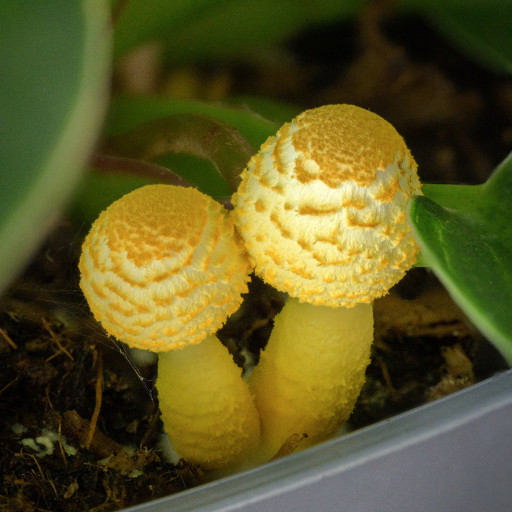
Often called the Flowerpot Parasol or "Plant Pot Dapperling," this bright, cheerful mushroom is a frequent surprise guest in indoor jungles. While it looks like a tiny sunny umbrella, it is actually a saprobic fungus that thrives in the warm, moist environment of tropical houseplant soil. Rather than being a sign of a "sick" plant, its presence usually means your soil is rich in organic matter.
🔍 How to Identify
- 🟡 The Cap: Starts as a small, bright yellow "egg" before expanding into a bell-shaped or flat parasol with fine, powdery scales and a pleated edge.
- 📏 The Gills: Features thin, sulfur-yellow gills underneath the cap that are "free," meaning they do not touch the stem.
- 💍 The Stem: A slender, hollow yellow stalk that usually features a delicate, papery ring (annulus) and a slightly swollen, bulbous base.
🌲 Habitat & Ecology
- 🪴 The Pot Dweller: This species is rarely found in the wild in temperate zones; instead, it has evolved to thrive in greenhouses and indoor pots, feeding on the peat and mulch in commercial potting soil.
- 🍄 Mycelial Network: Before the mushrooms pop up, you might see tiny white or yellowish grains in the soil—these are sclerotia, which act as "energy storage" for the fungus to survive dry spells.
⚠️ Safety & Toxicity
- 🚨 WARNING: Toxic if ingested. This mushroom should never be consumed by humans or animals.
- 🤢 Symptoms: Ingestion causes severe stomach upset, vomiting, and gastric distress.
- 🐾 Pet Safety: While it won't hurt your plant, it is a risk for curious cats or dogs. If your pet is a "nibbler," it is best to pluck the mushrooms and discard them immediately.
✨ Fun Fact
- ✨ This mushroom is a world-class hitchhiker! It is believed to have originated in the tropics, but it has spread to nearly every corner of the globe by hiding its microscopic spores and mycelium inside bags of commercial potting mix.

Detailed Care Instructions
| Humidity | Normal |
| Lighting | Shade |
| Toxicity | Poisonous |
| Difficulty | Hard |
| Hardiness Zones | 10 - 12 |
Leucocoprinus birnbaumii, commonly known as the yellow houseplant mushroom or the plantpot dapperling, is actually a type of fungus rather than a plant. It's often found growing in the soil of houseplants and greenhouse plants. This mushroom is not actively cultivated for its own sake because it's not edible and can be toxic if ingested. However, it sometimes appears incidentally in houseplants or garden pots that provide the right conditions.
If you're interested in the conditions that allow Leucocoprinus birnbaumii to thrive, here's what you need to know:
Environmental Conditions
- Soil: Leucocoprinus birnbaumii likes rich, organic soils. Its spores are often introduced into potting soil mixes, especially those that contain organic matter like compost.
- Moisture: This mushroom thrives in consistently moist conditions. Overwatering your houseplants or maintaining a high humidity level can provide a conducive environment for the fungus to grow.
- Temperature: It prefers warm temperatures, which is why it often appears in indoor settings like greenhouses or homes.
- Light: Moderate to low light conditions are often favorable. It doesn't necessarily need direct sunlight.
Cultivation Tips (for informational purposes)
- Purchase or Propagate Spores: While it's not common to purchase spores of Leucocoprinus birnbaumii due to its non-edible and toxic nature, spores can be introduced through contaminated soil or from spores already present in the environment.
- Prepare the Soil: Use organic-rich potting soil that retains moisture well. Avoid sterile soil unless you intend to introduce spores afterwards.
- Maintain Moisture and Humidity: Keep the soil consistently moist but not waterlogged. Using a humidity tray or misting the area around the plant can help maintain high humidity levels.
- Temperature Control: Aim to keep the temperature warm, typically within the range of 70-85°F (21-29°C).
- Light Conditions: Place the plant in an area with indirect or filtered light.
Observations
- Appearance: Leucocoprinus birnbaumii has small, bright yellow mushrooms with caps that are often 1-2 inches in diameter. The caps are dome-shaped when young and flatten out as they mature.
- Growth Duration: The mushrooms can appear quite suddenly, often overnight, and may persist for a few days before wilting.
Caution
- Toxicity: These mushrooms are toxic if ingested, so be sure to keep them out of reach of children and pets.
- Removal: If you do not want these mushrooms growing in your houseplants, remove them by picking them out as soon as you notice them. Also, reduce moisture levels and improve soil drainage to discourage their growth.
Final Note
Leucocoprinus birnbaumii is generally considered a sign of healthy, organic-rich soil. While not harmful to your plants, their presence might indicate that watering practices need to be adjusted to prevent unwanted fungal growth.
- Determine the soil type: Before watering the plant, it’s important to know what type of soil the Leucocoprinus Birnbaumii is growing in. This will help you determine how often to water it and how much water it needs.
- Check the moisture level: Before watering the plant, you should check the moisture level of the soil using a moisture meter or by sticking your finger about 1 inch into the soil. If the soil feels dry, it’s time to water the plant.
- Water the plant slowly: When watering the Leucocoprinus Birnbaumii, it’s important to do it slowly to give the soil time to absorb the water. Avoid overwatering the plant, as this can cause root rot and other problems.
- Use room temperature water: The water you use to water the plant should be at room temperature, as hot or cold water can shock the plant and cause damage.
- Water the base of the plant: When watering the Leucocoprinus Birnbaumii, make sure to water the base of the plant rather than the leaves. This will help prevent fungal growth and other issues.
- Use a watering can or drip system: To avoid overwatering the Leucocoprinus Birnbaumii, it’s best to use a watering can or drip system to apply water slowly and evenly to the soil.
- Monitor the plant: After watering the plant, monitor it closely for any signs of stress or damage. If you notice any issues, adjust your watering schedule accordingly.
Here are the fertilizing instructions for Leucocoprinus Birnbaumii:
- Type of Fertilizer:
- Use a balanced, water-soluble houseplant fertilizer. A formulation with equal parts nitrogen (N), phosphorus (P), and potassium (K), such as a 10-10-10 or 20-20-20 fertilizer, works well.
- Use a balanced, water-soluble houseplant fertilizer. A formulation with equal parts nitrogen (N), phosphorus (P), and potassium (K), such as a 10-10-10 or 20-20-20 fertilizer, works well.
- Dilution:
- Dilute the fertilizer to half the recommended strength on the package. Excessive fertilizer can harm the plant and promote unwanted fungal growth.
- Dilute the fertilizer to half the recommended strength on the package. Excessive fertilizer can harm the plant and promote unwanted fungal growth.
- Frequency:
- Fertilize once every month during the growing season (spring through early autumn). Reduce feeding during the dormant period (late autumn and winter) to once every 2-3 months or stop entirely.
- Fertilize once every month during the growing season (spring through early autumn). Reduce feeding during the dormant period (late autumn and winter) to once every 2-3 months or stop entirely.
- Application Method:
- Apply the diluted fertilizer solution directly to the soil around the plant. Avoid getting fertilizer on the foliage to prevent potential burning.
- Apply the diluted fertilizer solution directly to the soil around the plant. Avoid getting fertilizer on the foliage to prevent potential burning.
- Watering:
- Ensure the soil is moist before applying fertilizer. Fertilizing dry soil can damage the plant’s roots.
- Ensure the soil is moist before applying fertilizer. Fertilizing dry soil can damage the plant’s roots.
- Monitoring:
- Keep an eye on the plant for signs of over-fertilization, such as yellowing leaves or brown leaf tips. If these symptoms appear, flush the soil with water to remove excess salts.
By following these instructions, you can ensure healthy growth and development for your Leucocoprinus Birnbaumii.
- Keep an eye on the plant for signs of over-fertilization, such as yellowing leaves or brown leaf tips. If these symptoms appear, flush the soil with water to remove excess salts.
The ideal type of soil for the Leucocoprinus Birnbaumii plant is a well-draining, nutrient-rich, and slightly acidic soil. It should have good drainage and be loose enough to allow for air circulation. It is important to avoid soil that is too compacted or clay-like, as this can lead to draining problems and decrease the plant's ability to grow. Additionally, the soil should not be overly moist or wet, as this can cause root rot. Adding organic matter, such as compost or peat moss, can improve the soil's fertility and assist with drainage. It is also recommended to sprinkle a slow-release fertilizer on the soil during the growing season to support healthy growth. Overall, the soil should provide the Leucocoprinus Birnbaumii plant with the necessary nutrients and water it needs to thrive.
Leucocoprinus birnbaumii is a type of mushroom and not a plant, so its propagation differs significantly from that of plants. Here is a detailed guide on how to encourage the growth of this particular fungus:
Environmental Conditions
- Substrate: Leucocoprinus birnbaumii typically grows in potting soil, often seen in indoor potted plants. Ensure that the substrate contains organic matter, which helps in providing the necessary nutrients for the fungi.
- Moisture: Keep the soil consistently moist, but not waterlogged. This species thrives in high humidity conditions, which can be maintained by regular watering and avoiding allowing the substrate to dry out completely.
- Temperature: It prefers warm environments, typically between 20-30°C (68-86°F). Make sure the environment does not drop significantly below or above this range.
Spore Collection and Dissemination
- Collection: Collecting spores from a mature mushroom is a primary way to propagate this fungus. To do this, place a mature cap on a piece of paper and place a bowl or glass over it to create a spore print. Spores are usually released within 24 hours, leaving a pattern on the paper.
- Dissemination: Sprinkle the collected spores onto the suitable substrate. Lightly mist the area to keep it moist, and try to keep the environment warm and humid to facilitate spore germination.
Mycelium Encouragement
- Colonization: The spores will germinate and form mycelium if conditions are favorable. Mycelium is the vegetative part of the fungus, consisting of a network of fine white filaments (hyphae). Maintain moisture and humidity during this phase to encourage mycelial growth.
- Monitoring: Regularly check the substrate for signs of mycelium. It may take a few weeks for significant growth to occur.
Fruiting Conditions
- Inducing Fruiting: Once the mycelium is well established, fruiting bodies (the mushrooms) can be encouraged by making slight alterations to the environment, such as adjusting the temperature and humidity. Oftentimes, maintaining a stable and favorable environment without drastic changes can naturally lead to fruiting.
- Light: Some light exposure is often beneficial during the fruiting stage, although Leucocoprinus birnbaumii can fruit in low-light conditions.
Care and Maintenance
- Observation: Regularly observe for signs of contamination or any adverse conditions. Fungi can be susceptible to mold and other problems if the conditions are not optimal.
- Replenishment: If the substrate appears to be depleted of nutrients or overly compact, it might be necessary to refresh or replace it to continue the growth cycle.
Safety Note
Since Leucocoprinus birnbaumii can be toxic if ingested, it is crucial to handle it with care, especially if you have children or pets around the areas where the mushrooms are growing.
By following these steps, you can successfully encourage the growth and propagation of Leucocoprinus birnbaumii.







