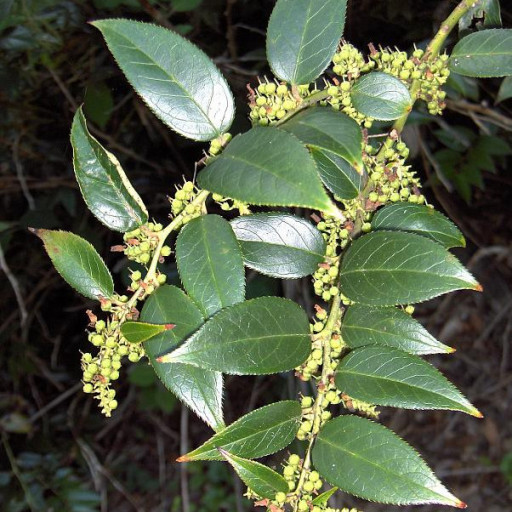
Plant Overview
Known as the "Highland Doghobble" or "Drooping Laurel," this elegant evergreen is a masterpiece of the Appalachian woodlands. It is cherished by gardeners for its graceful, fountain-like arching branches and its ability to turn a dark, damp corner into a lush sanctuary. Whether it's providing year-round privacy or delicate spring blooms, it brings a touch of wild, mountain mystery to the home landscape.
🔍 How to Identify
- 🍃 Lustrous Foliage: Long, lance-shaped leaves with a leathery texture and finely serrated edges. They are a deep, glossy green in summer but often take on a stunning bronze or burgundy tint during the winter months.
- 🔔 Pearl-Like Blooms: In late spring, the plant produces "racemes" (hanging clusters) of tiny, creamy-white flowers. These urn-shaped blossoms resemble Lily of the Valley and hang delicately from the underside of the stems.
- 🌿 Zig-Zag Growth: The branches don't grow straight; they have a distinctive zig-zagging, arching habit that creates a dense, layered mound of greenery.
🏡 In Your Garden
- 🏔️ Woodland Roots: Because it originated in the moist ravines of the southeastern United States, it craves acidic, organic-rich soil. It is the "best friend" of Rhododendrons and Azaleas, thriving in the same cool, shaded conditions where most sun-loving plants fail.
- 🛡️ Natural Stabilizer: Its spreading nature makes it an excellent choice for erosion control on shady banks. However, it hates "wet feet"—while it loves moisture, the soil must drain well to prevent root rot.
⚠️ Safety & Toxicity
- 🚫 High Toxicity: All parts of the Leucothoe (leaves, flowers, and nectar) are highly toxic if ingested by humans or animals.
- 🐾 Pet & Livestock Risk: It contains grayanotoxins, which can cause severe gastrointestinal distress, weakness, and heart rhythm issues. Keep it out of reach of curious dogs, cats, and horses.
✨ Fun Fact
The common name "Doghobble" is quite literal! In its native Appalachian habitat, the plant grows so thick and its arching branches so tangled that it was famously said to "hobble" (trip up or slow down) hunting dogs as they chased through the underbrush.

Detailed Care Instructions
To grow a Leucothoe Fontanesiana plant, you can follow these steps:
- Choose a suitable location: Leucothoe Fontanesiana plants prefer partial shade to full shade, so select a spot in your garden that provides this kind of light condition. The soil should be well-draining and slightly acidic.
- Prepare the soil: The soil should be moist but not waterlogged. If your soil is heavy clay, amend it with organic matter like compost or peat moss to improve drainage.
- Planting the shrub: Dig a hole that is slightly wider and deeper than the root ball of the Leucothoe Fontanesiana plant. Place the plant in the hole, ensuring that the root ball is level with or slightly above the soil level. Backfill the hole with soil, firming it gently around the roots.
- Watering: Keep the soil consistently moist but not waterlogged. Water the plant deeply, making sure the water reaches the root zone. During dry periods, increase the frequency of watering.
- Mulching: Apply a layer of organic mulch around the base of the shrub to help retain moisture, suppress weeds, and insulate the roots. Leave a small gap between the mulch and the trunk to prevent rot.
- Pruning: Prune Leucothoe Fontanesiana plants in late winter or early spring to maintain a compact shape and promote new growth. Remove any dead, damaged, or crossing branches.
- Fertilizing: Leucothoe Fontanesiana plants generally do not require regular fertilization. However, if the foliage appears pale or the growth is weak, you can apply a slow-release, acidic fertilizer in spring.
- Pests and diseases: These plants are generally resistant to most pests and diseases. However, keep an eye out for aphids, scales, or spider mites. If necessary, use insecticidal soap or horticultural oil to control infestations.
- Winter protection: Leucothoe Fontanesiana is a hardy plant but may benefit from winter protection in colder regions. Apply a layer of mulch or burlap around the base of the shrub to insulate the roots during freezing temperatures.
By following these guidelines, you should be able to successfully grow a Leucothoe Fontanesiana plant in your garden.

Place in a window with dappled sun or a spot in the middle of a room. Or directly in a window facing west or east.

To water this particular plant, it is important to keep the soil consistently moist, but not water-logged. This can be achieved by watering deeply once or twice a week, checking the soil moisture level regularly to ensure it does not dry out completely. It is best to water the plant at the base, to avoid getting the foliage wet, which can lead to fungal infections. During periods of high heat or drought, the plant may require more frequent watering to prevent stress. It is also important to avoid over-watering, as this can cause root rot and other problems. An organic mulch can help to retain soil moisture and regulate temperature, and should be applied around the base of the plant to a depth of around 2-3 inches.
To fertilize this plant, apply a slow-release fertilizer high in nitrogen in early spring before new growth appears. The fertilizer should be applied according to the package instructions and watered in well. Avoid fertilizing the plant after mid-summer to prevent late-season growth that can be damaged by frost. Alternatively, you can apply a liquid fertilizer every two to three weeks during the growing season. Keep the fertilizer away from the base of the plant and water after application to prevent burning the roots.
When it comes to the soil requirements for this particular plant, it is important to choose a soil that has good drainage properties. A soil mix that is rich in organic matter and slightly acidic is ideal. In terms of pH, a range between 4.5 and 6.5 is best. Avoid using heavy clay soils or those that are excessively alkaline. Adding compost or other organic matter to the soil can help improve its texture and fertility. Overall, it is important to choose a soil that will provide good moisture retention while also allowing excess water to drain away.
Leucothoe Fontanesiana plant can be propagated through several methods. One way is to take semi-hardwood cuttings in late summer or early fall. Select a stem that is about 6 inches long with several sets of leaves. Remove the lower leaves from the stem and dip it in rooting hormone. Place the cutting in a potting mix of equal parts of peat moss and perlite. Keep the soil moist and the cutting in a shaded area. After a month, check for root growth by gently tugging on the stem. If rooted, transplant the cutting into a larger container or outside in the garden.
Another way to propagate the plant is by layering. Bury a low branch of the plant in soil while it's still attached to the parent plant. The branch should be pinned down with a bent wire or covered with soil and held down with a rock. After a few months, new roots should develop at the covered area. Cut the new plant free and transplant it to a new location.
Thirdly, the plant can also be propagated through seed. Collect the seeds in the fall and sow them in a pot with potting soil. Keep the soil moist and in a cool place for a few weeks. When the seedlings sprout, transplant them into individual containers and grow them until they are large enough to transplant outside.








