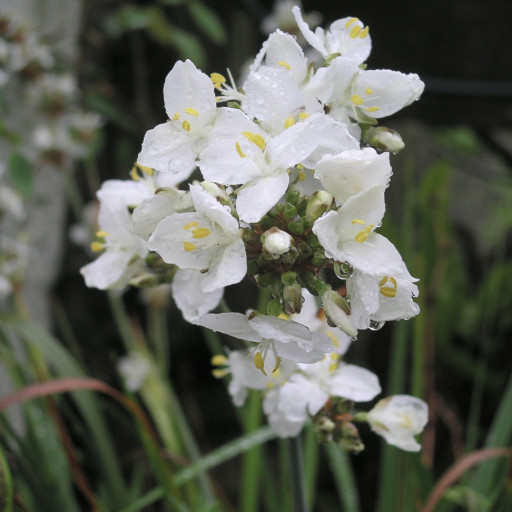
Plant Overview
Known as the New Zealand Iris or Mikoikoi, Libertia grandiflora is an architectural gem that brings a touch of wild "kiwi" elegance to any landscape. Often called the "Snowy Mermaid" for its drifts of pristine white blooms, this hardy perennial is a favorite among garden designers for its clean, vertical lines and year-round structure. It is as tough as it is beautiful, thriving where more delicate lilies might falter.
🔍 How to Identify
- 🌿 The Foliage: It features stiff, leathery, sword-like leaves that grow in dense, fan-shaped clumps. The leaves are evergreen and maintain a rich, olive-green hue throughout the year.
- ❄️ The Blooms: In late spring, it produces clusters of pure white, three-petaled flowers. These blossoms are held on wiry stems that sit just above the foliage, creating a "snowy" halo effect.
- 🟠 The Seed Pods: After the petals fall, the plant develops attractive triangular pods. These pods eventually turn a bright, decorative orange or yellow-tan, adding visual interest well into the autumn.
🏡 In Your Garden
- 🛡️ Coastal Warrior: Because of its origins in New Zealand, this plant is exceptionally wind-tolerant. Its leathery leaves are designed to withstand salt spray and heavy gusts, making it perfect for exposed or seaside gardens.
- ⚖️ Low Maintenance Needs: The "why" behind its popularity is its self-sufficiency. It doesn't require frequent dividing like other irises and is generally ignored by common garden pests like snails and slugs.
- 💧 Soil Preference: While it is adaptable, it hates "wet feet" during the winter. Ensure your soil is well-draining; if you have heavy clay, consider planting it on a slight slope or in a raised bed.
⚠️ Safety & Toxicity
- 🐾 Pet Friendly: Libertia grandiflora is generally considered non-toxic to cats, dogs, and horses, making it a "worry-free" addition to a pet-filled backyard.
- 🧒 Physical Safety: While not chemically toxic, the tips of the leaves can be quite stiff and sharp. Avoid planting it directly next to narrow pathways where the foliage might poke the eyes of small children or pets.
✨ Fun Fact
The genus was named in honor of Marie-Anne Libert, a pioneering 19th-century Belgian botanist. She was one of the first women to be recognized for her scientific work in "cryptogams" (plants that reproduce by spores, like ferns and mosses), breaking glass ceilings long before it was common!

Detailed Care Instructions
To grow Libertia Grandiflora plant, you can follow these steps:
- Choose the right location: Libertia Grandiflora thrives in full sun to partial shade. Select a well-draining area in your garden or a large container with drainage holes.
- Prepare the soil: Libertia Grandiflora prefers moist but well-drained soil. Amend the soil with organic matter, such as compost, to improve fertility and drainage.
- Planting: Dig a hole slightly larger than the root ball of the plant. Place the plant in the hole, making sure the top of the root ball is level with the surrounding soil. Backfill the hole and gently firm the soil around the plant to eliminate air pockets.
- Watering: Water the plant thoroughly after planting to help settle the soil. During the growing season, keep the soil consistently moist but not waterlogged. Water deeply at the base of the plant rather than overhead to avoid fungal diseases.
- Mulching: Apply a layer of organic mulch around the plant to help retain soil moisture and suppress weeds. Keep the mulch about three inches away from the plant's base to prevent stem rot.
- Fertilizing: Libertia Grandiflora generally does not require heavy fertilizing. However, you can apply a slow-release, balanced fertilizer in early spring to promote healthy growth. Follow the package instructions for the correct application rate.
- Pruning: Remove any dead or damaged foliage as necessary. In early spring, prune back the plant to encourage new growth and maintain its shape.
- Propagation: Libertia Grandiflora can be propagated through division. Carefully dig up the plant and separate the clumps into smaller sections. Replant the divided sections in their new locations and water thoroughly.
- Pests and diseases: Libertia Grandiflora is relatively resistant to pests and diseases. However, keep an eye out for slugs, snails, or aphids, and take appropriate measures to control them if necessary.
- Winter care: Libertia Grandiflora is frost hardy and can withstand light frosts. However, extreme cold can damage the plant. Consider applying a layer of mulch around the plant in late autumn to help insulate the roots during winter.
By following these steps, you should be able to successfully grow Libertia Grandiflora plant in your garden or container.

Place in a bright room that is sun drenched almost all day. Or directly in a south-facing window.

To water this particular plant, it is recommended to wait until the top inch of soil is dry before watering. Then, water the plant thoroughly, ensuring that the water is able to penetrate the soil deeply. Avoid letting the roots sit in standing water, as this can cause root rot. It is important to maintain consistent moisture levels, but do not over-water as this can also damage the plant. During the winter months, reduce watering to prevent root rot and ensure the soil has adequate drainage to prevent standing water.
To fertilize the plant, use a balanced fertilizer with an N-P-K ratio of 10-10-10 or 12-12-12. Apply the fertilizer during the growing season, which is typically in spring and summer. Dilute the fertilizer according to the instructions on the package, being careful not to over-fertilize as this can damage the plant. Apply the fertilizer around the base of the plant, avoiding direct contact with the leaves or stems. Water the plant thoroughly after fertilizing to ensure that the nutrients penetrate the soil.
The ideal soil for the plant should be well-draining, loamy soil that is rich in organic matter. It should have a pH level between 5.5 and 7.5. The soil should be moist but not waterlogged. The plant prefers soils that are slightly acidic, but it can also grow in neutral or slightly alkaline soils. The soil should be loose and friable, allowing for root growth, but also provide stability for the plant. It is recommended to mix coarse sand or perlite into the soil to improve drainage. The plant can also tolerate soils that are sandy or clayey. It prefers full sun to partial shade and should be planted in an area with good air circulation to prevent fungal diseases.
To propagate this plant, start by selecting healthy plants. Then, carefully divide the clump of the plant into several smaller sections, ensuring each section has roots and foliage. Plant each section in a well-draining soil mix and water thoroughly. Keep the newly planted sections in a shaded area for a few days to allow them to adjust to their new environment. Regularly water the newly planted sections and keep them in a humid area until they have established themselves. Once established, they can be moved to a more permanent location.








