Plant Overview
Often called "The Rocket" for its sky-piercing yellow spires, Ligularia stenocephala is a majestic addition to damp, shady corners. Native to the cool woodlands of East Asia, it brings a sense of lush, architectural drama to any landscape. If you are looking for a plant that bridges the gap between a wild forest floor and a structured garden, this golden beauty is the perfect candidate.
🔍 How to Identify
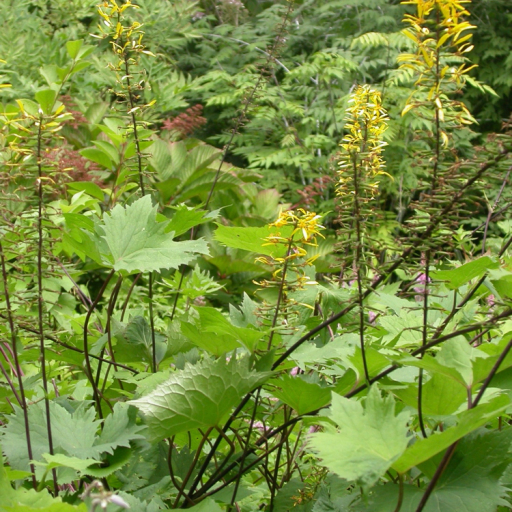
- 🍃 Jagged Foliage: The leaves are large, heart-shaped, and feature distinct "toothed" or serrated edges that give the base a textured, ruffly appearance.
- 🚀 Flower Spikes: In mid-to-late summer, it sends up tall, dark-colored stems (often deep purple or black) topped with densely packed, bright yellow daisy-like flowers.
- 📏 Growth Habit: It grows in mounded clumps, with the foliage staying relatively low while the "rocket" spikes can reach heights of 4 to 5 feet.
🏡 In Your Garden
- 💧 The Moisture Hog: This plant is a "bog lover" at heart. It thrives in soil that remains consistently moist and is a perfect choice for the edges of ponds or low-lying areas where water tends to collect.
- ☂️ Sun Sensitivity: It is famously dramatic; if it catches even an hour of harsh afternoon sun, the leaves will "faint" and go completely limp. It requires a shady retreat to keep its foliage looking crisp and upright.
- 🌱 Soil Context: Because it produces so much lush growth, it is a heavy feeder. It prefers rich, organic soil packed with compost to fuel its impressive summer bloom.
⚠️ Safety & Toxicity
- 🐾 Pet Safety: Ligularia stenocephala is generally considered non-toxic to dogs, cats, and horses, making it a safe choice for pet-friendly backyards.
- 👶 General Caution: While not poisonous, the plant contains pyrrolizidine alkaloids common to many members of the Aster family. It should not be ingested by humans, and sensitive individuals should wear gloves to avoid minor skin irritation from the sap.
✨ Fun Fact
Ligularia is often nicknamed the "Drama Queen" of the garden. On a hot day, it may appear to be dying as its leaves wilt flat against the ground, only to "miraculously" stand perfectly upright again within minutes of the sun setting or a quick watering.

Detailed Care Instructions
Ligularia stenocephala, also known as leopard plant, is a perennial plant that is a great addition to any garden due to its large, bold leaves and striking yellow flowers. Here are some tips on how to grow Ligularia stenocephala:
- Location: Ligularia stenocephala prefers partial shade to full shade, although it can tolerate some sun if given enough moisture. Choose a location in your garden that receives morning sun and afternoon shade.
- Soil: Ligularia stenocephala prefers moist, well-draining soil that is rich in organic matter. Amend the soil with compost or well-rotted manure before planting to improve drainage and fertility.
- Planting: Plant Ligularia stenocephala in the spring or fall. Dig a hole that is slightly larger than the root ball of the plant and place the plant in the hole, making sure that the top of the root ball is level with the surrounding soil. Water the plant thoroughly after planting.
- Watering: Keep the soil consistently moist but not waterlogged. Water the plant deeply once a week, especially during hot and dry weather. Mulch around the plant to help retain moisture and suppress weeds.
- Fertilizing: Fertilize Ligularia stenocephala in the spring with a balanced, slow-release fertilizer. Avoid over-fertilizing, as this can lead to leggy growth and decreased flowering.
- Pruning: Remove any dead or damaged leaves as needed. Trim back old flower stalks to encourage new growth and maintain a tidy appearance.
- Division: Ligularia stenocephala can become crowded over time, leading to decreased flowering and vigor. Divide the plant every 3-4 years in the spring to rejuvenate it and increase flowering.
By following these tips, you can successfully grow Ligularia stenocephala in your garden and enjoy its beautiful foliage and flowers for years to come.

Place in a window with dappled sun or a spot in the middle of a room. Or directly in a window facing west or east.

To properly water the Ligularia stenocephala plant, it is important to maintain consistently moist soil. This can be achieved by watering the plant regularly, especially during periods of hot weather or if the soil dries out quickly. It is best to water the plant at the base, near the roots, rather than watering overhead, to prevent water from accumulating on the leaves and causing rot or disease. The plant may require more water during the growing season and less during the winter months when it is dormant. Additionally, it is important to ensure proper drainage to prevent waterlogging of the soil, as this can lead to root rot and other issues. Overall, monitoring the soil moisture levels and adjusting the watering schedule accordingly will help to keep the Ligularia stenocephala plant healthy and thriving.
To fertilize the Ligularia Stenocephala plant, apply a balanced slow-release fertilizer in the early spring as new growth starts to emerge. Follow the instructions on the fertilizer packaging for the correct dosage and application method. Avoid over-fertilizing as this can cause damage to the plant. Water the plant well after fertilizing to help the nutrients penetrate the soil and reach the roots. Repeat the fertilization process in late spring if necessary, but always monitor the plant's growth and health to determine its fertilization needs.
Ligularia Stenocephala plants thrive in well-draining, moist soils that are rich in organic matter. A sandy loam or loamy soil with a slightly acidic to neutral pH level is ideal for these plants. It is important to ensure that the soil remains consistently moist, but not waterlogged, as these plants do not tolerate dry conditions well.
Adding organic matter such as compost, peat moss, or well-rotted manure to the soil before planting can help improve its moisture retention and nutrient content. Additionally, incorporating a slow-release fertilizer specifically formulated for flowering plants can help provide the necessary nutrients for healthy growth and blooming.
Regularly mulching the soil surface around the plant can also help conserve moisture and regulate soil temperature, which is especially beneficial during hot summer months. It is recommended to top-dress the soil with fresh compost or mulch in the spring and fall to maintain soil fertility and health.
Overall, providing Ligularia Stenocephala plants with a well-draining, rich soil that is kept consistently moist and fertilized appropriately will promote vigorous growth, abundant blooming, and overall plant health.
Propagation of Ligularia Stenocephala plants can be done through division or by taking stem cuttings.
To propagate through division, carefully dig up the mature plant and separate the sections of the root system, making sure each division has a viable root system and multiple growth points. Replant the divisions in well-draining soil with adequate moisture.
To propagate through stem cuttings, take a cutting from a healthy and mature stem, making sure to include several nodes. Remove the lower leaves and place the cutting in a small pot with a mixture of potting soil and perlite. Keep the cutting consistently moist and provide indirect light until roots begin to form.
Regardless of the method used, it is important to provide the newly propagated plants with adequate water, sunlight, and nutrients to help them establish and grow successfully.








