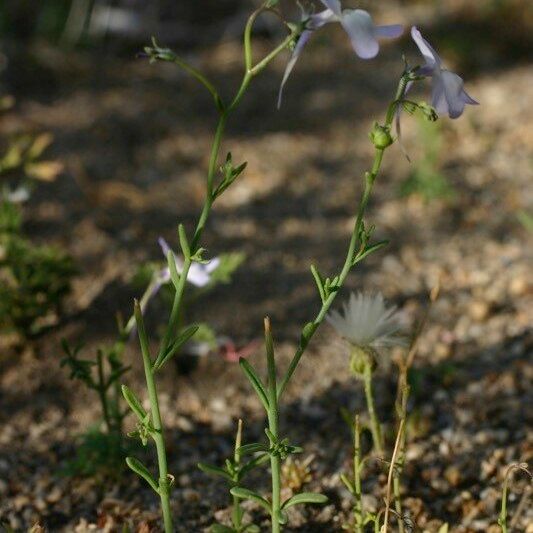
Plant Overview
Known as the Black Toadflax or "Perritos Negros," Linaria nigricans is a rare and striking treasure of the Spanish desert. This tiny annual is a master of survival, pushing through the parched, volcanic soils of Almería. Its dramatic, dark-as-night flowers look like something out of a gothic fairytale, standing in sharp contrast to the sun-bleached landscapes it calls home.
🔍 How to Identify
- 🖤 The Flowers: The most striking feature is the bicolored "snapdragon" shape. The upper lip is a deep, velvety purple-black, while the lower lip features a bright white or pale yellow "palate" that acts as a landing strip for pollinators.
- 🌿 The Foliage: The leaves are narrow, almost needle-like, and have a soft, grayish-green hue. They are arranged in whorls at the base and become more scattered as they move up the stem.
- 📏 Growth Habit: This is a petite plant, usually reaching only 10 to 25 centimeters in height. It grows in upright spikes that sway gently in the desert breeze.
🌵 Habitat & Ecology
- 🏜️ Desert Specialist: Unlike most garden toadflaxes, this species is endemic to a tiny strip of southeastern Spain. It thrives in the semi-arid, gypsum-rich, or volcanic sands of the Tabernas Desert and Cabo de Gata.
- ⏳ Ephemeral Life: As an annual, it spends most of the year as a seed waiting for the perfect spring rains. Once the moisture hits, it grows, blooms, and sets seed rapidly before the scorching summer heat arrives.
- 🦋 Pollinator Magnet: Despite its dark color, it is highly attractive to specialized bees who have learned how to "trip" the flower’s mechanism to reach the nectar hidden in the spur.
⚠️ Safety & Toxicity
- 🐾 Mild Toxicity: Like many members of the Plantaginaceae family, Linaria nigricans contains iridoid glycosides. While not typically lethal, it can cause stomach upset or skin irritation if handled excessively or ingested by curious pets.
- 🛡️ Conservation Status: This plant is considered vulnerable and protected by law in its native habitat. It should never be picked or dug up from the wild; its survival depends on its seeds staying in their native soil.
✨ Fun Fact
- Linaria nigricans is a "narrow endemic," meaning it is found nowhere else on Earth except for one specific province in Spain. If you spot one in the wild, you are looking at one of the rarest floral displays in Europe!

Detailed Care Instructions








