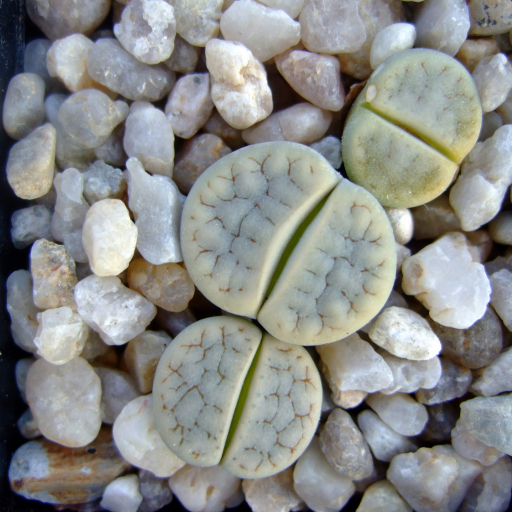
Plant Overview
Known as the "Living Stone" or "Pebble Plant," Lithops gracidelineata is nature’s ultimate master of disguise. These tiny, slow-growing succulents have evolved over millions of years to look exactly like the quartz and limestone fragments of their native Namibian deserts to avoid being eaten. They are the perfect "set it and forget it" companions for collectors who appreciate the strange and beautiful.
🔍 How to Identify
- 🪨 The Body: This plant consists of two thick, fused succulent leaves with a deep fissure in the center, resembling a small, rounded stone or a pair of brain-like lobes.
- 🎨 The Patterns: The top surface (called the "window") is usually a creamy-grey or brownish hue, etched with intricate, jagged dark lines that look like delicate cracks in a marble slab.
- 🌼 The Bloom: In mid-to-late autumn, a single, daisy-like yellow flower emerges from the central slit, often appearing so large that it completely hides the plant beneath it.
🏡 In Your Garden
- 🏜️ The Art of Neglect: Unlike most houseplants, Lithops require a strict "dry season." When the old leaves begin to shrivel and new ones emerge from the center, you must stop watering entirely; the new leaves are actually "drinking" the moisture from the old ones.
- ☀️ Sun & Soil: They crave bright, indirect light and will stretch out (etiolate) if kept in the dark. They require a very gritty, mineral-heavy soil—think 80% pumice or sand and only 20% organic matter to prevent root rot.
⚠️ Safety & Toxicity
- ✅ Non-Toxic: Lithops gracidelineata is generally considered non-toxic to humans, cats, and dogs, making it a safe choice for pet-friendly homes.
- 🪨 Choking Hazard: Because of their small size and firm texture, they can be a choking hazard for curious toddlers who might mistake the plant for a colorful pebble or a piece of candy.
✨ Fun Fact
- 👁️ Solar Windows: The patterns on top of the leaves aren't just for camouflage; they are translucent "fenestrations" or windows. They allow sunlight to filter deep into the body of the plant so it can photosynthesize from the inside out, while the rest of the plant remains safely buried in the cool soil.

Detailed Care Instructions
To successfully grow Lithops gracilidelineata (living stone plants), follow these steps:
- Provide the right growing conditions:
- Place the plant in a sunny location, such as a south-facing window, to ensure they receive at least 5-6 hours of direct sunlight per day.
- Maintain a temperature range of 65-80°F (18-27°C) during the growing season (spring and summer).
- Provide good ventilation to prevent mold or fungal growth.
- Place the plant in a sunny location, such as a south-facing window, to ensure they receive at least 5-6 hours of direct sunlight per day.
- Soil and potting:
- Plant Lithops in a well-draining soil mix with a high mineral content. Use a commercial cactus or succulent potting mix or create your own mix by combining equal parts coarse sand, perlite, and potting soil.
- Lithops have shallow roots, so choose a shallow container with drainage holes to prevent waterlogged soil.
- Plant Lithops in a well-draining soil mix with a high mineral content. Use a commercial cactus or succulent potting mix or create your own mix by combining equal parts coarse sand, perlite, and potting soil.
- Watering:
- During the growth period, water Lithops sparingly. Allow the soil to dry out completely between waterings.
- Reduce watering during the winter months, as Lithops go through a dormant period. During this time, only provide enough water to prevent the plants from shriveling.
- During the growth period, water Lithops sparingly. Allow the soil to dry out completely between waterings.
- Fertilizing:
- Lithops do not require frequent fertilizing. Use a diluted, balanced liquid fertilizer once or twice during the growing season (spring and summer) to provide necessary nutrients. Avoid fertilizing during the dormant period.
- Lithops do not require frequent fertilizing. Use a diluted, balanced liquid fertilizer once or twice during the growing season (spring and summer) to provide necessary nutrients. Avoid fertilizing during the dormant period.
- Repotting:
- Lithops don't require frequent repotting. Repot only when the plant outgrows its current container.
- During repotting, handle the plants with care, as their leaves can be easily damaged.
- Lithops don't require frequent repotting. Repot only when the plant outgrows its current container.
- Pest control:
- Keep an eye out for common succulent pests like mealybugs or aphids. If infested, you can use a cotton swab soaked in rubbing alcohol to control the pests.
- Keep an eye out for common succulent pests like mealybugs or aphids. If infested, you can use a cotton swab soaked in rubbing alcohol to control the pests.
- Propagation:
- Lithops can be propagated through seeds or division.
- Seeds: Collect mature seeds after the plant flowers and sow them in a well-draining soil mix. Keep the soil lightly moist and provide adequate sunlight.
- Division: Divide the plant during repotting by carefully separating offsets from the main plant. Allow the offsets to dry for a few days before planting them in new pots.
Remember, Lithops are unique and fascinating plants, but they require careful attention to their specific needs. With proper care, you can enjoy the growth and beauty of Lithops gracilidelineata.
- Lithops can be propagated through seeds or division.
Lithops Gracilidelineata plant requires occasional watering and prefers a well-draining soil mix that allows excess water to drain away quickly. When it comes to watering, it is important to avoid overwatering and allowing the soil to become waterlogged, as this can lead to root rot and ultimately kill the plant.
To water, you should first check the soil moisture level by inserting your finger into the soil to a depth of about an inch. If the soil feels dry to the touch, it is time to water. Use a watering can with a narrow spout to avoid splashing water on the leaves and to direct the water directly to the base of the plant.
Water the plant slowly and thoroughly until the excess water begins to drain from the bottom of the pot. It is essential to ensure that the soil is evenly moist but not saturated. After watering, allow excess water to drain away before returning the pot to its position.
Watering frequency can vary depending on factors such as the temperature, humidity, and air circulation in the growing environment, so it is essential to monitor the soil moisture level and adjust the watering frequency accordingly. As a general rule, Lithops Gracilidelineata prefers a more prolonged period of drought than most other plants, so it is better to underwater and observe the plant's behavior.
To provide nutrition to the Lithops Gracilidelineata plant, use a specialized fertilizer blend that is meant for succulents. Apply the fertilizer during the growing season, typically in the spring and summer months. Dilute the fertilizer to half of the recommended strength and apply it to the soil around the base of the plant, making sure to avoid getting it on the leaves. Water the plant thoroughly after fertilizing. Avoid fertilizing during the dormant season when the plant is not actively growing.
Lithops Gracilidelineata plant requires a well-draining, rocky or sandy soil mixture that allows for proper water drainage. The soil should not retain moisture for extended periods of time. It is recommended to use a soil mix that is specifically designed for succulent plants or to create a custom mix using coarse sand, perlite, and a small amount of potting soil or peat moss. Avoid using heavy or compacted soils as they can retain too much moisture and lead to root rot. Additionally, the plant prefers a slightly acidic to neutral soil with a pH range of 6.0-7.0.
There are a few different methods to propagate this plant. One option is to remove the offsets or "pups" that grow from the base of the plant and replant them in a separate pot with well-draining soil. Another method is to collect the seeds produced by the plant and sow them in a suitable growing medium. The seeds should be placed on the surface of the soil and lightly pressed down to ensure contact with the soil. Keep the soil moist but not saturated and provide bright, indirect light. The seeds should germinate within a few weeks to a few months, depending on growing conditions. Once the seedlings are large enough, they can be transplanted into individual pots. It is important to note that Lithops Gracilidelineata is a slow-growing plant and propagation can take some time to yield a mature plant.








