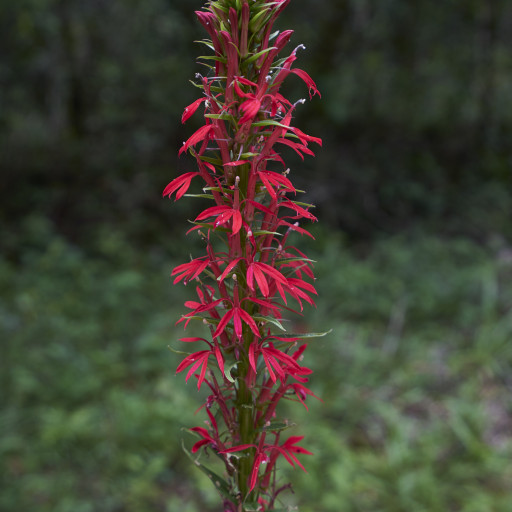
Plant Overview
Often called the Cardinal Flower, this North American native is famous for its "stop-light" red blooms that practically glow in the shade. It’s a favorite in garden folklore for its intense color, which reminded early European settlers of the striking red robes worn by Roman Catholic Cardinals. It is a moisture-loving masterpiece that brings high-definition color to the dampest corners of a landscape.
🔍 How to Identify
- 🌺 Floral Spikes: Densely packed, upright racemes of fiery red, two-lipped flowers. The lower lip has three prominent lobes, while the upper has two.
- 🍃 Lance-shaped Leaves: Alternate, dark green leaves with finely serrated (toothed) edges that can grow up to 6 inches long.
- 📏 Sturdy Stems: A tall, unbranched central stem that can reach heights of 2 to 4 feet, often standing out like a colorful scepter in marshy areas.
🏡 In Your Garden
- 💧 Thirsty Nature: Unlike many garden perennials, this plant craves "wet feet." It naturally thrives in swamps and along stream banks, making it the perfect candidate for rain gardens or heavy clay soils that stay consistently damp.
- 🐦 Hummingbird Magnet: Because its tubular flowers are too deep for most bees to reach the nectar, it relies almost entirely on the Ruby-throated Hummingbird for pollination. Planting this is like putting out a neon "Open" sign for hummers.
- 🌱 Short-lived Vitality: It is often a short-lived perennial that may exhaust itself after a few years of heavy blooming. To keep it in your garden long-term, avoid covering the "crown" with heavy mulch in winter, as it needs light to produce the next year's rosettes.
⚠️ Safety & Toxicity
- 🚫 Toxic Status: Contains a complex mix of alkaloids, including lobeline, which is chemically similar to nicotine.
- 🐕 Details: All parts of the plant are considered toxic to humans, dogs, cats, and horses if eaten in large quantities. Ingestion can cause nausea, vomiting, and exhaustion. Always wear gloves if you have sensitive skin, as the milky sap can sometimes cause mild irritation.
✨ Fun Fact
Native Americans once used the roots and leaves of the Cardinal Flower in "love charms"—the plant was supposedly so powerful that if you ground it up and put it in the food of an object of your affection, they would be yours forever! (Note: We highly recommend sticking to its visual beauty instead.)

Detailed Care Instructions
| Color | Red, Pink, Or White |
| Soil Ph | Slightly Acidic To Neutral |
| Humidity | Normal |
| Lighting | Part Sun |
| Toxicity | Toxic |
| Soil Type | Rich, Moist Soil |
| Bloom Time | Summer To Early Fall |
| Difficulty | Medium |
| Plant Type | Perennial |
| Mature Size | 2 To 4 Feet Tall; 1 To 2 Feet Wide |
| Native Area | United States And Canada |
| Temperature | 18°C - 25°C |
| Sun Exposure | Full Sun To Partial Shade |
| Hardiness Zones | 3-9 |
To grow Lobelia Cardinalis plant, also known as cardinal flower, you can follow these steps:
- Choose a suitable location: Lobelia Cardinalis thrives in moist to wet soil conditions, so select a spot in your garden that receives partial shade to full sun. Ensure that the soil is well-draining.
- Prepare the soil: Loosen the soil by tilling it to a depth of about 6 inches. Remove any weeds or debris, and incorporate some organic matter like compost to improve the soil quality and drainage.
- Planting: Dig holes in the prepared soil that are slightly wider and deeper than the root ball of the plant. If you are planting multiple Lobelia Cardinalis plants, space them about 12 to 18 inches apart. Place the plant in the hole, ensuring the crown is level with the soil surface. Backfill the hole with soil and gently pat it down to remove any air pockets.
- Watering: Water the newly planted Lobelia Cardinalis thoroughly to settle the soil around the roots. Keep the soil consistently moist, but avoid overwatering, as this can lead to root rot. Water deeply whenever the top inch of soil feels dry.
- Mulching: Apply a layer of organic mulch around the base of the plants to retain moisture and suppress weed growth. Avoid piling the mulch directly against the stems to prevent rot.
- Fertilization: Lobelia Cardinalis generally doesn't require heavy feeding. However, a light application of balanced fertilizer in early spring can encourage healthy growth. Follow the manufacturer's instructions for the appropriate dosage.
- Maintenance: Deadhead faded flowers regularly to encourage continuous blooming. Additionally, prune the plants in early spring by removing any dead or damaged stems to promote new growth.
- Protection: Protect Lobelia Cardinalis from strong winds, as they can cause the tall stems to bend or break. You can use stakes or supports to provide stability.
- Winter care: Lobelia Cardinalis is a herbaceous perennial and can survive cold winters. Mulching around the base of the plants in late fall can provide extra insulation and protect the roots from freezing.

Place in a window with dappled sun or a spot in the middle of a room. Or directly in a window facing west or east.

To water this particular plant, it is suggested to check its soil moisture regularly and avoid letting the soil completely dry out, as this can cause the plant to wilt or die. When watering, it is recommended to give a thorough soaking and allow the excess water to drain from the bottom of the pot or container. It is important not to let the plant sit in standing water, as this can lead to root rot. Additionally, it is advised to use room temperature or lukewarm water and avoid using hard water or water containing high levels of chlorine, as this can damage the plant's leaves and roots.
To provide proper nutrients for this particular plant, it is recommended to use a water-soluble fertilizer that is high in nitrogen and potassium. Fertilize the plant once a week throughout the growing season, but only half as often during the winter months. Carefully follow the instructions on the fertilizer packaging, taking care not to over-fertilize the plant as this can damage the roots.
The ideal soil for the plant has a neutral to slightly acidic pH, ranging from 6.0 to 7.0. It should be well-draining and rich in organic matter, and have good water retention capacity. A soil mixture with a combination of sandy loam, peat moss, and perlite is suitable for the plant as it will provide nutrient-rich soil while also allowing for proper drainage. Additionally, regular fertilization with a balanced, water-soluble fertilizer will ensure the plant remains healthy and dense.
One way to propagate this plant is through stem cuttings. Select a healthy stem that is relatively long and cut it at an angle with a sharp knife or scissors. Remove any leaves that are close to the bottom of the stem and dip the cut end in rooting hormone to encourage root growth. Plant the cutting in moist soil and keep the soil consistently moist until roots have developed. Once roots have developed, the plant can be transplanted into its final location.
Common pests of the cardinal flower include Spider mites, larvae. Make a habit of checking your cardinal flower frequently for pests so that any infestations can be caught and managed early.








