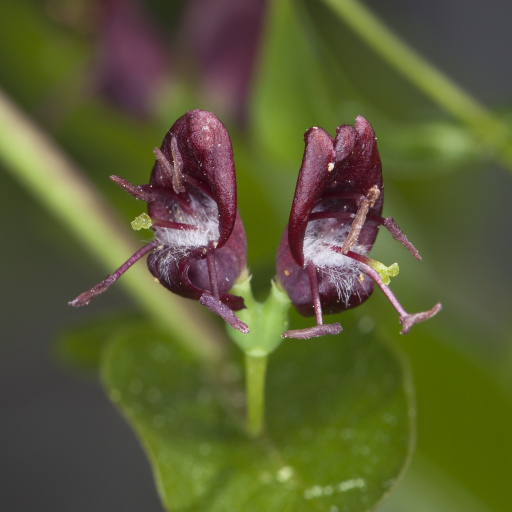
Plant Overview
Commonly known as the Purpleflower Honeysuckle, this understated shrub is a hidden gem of the high-altitude forests of the western United States. While many honeysuckles are known for flashy, fragrant blooms, this species prefers a "gothic" aesthetic with its deep maroon blossoms that appear in inseparable pairs. It is a plant of the wilderness, often found flanking cool mountain streams where it provides vital cover for birds and small mammals.
🔍 How to Identify
- 🌸 The Flowers: Look for small, tubular blossoms that are a striking dark purple to brownish-red. They almost always grow in pairs on a single stalk, nodding slightly toward the ground.
- 🍃 The Foliage: The leaves are simple, oval-shaped, and arranged oppositely along the stem. They have a soft, thin texture and a dull green finish, lacking the waxy shine of some ornamental varieties.
- 🍒 The Fruit: After blooming, the plant produces bright, translucent red berries. In a unique twist, these berries are often partially or completely fused together into a single "double berry."
🏡 In Your Garden
- ⛰️ Native Habitat: This shrub thrives in moist, shaded locations, particularly in montane or subalpine zones. If you are incorporating it into a landscape, aim for a spot that mimics a forest floor—cool, damp, and protected from the harsh afternoon sun.
- 💧 Moisture Needs: It is quite particular about its "thirst." It loves consistent moisture and rich, organic soil. It is an excellent choice for a rain garden or a shady corner near a water feature where other plants might struggle with damp conditions.
⚠️ Safety & Toxicity
- 🚫 Status: Non-edible.
- 🐾 Details: Like many members of the Lonicera genus, the bright red berries are considered toxic to humans and most pets. Ingesting them can cause stomach upset, vomiting, or lethargy. While birds enjoy them, it is best to keep this plant away from areas where curious children or dogs might be tempted by the "candy-like" appearance of the fruit.
✨ Fun Fact
The species name conjugialis comes from the Latin word for "conjugal" or "married." This refers to the botanical marriage of the flowers and berries, which are joined at the base in pairs, seemingly inseparable throughout their life cycle.

Detailed Care Instructions
To successfully grow Lonicera Conjugialis, also known as twinberry honeysuckle, you will need to follow these steps:
- Climate and location: Lonicera Conjugialis thrives in USDA hardiness zones 4-8. Choose a location that receives partial to full sun, preferably with well-draining soil.
- Soil preparation: Before planting, prepare the soil by removing any weeds, rocks, or debris. Lonicera Conjugialis prefers moist, fertile soil with a pH level between 5.5 and 7.0. If the soil is heavy or clay-like, consider adding organic matter such as compost or well-rotted manure to improve drainage.
- Planting: Dig a hole that is slightly larger than the nursery container in which the plant is currently growing. Gently remove the plant from its container, being careful not to damage the roots. Place it in the hole, making sure the top of the root ball is level with or slightly above the soil surface. Backfill the hole with soil, firming it gently around the plant.
- Watering: Lonicera Conjugialis prefers consistent moisture, especially during the growing season. Water thoroughly after planting and keep the soil evenly moist. However, be cautious not to overwater as it may cause root rot. Avoid getting the leaves wet to prevent fungal diseases.
- Mulching: Apply a layer of organic mulch around the base of the plant, which will help retain moisture, suppress weeds, and regulate soil temperature. Keep the mulch a few inches away from the stem to avoid rotting.
- Pruning: Regular pruning is not necessary for Lonicera Conjugialis, but it can benefit from occasional maintenance pruning to remove dead or damaged branches. Prune immediately after flowering to avoid removing potential blooms for the following season.
- Fertilizing: Lonicera Conjugialis does not have significant nutritional requirements, but you can supplement it with a balanced organic fertilizer in early spring or late fall to promote healthy growth.
- Pests and diseases: Keep an eye out for common pests such as aphids, scale insects, and spider mites. Treat infestations with insecticidal soap or a gentle, organic pesticide. While Lonicera Conjugialis is generally disease-resistant, it may occasionally suffer from powdery mildew or leaf spot, which can be managed by improving air circulation and reducing overhead watering.
By following these guidelines, you should be able to successfully grow Lonicera Conjugialis and enjoy its vibrant foliage and attractive berries.

Place in a bright room that is sun drenched almost all day. Or directly in a south-facing window.

Lonicera Conjugialis is a flowering plant that is native to a diverse range of habitats across North America. To effectively water this plant, it is important to understand its unique moisture requirements.
Firstly, Lonicera Conjugialis prefers consistently moist soil but does not tolerate waterlogged conditions. Therefore, it is important to avoid overwatering the plant. One way to achieve this is to ensure that the plant is grown in well-draining soil.
Secondly, it is recommended to water Lonicera Conjugialis deeply to encourage root growth. This means watering the plant until the water reaches a depth of at least 6 inches. However, frequency of watering will depend on a variety of factors such as temperature, humidity, and soil type.
Finally, it is advisable to water Lonicera Conjugialis in the morning or late afternoon, when the sun is less intense. This prevents water from evaporating too quickly and allows the plant to absorb moisture more effectively.
Overall, providing adequate moisture to Lonicera Conjugialis is vital to its health and growth. With proper care and attention to water needs, this plant can thrive and produce beautiful blooms.
To fertilize this plant, it is recommended to use a balanced fertilizer with equal parts nitrogen, phosphorus, and potassium. Fertilize twice a year, once in early spring and once in late summer, using a slow-release granular fertilizer. Do not over-fertilize as it can cause damage to the plant. Water the plant thoroughly before and after fertilizing to prevent burning.
When planting Lonicera Conjugialis, it is important to select an appropriate soil type that provides the necessary nutrients for the plant's growth and development. The ideal soil for this plant should be well-draining, with a pH level between 6.0 to 7.5. It should also be rich in organic matter and provide adequate aeration to allow the roots to breathe.
The recommended soil type for Lonicera Conjugialis is a loamy soil that contains a good mix of sand, silt, and clay. This type of soil provides excellent drainage while also retaining moisture, which is important for the plant's growth.
Before planting, you should prepare the soil by adding compost or well-aged manure to boost its nutrient content. You may also consider adding perlite or vermiculite to improve soil aeration.
It is important to note that Lonicera Conjugialis prefers slightly acidic soil, so if your soil is too alkaline, you may need to add some sulfur to lower the pH level.
Overall, providing the right soil type and conditions is crucial for the healthy growth and development of Lonicera Conjugialis.
Lonicera Conjugialis is a type of perennial plant that can be propagated by taking cuttings from its stem. The best time to take cuttings is in the early summer when the plant is actively growing.
To begin propagation, select a healthy stem on the plant and make a 4-6 inch cutting using a sharp, clean pair of pruning shears. Remove any leaves or flowers from the cutting except for the top few leaves.
Next, fill a small pot with a well-draining potting soil and moisten it lightly. Dip the cut end of the stem into rooting hormone powder and gently tap off any excess. Plant the cutting into the potting soil, burying it up to the top leaves.
Place the pot in a warm, bright area with indirect sunlight and keep the soil just lightly moist. In about 3-4 weeks, new roots will begin to form from the cut end of the stem. Once the roots have developed, the new plant can be transplanted into a larger pot or out into the garden.
Propagation can also be done by layering, where a portion of the stem is buried in the soil and allowed to root, or by dividing an established plant into smaller clumps.








