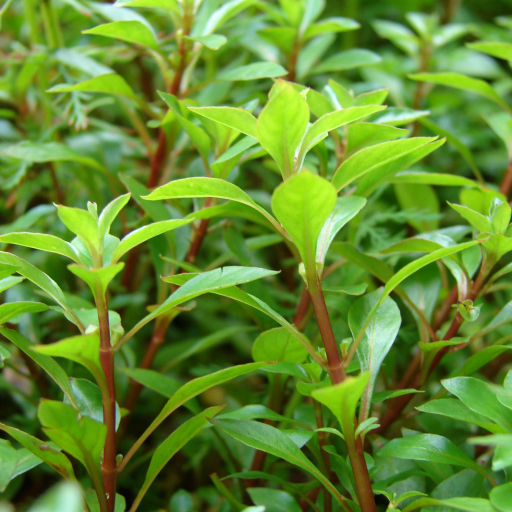
Plant Overview
Often called the "Water Purslane" or "Marsh Seedbox," Ludwigia palustris is a cosmopolitan wonder that bridges the gap between land and water. This versatile beauty is a favorite among aquascapers for its ability to transform from a humble green weed into a fiery crimson centerpiece. In the wild, it acts as a silent guardian of wetlands, carpeting pond edges across nearly every continent.
🔍 How to Identify
- 🌿 Leaf Logic: The leaves are lance-shaped or oval and grow in strictly opposite pairs along the stem, a key feature that distinguishes it from many lookalikes.
- 🎨 Color Shifting: Depending on its environment, the foliage ranges from a translucent lime green to a deep, dramatic burgundy or reddish-orange.
- 🌸 Petal-less Blooms: It produces tiny, inconspicuous flowers in the leaf axils. Interestingly, these flowers lack petals entirely, consisting only of four green sepals.
🏡 In Your Garden & Aquarium
- ☀️ The Light Spectrum: While it survives in low light, this plant is a biological "mood ring." To achieve the famous deep red hues that hobbyists crave, it requires high-intensity lighting and a steady supply of iron in the water.
- 💧 Amphibious Nature: This plant is equally happy growing completely submerged in a fish tank or "emergent" (creeping along the muddy banks of a backyard pond). When grown above water, the leaves tend to be thicker and waxier to prevent drying out.
- ✂️ Pruning & Propagation: It is a fast grower that can quickly take over a small space. Luckily, it is incredibly easy to propagate; simply snip a stem and tuck it into the substrate, where it will develop a new root system within days.
⚠️ Safety & Toxicity
- ✅ Status: Non-toxic and safe.
- 🐾 Details: Ludwigia palustris is generally considered safe for curious cats, dogs, and children. In an aquarium setting, it provides excellent cover for fry and shrimp without leaching any harmful substances into the water column.
✨ Fun Fact
Unlike many of its cousins in the Evening Primrose family (Onagraceae), which boast large, showy yellow flowers to attract bees, Ludwigia palustris evolved to be wind-pollinated or self-pollinating, which is why it completely did away with the need for colorful petals!

Detailed Care Instructions
| Humidity | Normal |
| Difficulty | Medium |
| Hibernation | Cold Period |
| Temperature | 21°C - 27°C |
| Hardiness Zones | 3 - 7 |
To grow Ludwigia Palustris, also known as Marsh Seedbox or Water Purslane, you can follow these steps:
- Choose the right planting area: Ludwigia Palustris prefers wet or moist soil conditions, so select an area in your garden or pond where it will receive plenty of water or can be submerged in up to 6 inches of water.
- Prepare the soil: Ludwigia Palustris thrives in rich, loamy soil. Ensure the planting area has well-draining soil, especially if it's not submerged in water.
- Planting method 1: If planting in a water garden or pond, secure the Ludwigia Palustris plant in a pot with aquatic soil or clayey soil mixed with sand. Submerge the pot at a depth of around 2-6 inches, making sure the plant is entirely underwater. The plant can also be anchored using rocks or other weights to keep it in place.
- Planting method 2: If planting in a moist garden bed, dig a hole slightly larger than the rootball of the Ludwigia Palustris plant. Place the plant in the hole ensuring it is level with the soil surface. Backfill the hole with soil, gently firming it around the plant.
- Water requirements: Keep the plant continuously moist or submerged in water if planted in a pond. If planted in a garden bed, water it regularly to maintain soil moisture.
- Sunlight requirements: Ludwigia Palustris thrives in full sun to partially shaded areas. Provide at least 6 hours of direct sunlight per day for the best growth.
- Fertilization: Feed the Ludwigia Palustris plant with a balanced aquatic or general-purpose fertilizer every 4-6 weeks during the growing season.
- Pruning: Trim the plant regularly to maintain its shape and promote healthy growth. Pruning also helps prevent overcrowding and promotes new growth.
- Winter care: If the plant is in a pond, it can be left in place during winter if the water does not freeze solid. However, if it's planted in a garden bed, it is recommended to dig up the plant and store it indoors in a pot with moist soil until the following growing season.
By following these steps, you can successfully grow Ludwigia Palustris and enjoy its vibrant foliage in your garden or pond.

Place in a bright room that is sun drenched almost all day. Or directly in a south-facing window.

Ludwigia Palustris is a flowering plant that requires a consistent supply of water to thrive. To water this plant, ensure that the soil is evenly moist by watering it regularly. However, be careful not to overwater as this can lead to waterlogging and root rot.
One way to keep up with the watering needs of Ludwigia Palustris is to check the soil regularly for moisture. Use your finger to feel the soil around the plant to see if it is dry or moist. If the soil feels dry to the touch, it is time to water.
Another way to water this plant is to use a watering can or hose with a gentle sprayer attachment. Water around the base of the plant, making sure to wet all of the soil evenly. Avoid getting water on the leaves as this can cause damage and promote fungal growth.
During hot weather or in a dry climate, it may be necessary to water Ludwigia Palustris more frequently. However, be cautious and avoid letting the soil become waterlogged.
In summary, to water Ludwigia Palustris, ensure that the soil is evenly moist, avoid overwatering, check the soil regularly for moisture, use a watering can or hose with a gentle sprayer attachment, and adjust the watering frequency according to the weather conditions and the needs of the plant.
- Start by selecting a well-draining substrate and placing it in a suitable container.
- Add a slow-release fertilizer to the substrate before planting.
- When planting the Ludwigia Palustris, ensure that the roots are well-covered with the substrate.
- Add liquid fertilizer to the water once a week.
- Do not over-fertilize, as this can harm the plant and cause algae growth in the aquarium.
- Keep an eye on the growth of the Ludwigia Palustris, as this will indicate whether it is receiving enough fertilizer.
The ideal soil for this plant should be nutrient-rich and well-draining to promote healthy growth. A mixture of organic soil and sand can be used to enhance the drainage capacity of the soil. Additionally, it is important to ensure that the pH of the soil is slightly acidic to neutral, with a range of 6.0 - 7.5. This plant prefers slightly acidic soil conditions. When planting this species, ensure that the soil is moist but not waterlogged as excess moisture can lead to root rot and other fungal diseases. Regular fertilization can also be beneficial to promote healthy growth and ensure that the plant receives adequate nutrients.
- Take a healthy stem cutting from the plant using a sharp, sterilized cutting tool.
- Remove any leaves from the bottom of the stem, leaving only a few at the top.
- Dip the cut end of the stem into rooting hormone powder.
- Plant the stem cutting into a container filled with moist soil or potting mix.
- Place the container in a bright, indirect sunlight location.
- Keep the soil moist and wait for the stem cutting to develop roots and new growth.
- Once the new growth has developed, it can be transplanted into a larger container or planted in the ground.
- It is important to continue to maintain proper watering and lighting conditions for the new plant to thrive.








