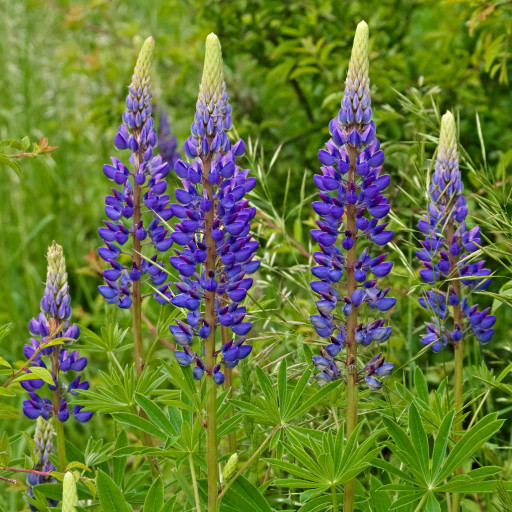
Plant Overview
Known as the Bigleaf Lupine or "The Wolf Flower," this perennial is a titan of the cottage garden, famous for its towering spires of pea-like blooms. Originally from the meadows of western North America, it has traveled the globe, often escaping gardens to paint entire mountainsides in vibrant shades of blue, purple, and pink. Despite its elegant appearance, it is a rugged pioneer plant capable of thriving where other flowers might starve.
🔍 How to Identify
- 🖐️ Palmate Leaves: The foliage is unmistakable, featuring "star-burst" or hand-shaped leaves with 9 to 17 narrow leaflets radiating from a central point.
- 🗼 Flower Spires: It produces dense, elongated clusters (racemes) of flowers that can grow up to 2 feet tall, blooming from the bottom upward.
- ☁️ Silvery Texture: The stems and the undersides of the leaves are often covered in fine, silky hairs that catch the morning dew.
🏡 In Your Garden
- ⚓ The Taproot Rule: This plant develops a long, deep taproot early in life. Because of this, it absolutely hates being moved; transplanting an established Lupine often leads to "sudden death" syndrome.
- 🧪 Soil Improver: Lupines are part of the legume family and work with soil bacteria to "fix" nitrogen. They actually leave the soil richer than they found it, making them perfect for rejuvenating tired garden beds.
- 🏔️ Climate Preference: They thrive in cool, moist summers. In high-heat areas, they may wilt or go dormant early, so providing some afternoon shade in warmer zones is a must.
⚠️ Safety & Toxicity
- 🚫 Status: Toxic to humans and animals.
- 🐾 Details: The entire plant, especially the seeds (pods), contains bitter alkaloids like lupinine. If ingested by dogs, cats, or livestock, it can cause lethargy, slow heart rate, and respiratory distress. Keep these away from curious pets and toddlers who might mistake the seed pods for edible peas.
✨ Fun Fact
The name Lupinus comes from the Latin word lupus, meaning "wolf." Ancient farmers believed these plants "wolfed" or devoured the nutrients from the soil because they often grew in poor, sandy ground. In reality, they were the only things tough enough to grow there because they create their own fertilizer!

Detailed Care Instructions
| Humidity | Normal |
| Invasive | Weed |
| Lighting | Full Sun |
| Difficulty | Medium |
| Hibernation | Cold Period |
| Temperature | 10°C - 30°C |
| Hardiness Zones | Min 5A |
To grow Lupinus polyphyllus (commonly known as lupine or garden lupin), follow these steps:
- Climate and Soil Requirements:
- Choose a sunny location in your garden with well-draining soil.
- Lupines prefer cool climates and do well in USDA hardiness zones 4-8.
- Choose a sunny location in your garden with well-draining soil.
- Seed Selection and Preparation:
- Obtain lupine seeds from a reputable nursery or garden center.
- Scarify the seeds by nicking or scratching the hard seed coat with sandpaper or a sharp knife. This helps enhance germination.
- Obtain lupine seeds from a reputable nursery or garden center.
- Planting:
- Sow the seeds directly outdoors in early spring (for cool-climate gardens) or in early fall (for warmer climates).
- Make sure the soil is moist but not waterlogged.
- Plant the seeds about 1/4 inch deep and space them around 12-24 inches apart.
- If you prefer, you can start the seeds indoors 6-8 weeks before the last frost date and transplant them later.
- Sow the seeds directly outdoors in early spring (for cool-climate gardens) or in early fall (for warmer climates).
- Care and Maintenance:
- Water the plants regularly, aiming for about 1 inch of water per week (water more in dry spells).
- Apply a layer of organic mulch around the base of the plants to help retain moisture and suppress weeds.
- Stake taller varieties if necessary to provide support.
- Remove spent flower spikes to encourage further blooming and prevent self-seeding.
- Monitor for pests and diseases like aphids or powdery mildew and address any issues promptly.
- Water the plants regularly, aiming for about 1 inch of water per week (water more in dry spells).
- Fertilization:
- Lupines are nitrogen-fixing plants, so they don't require heavy fertilization.
- If your soil is poor or if you want to enhance growth, you can apply a balanced slow-release fertilizer or a compost mulch in early spring.
- Lupines are nitrogen-fixing plants, so they don't require heavy fertilization.
- Winter Care:
- In colder areas, lupines may die back in winter but will regrow in spring. Apply a layer of mulch around the base of the plants in late fall to protect them from freezing temperatures.
By following these guidelines, you can enjoy the beautiful blooms of Lupinus Polyphyllus in your garden.
- In colder areas, lupines may die back in winter but will regrow in spring. Apply a layer of mulch around the base of the plants in late fall to protect them from freezing temperatures.

Place in a bright room that is sun drenched almost all day. Or directly in a south-facing window.

To properly hydrate this species of plant, one should ensure that the soil around it is always moist but not waterlogged. It is important to avoid letting the soil dry out completely, as this can cause the plant to wilt and ultimately die. One way to maintain the appropriate level of moisture is to water the plant deeply once or twice a week, allowing the water to seep deep into the soil. This will encourage the roots to grow downward, helping to anchor the plant and maintain its overall health and vigor. Additionally, it is important to avoid getting water on the leaves or flowers, as this can promote the growth of fungal diseases. Finally, during periods of hot, dry weather, it may be necessary to water the plant more frequently to prevent it from becoming stressed or dehydrated.
To fertilize this plant, first make sure it is well-established and has been in the ground for at least 6-8 weeks. Then, choose a balanced fertilizer with equal parts nitrogen, phosphorus, and potassium. Prior to applying the fertilizer, water the plant thoroughly to avoid root damage. Follow the manufacturer's instructions for application rates based on the size and age of the plant. It is best to fertilize in early spring or late fall when active growth has slowed down. Do not over-fertilize, as this can lead to burning or death of the plant.
The best type of soil to use for this plant is a well-draining, loamy soil that is rich in organic matter. It should have a pH level between 6.0 and 7.5, which is slightly acidic to slightly alkaline. The soil should also be moist, but not waterlogged, as this can lead to root rot. It is recommended to mix in compost or well-rotted manure before planting to improve soil fertility. Additionally, this plant tends to prefer full sun to partial shade and regular watering during dry periods.
Lupinus Polyphyllus is a flowering plant that can be propagated through various methods. One way to propagate this plant is through seed propagation. To do this, collect mature seeds from the plant and store them in a dry and cool place until planting season. In the spring, sow the seeds in a well-draining soil mix, and keep the soil evenly moist until the seeds germinate.
Another method of propagation is through stem cuttings. Take a stem cutting from the plant and remove the leaves from the lower part of the stem. Dip the cut end in rooting hormone and plant it in a well-draining soil mix. Keep the soil moist and place the cutting in a bright, indirect light until roots form and the plant begins to grow.
Dividing the plant is another way to propagate Lupinus Polyphyllus. This method is best done in the spring or fall. Carefully dig up the plant and divide the root ball into sections. Ensure that each section has a good amount of roots and replant them in a well-draining soil mix.
With the right care and attention, Lupinus Polyphyllus can be propagated successfully using these methods.
Common pests of the garden lupine include Aphids. Make a habit of checking your garden lupine frequently for pests so that any infestations can be caught and managed early.








