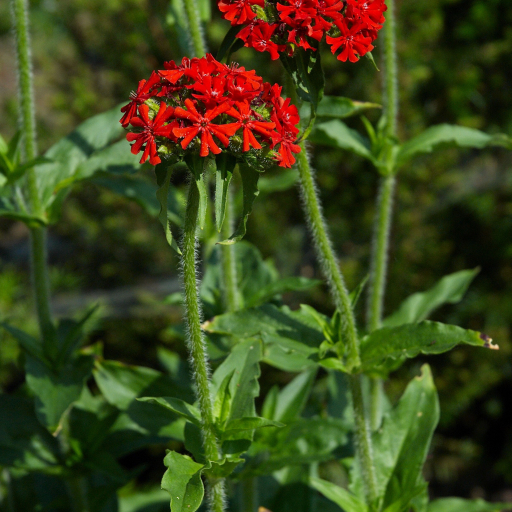
Plant Overview
Known as the "Maltese Cross" or "Scarlet Lightning," this heritage perennial has been a garden staple for centuries. It earned its name from its distinctive, brilliant red blooms that perfectly mimic the cross symbol used by the Knights of Malta. In the height of summer, these fiery clusters act as a glowing beacon for hummingbirds and swallowtail butterflies.
🔍 How to Identify
- 🌸 The Bloom: Dense, flat-topped clusters (cymes) containing up to 50 small, scarlet-red flowers. Each individual petal is deeply notched, creating the iconic four-armed cross shape.
- 🌿 Texture & Foliage: The stems and lance-shaped leaves are covered in fine, bristly hairs, giving the plant a slightly rough, sandpaper-like feel.
- 📏 Growth Habit: It grows in a sturdy, upright clump, typically reaching 2 to 4 feet in height. The stems are unbranched until they reach the flower heads at the very top.
🏡 In Your Garden
- ☀️ The Sun Factor: This plant is a true sun-lover. While it can tolerate partial shade, the stems tend to become "leggy" and flop over if they have to stretch for more light.
- 💧 Soil & Drainage: It thrives in rich, moist soil but is surprisingly sensitive to "wet feet" during the winter. Ensuring good drainage is the secret to helping this perennial survive through several seasons.
- ✂️ Deadheading Nuance: To prevent the plant from becoming invasive through self-seeding, snip off the flower heads once they fade. This also encourages the plant to put energy back into its roots for next year.
⚠️ Safety & Toxicity
- ✅ General Status: Lychnis chalcedonica is widely considered non-toxic to humans and common household pets like dogs and cats.
- 🧤 Skin Sensitivity: Because the stems are covered in tiny, stiff hairs, some gardeners with sensitive skin may experience mild mechanical irritation (itching) when handling the plant without gloves.
- 🧼 Saponin Content: Like many members of the Pink (Caryophyllaceae) family, it contains saponins. While these are poorly absorbed by the body, they can cause a mild stomach upset if large quantities of the leaves are ingested.
✨ Fun Fact
Legend says that this plant was brought back to Europe from the Middle East by the Crusaders. It was so well-loved in historical gardens that Thomas Jefferson even grew it at Monticello!

Detailed Care Instructions
Clumps can be divided in spring or early fall. Lift the clump out of the grand and shake off the excess soil so you can see the roots. Use two garden forks or a sharp shovel to divide the plant into three to five sections.
Is the Flower of Bristol plant a good choice for a weekend gardener?
Flower of Bristol is highly disease free and low maintenance, which makes the plant a good choice for gardeners with limited time to devote to it.
Do deer eat Flower of Bristol plants?
The plant is deer and rabbit resistant.
| Color | Red, White, Or Pink |
| Soil Ph | Between 6.5 To 7.5 |
| Humidity | Normal |
| Lighting | Full Sun |
| Soil Type | Evenly Moist And Well-Drained |
| Bloom Time | Early To Mid-Summer |
| Difficulty | Easy |
| Plant Type | Herbaceous Perennial |
| Hibernation | Cold Period |
| Mature Size | 3 To 4 Feet Tall And 1 1/2 Feet Wide |
| Native Area | Eurasia |
| Temperature | 20°C - 30°C |
| Sun Exposure | Full Sun |
| Hardiness Zones | Zones 3 To 10 |
To grow a Lychnis Chalcedonica plant, also known as Maltese cross, follow these steps:
- Select a suitable planting location: Choose an area that receives full sun to partial shade. The soil should be well-draining and rich in organic matter.
- Prepare the soil: Prior to planting, amend the soil with compost or well-rotted manure to improve its fertility and drainage. Remove any weeds or debris from the area.
- Planting seeds: Sow the seeds directly into the soil in early spring, after the last frost date. Lightly press the seeds into the soil without covering them entirely, as they require light for germination. Space the seeds about 12 inches apart.
- Watering: Keep the soil moist but not waterlogged during germination. Once the plants are established, they are generally drought-tolerant and do not require excessive watering. Water deeply when the top few inches of soil are dry.
- Fertilization: Apply a balanced, slow-release fertilizer or compost in early spring to provide necessary nutrients for the plant's growth.
- Mulching: Apply a layer of organic mulch, such as straw or wood chips, around the plants to help retain moisture, suppress weed growth, and maintain a cool root zone.
- Deadheading: To encourage continuous flowering, regularly remove faded flowers by cutting or pinching them off. This process, known as deadheading, directs the plant's energy towards producing new blooms.
- Division: Every few years, consider dividing the mature plants to maintain their vigor and promote new growth. Dig up the plant, separate the clumps, and replant them in well-prepared soil.
- Pests and diseases: Lychnis Chalcedonica is generally pest and disease-resistant. However, occasional issues with aphids, slugs, or powdery mildew may occur. Monitor the plants regularly and take appropriate measures if any problems arise.
- Support: If the plants grow tall and tend to flop, provide support by using stakes or a plant cage to help keep them upright.
By following these steps, you can successfully grow and care for your Lychnis Chalcedonica plant. Enjoy the vibrant red flowers it produces!

Place in a bright room that is sun drenched almost all day. Or directly in a south-facing window.

Lychnis Chalcedonica is a flowering plant that requires regular watering to flourish. When watering, it is important to avoid getting water on the leaves of the plant, as this can promote the growth of fungal diseases. Instead, water the base of the plant deeply and thoroughly, allowing the water to soak into the soil and reach the plant's roots.
The frequency of watering will depend on several factors, including the climate, soil type, and the size of the plant. In general, Lychnis Chalcedonica prefers moist soil, so it is important to monitor the plant's watering needs regularly. In hot, dry climates or during periods of drought, the plant may need to be watered more frequently.
To determine if the plant needs water, check the top inch of soil. If it feels dry to the touch, it's time to water. When watering, use a watering can or hose with a gentle spray, taking care not to disturb the soil or the plant's delicate roots.
In addition to regular watering, Lychnis Chalcedonica will benefit from a layer of organic mulch, such as compost or bark chips. This will help retain moisture in the soil and provide additional nutrients to the plant as the mulch breaks down over time.
Overall, with regular watering and a little care, Lychnis Chalcedonica is a hardy and rewarding plant that will add color and vibrancy to any garden.
To fertilize this plant, apply a balanced fertilizer with equal parts nitrogen, phosphorus, and potassium in the early spring before new growth begins. Apply the fertilizer around the base of the plant, taking care not to get any on the leaves or stem. Water the plant thoroughly after fertilizing. Repeat this process in mid-summer if desired. Avoid over-fertilizing, as it can cause the plant to grow too quickly and become weak and susceptible to disease.
When planting Lychnis Chalcedonica, it is recommended to use soil that is well-draining and rich in organic matter. The soil should have a pH level that is slightly acidic to neutral, with a range of 5.5 to 7.0. It is also recommended to incorporate compost or other organic matter into the planting area to improve the soil quality. Additionally, adding a balanced fertilizer before planting can help provide essential nutrients for the plant to grow healthy. Overall, the key is to ensure the soil is rich in nutrients and allows excess water to drain away to prevent the roots from becoming waterlogged.
To propagate this plant, the gardener can take cuttings in the spring or early summer. The cuttings should measure around 3 to 4 inches long and the gardener should remove the lower leaves. Next, the gardener should dip the cut end into a rooting hormone powder and plant it in a well-draining soil mix. The cutting should be kept in a cool, shaded area with high humidity until roots develop. After root development, the cutting can be transplanted to a permanent location. Another method of propagation is through dividing the plant in the spring, where the gardener can carefully separate the plant into smaller sections with roots and replant them in a new location.








