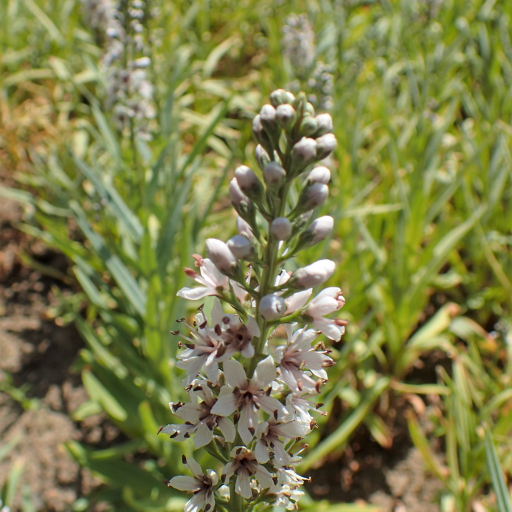
Plant Overview
Often called the Willow-leaved Loosestrife, this elegant perennial is the sophisticated "well-behaved" cousin of the Lysimachia family. Unlike its more aggressive relatives that can take over a garden, this species offers a refined, architectural look with its smoky, silver-blue foliage. It is a favorite in European estate gardens for its ability to bridge the gap between structural height and delicate texture.
🔍 How to Identify
- 🍃 Willow-like Foliage: The leaves are its most striking feature—long, narrow, and a distinct glaucous (waxy grey-green) color that looks like it has been dusted with silver.
- ☁️ Starry Spires: In mid-to-late summer, it produces tall, slender racemes (spikes) packed with tiny, five-petaled white flowers that often have a subtle pearly-pink eye.
- 📏 Upright Habit: It grows in neat, vertical clumps that can reach up to 3 or 4 feet tall, remaining sturdy and upright without the need for staking.
🏡 In Your Garden
- 💧 Moisture Enthusiast: This plant is a "thirsty" species. It thrives in boggy soil or at the edge of a pond. While it can handle normal garden beds, it will struggle if the soil dries out completely during a heatwave.
- 🦋 Pollinator Banquet: The long-lasting flower spikes are a magnet for bees and butterflies. Because the flowers bloom from the bottom of the spike upward, it provides a consistent food source for several weeks.
- 🌱 Low Maintenance: Unlike other loosestrifes, it does not spread via aggressive runners. It stays exactly where you plant it, making it ideal for the middle or back of a mixed border.
⚠️ Safety & Toxicity
- ✅ Non-Toxic: Lysimachia ephemerum is generally considered safe for humans, cats, and dogs. It does not possess the invasive tendencies or the irritating sap found in some other garden perennials.
- 🧤 General Care: While safe, it is always wise to wear gloves when pruning any garden plant to avoid minor skin irritation from environmental dust or debris trapped on the leaves.
✨ Fun Fact
The specific epithet Ephemerum actually means "short-lived" or "lasting only a day." This is a bit of a botanical irony; while the individual tiny flowers on the spike may fade quickly, the plant itself is a long-lived, hardy perennial that will return to your garden every spring for decades!

Detailed Care Instructions
Here are some steps you can follow to help grow Lysimachia ephemerum:
- Choose the right location: Lysimachia ephemerum prefers partial shade to full sun. Ensure the location you select receives bright, indirect sunlight for a few hours each day.
- Soil preparation: The plant thrives in moist, well-draining soil. Amend the soil with organic matter like compost to improve its fertility and drainage.
- Planting: Start by preparing a hole in the soil that is slightly larger than the root ball of the plant. Place the plant in the hole, ensuring it is at the same depth as it was in its nursery pot. Backfill the hole with soil and gently press it down around the roots.
- Watering: Lysimachia ephemerum requires consistent moisture. Water the plant deeply once or twice a week, keeping the soil evenly moist but not waterlogged. Adjust the frequency of watering depending on the weather conditions and the moisture needs of the plant.
- Mulching: Apply a layer of mulch, like wood chips or straw, around the base of the plant to help retain moisture and regulate soil temperature. Make sure not to heap the mulch directly against the stem to avoid rotting.
- Fertilization: Lysimachia ephemerum generally does not require regular fertilization. However, you can apply a balanced, slow-release fertilizer in spring to boost growth. Follow the instructions on the fertilizer packaging for proper application.
- Pruning: Regularly trim away any dead or damaged foliage to keep the plant healthy and neat. Additionally, you can trim back the plant after the flowering season to encourage bushier growth.
- Propagation: Lysimachia ephemerum can be propagated by division. This can be done in early spring or fall. Carefully dig up the plant, and using a sharp, sterilized knife, divide the clumps into smaller sections, ensuring that each division has healthy roots. Replant the sections in prepared soil and water thoroughly.
By following these guidelines, you should be able to successfully grow Lysimachia ephemerum. Remember to monitor the plant's growth, provide adequate care, and make any necessary adjustments to its environment.

Place in a bright room that is sun drenched almost all day. Or directly in a south-facing window.

To water this particular plant, it is recommended to use a watering can or hose. When watering, it is important to avoid getting water on the foliage, as this can cause damage to the leaves and promote disease. Instead, direct the water towards the base of the plant, allowing it to soak into the soil and reach the roots. Be sure not to overwater, as this can lead to root rot. It is a good idea to feel the soil before watering - if it feels dry to the touch, it is time to water. However, if the soil feels moist, hold off on watering until it dries out a bit more.
Apply a balanced fertilizer with equal parts nitrogen, phosphorus, and potassium. Apply this fertilizer during the growing season, every two weeks at a rate of 1 tablespoon per square foot. Water thoroughly after application to ensure the fertilizer is absorbed by the plant. Avoid over-fertilizing as this can cause damage to the plant.
Lysimachia Ephemerum plant thrive in nutrient-rich soil that provides good drainage. It prefers a slightly acidic to neutral pH soil with a pH level between 5.5 to 7.0. The ideal soil for Lysimachia Ephemerum plant is a mixture of peat moss, loamy soil, and sand. The addition of organic matter such as compost or well-rotted manure to the soil will increase fertility and improve drainage. It is important to avoid using heavy clay soils or soils that retain too much moisture which can lead to root rot. When selecting soil for planting Lysimachia Ephemerum, it is essential to consider the soil structure and quality to ensure the plant's optimal growth and health.
To propagate Lysimachia Ephemerum, follow these steps:
- Select a healthy parent plant: Choose a mature, healthy plant that has strong stems and vibrant foliage. This will ensure successful propagation.
- Prepare the cutting: Take a sharp, sterilized knife or scissors and make a clean cut on a healthy stem that is several inches long. Make sure there are at least two nodes on the cutting.
- Remove lower leaves: Trim off the lower leaves from the lower one-third to one-half of the cutting. This will prevent the leaves from rotting when placed in a growing medium.
- Optional rooting hormone: If desired, you can dip the cut end of the stem in a rooting hormone powder. This can promote faster root development, but it is not necessary for all plants.
- Choose a suitable growing medium: Lysimachia Ephemerum prefers moist, well-draining soil. A mixture of potting soil, perlite, and peat moss or vermiculite can be a suitable growing medium.
- Insert the cutting into the growing medium: Create a hole in the growing medium using a pencil or your finger, and gently place the cutting into the hole. Ensure that at least one node is buried in the soil.
- Watering: Water the cutting thoroughly after planting to provide adequate moisture. Avoid overwatering, as it can lead to rotting.
- Provide adequate light and temperature: Place the potted cutting in a location that receives bright, indirect light. Lysimachia Ephemerum prefers a temperature range of 60-75°F (15-24°C) for optimal growth.
- Mist the cutting: To maintain humidity levels around the cutting, mist it regularly with water. This will prevent the cutting from drying out and promote root development.
- Monitor and care for the cutting: Keep a close eye on the cutting for signs of growth. It may take several weeks for roots to develop. Ensure that the growing medium remains moist but not waterlogged.
- Transplanting: Once the cutting has developed a strong root system, it can be transplanted into a larger pot or directly into the garden soil. Gradually acclimate the plant to outdoor conditions if transplanting into the garden.
Note: It's important to research and follow any specific guidelines for propagating Lysimachia Ephemerum, as different varieties may have specific requirements.








