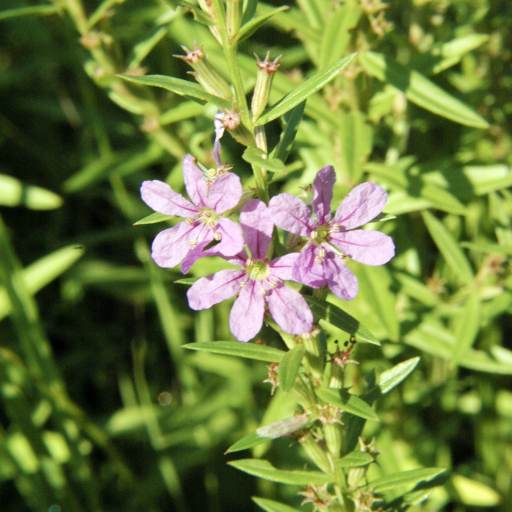
Plant Overview
Known as the Winged Loosestrife, this elegant North American native is the "well-behaved" cousin of the notorious invasive Purple Loosestrife. It earns its name from the distinctive, thin ridges that run vertically down its square stems, resembling tiny green wings. Often found dancing in the breeze of wet prairies and marshes, it provides a sophisticated splash of violet to any damp corner of a landscape.
🔍 How to Identify
- 🦋 The "Wings": The most telling feature is the square-shaped stem with prominent longitudinal ridges or "wings" extending from the corners.
- 🌸 Petite Blooms: It produces delicate, six-petaled violet flowers that emerge individually from the leaf axils, rather than in the dense, crowded spikes seen on its invasive relatives.
- 🍃 Variable Leaves: The dark green, lance-shaped leaves are usually opposite each other at the bottom of the plant but may switch to an alternating pattern as they climb toward the top.
🏡 In Your Garden
- 💧 Moisture Lover: This plant is a "hydrophile," meaning it craves wet feet. It is an ideal choice for rain gardens, the edges of ponds, or low-lying spots in your yard where water tends to collect after a storm.
- 🐝 Pollinator Magnet: While it may look delicate, it is a powerhouse for local ecology. It is a primary nectar source for long-tongued bees and various butterfly species, making it a "must-have" for a conservation-focused garden.
- 🌱 Non-Aggressive: Unlike the invasive Lythrum salicaria, the Winged Loosestrife stays exactly where you put it. It spreads slowly and politely, coexisting peacefully with other native perennials.
⚠️ Safety & Toxicity
- ✅ Safe Status: Lythrum alatum is generally considered non-toxic to humans and common household pets like dogs and cats.
- 🐾 Garden Safety: While not edible, it does not possess the harsh alkaloids found in some other marsh plants, making it a safe choice for families with curious toddlers or roaming pets.
✨ Fun Fact
Winged Loosestrife practices a fascinating reproductive strategy called heterostyly. Individual plants produce flowers with different lengths of male and female parts (stamens and pistils). This clever design ensures that a bee must visit different plants to transfer pollen, effectively preventing the plant from accidentally pollinating itself!

Detailed Care Instructions
Here are some tips for growing Lythrum Alatum (winged loosestrife) plants:
- Choose a suitable location: Lythrum Alatum prefers full sun to partial shade. Select a well-draining area with moist soil, as this plant requires ample moisture.
- Prepare the soil: Loosen the soil and remove any weeds or debris. You can also amend the soil with organic matter, such as compost, to improve its fertility and drainage.
- Plant the seeds or seedlings: If starting from seeds, sow them directly into the prepared soil in the spring or fall, as per the seed package instructions. If using seedlings, dig holes that are slightly larger than the root ball and place the seedlings in the holes. Space them at least 12-18 inches apart to allow for their spreading growth habit.
- Water regularly: Keep the soil consistently moist, especially during the first growing season. For established plants, aim to provide about 1 inch of water per week, either through rainfall or irrigation.
- Mulch the area: Apply a layer of organic mulch around the plants to help retain soil moisture, prevent weed growth, and maintain a cooler root temperature.
- Provide support if needed: Lythrum Alatum can benefit from support if grown in an area with strong winds. You can use stakes or trellises to provide support as the plants grow taller.
- Pruning and maintenance: While Lythrum Alatum does not require extensive pruning, you can deadhead spent flowers to encourage continuous blooming. Remove any damaged or diseased foliage promptly and keep the surrounding area clean to prevent pest or disease issues.
- Monitor for pests and diseases: Keep an eye out for common pests like aphids or slugs. If necessary, use appropriate organic pest control methods to protect the plants. Additionally, regular inspections can help detect any signs of diseases, such as powdery mildew or leaf spot, which may require appropriate treatment.
By following these steps, you should be able to successfully grow Lythrum Alatum plants. Remember to check with your local gardening centers or agricultural extension offices for specific advice tailored to your climate and growing conditions.

Place in a bright room that is sun drenched almost all day. Or directly in a south-facing window.

Lythrum Alatum is a perennial plant that requires proper watering. To water this plant, you should ensure that the soil is moist enough without being too wet. One critical aspect of watering Lythrum Alatum is to do it regularly and consistently throughout the growing season. It is recommended to water the plant deeply at least once a week, especially during the hot summer months.
When watering Lythrum Alatum, take note of the environmental conditions such as rainfall and temperature. If it is raining regularly, you may need to reduce the frequency of watering. Conversely, if the weather is hot and dry, you should water the plant more frequently to prevent it from drying out.
It is essential to monitor the soil moisture level to ensure that it is just right. To check the soil moisture level, you can use a moisture meter or place your finger into the soil. If the top inch of soil is dry, it's time to water the plant. When watering Lythrum Alatum, you should avoid overwatering as it can lead to root rot and other diseases.
In summary, watering Lythrum Alatum requires regularity, consistency, and balance. Water the plant deeply once a week, monitor the soil moisture level, and adjust accordingly. By following these tips, you'll be able to maintain a healthy and vibrant Lythrum Alatum plant.
Lythrum alatum is a perennial plant that requires regular fertilization to ensure healthy growth and development. Fertilizing should be done twice a year, once in the early spring and once in the late summer or early fall.
For optimal growth, use a balanced, slow-release fertilizer with an N-P-K ratio of 10-10-10 or 12-12-12. Apply the fertilizer according to the instructions on the label, being careful not to overapply.
To apply the fertilizer, scatter the granules around the base of the plant and water deeply. Avoid getting fertilizer on the leaves or stems of the plant, as this can cause burning or damage.
After fertilizing, be sure to water the plant regularly to promote deep root growth and nutrient uptake. With proper care and fertilization, Lythrum alatum can thrive and provide beautiful, colorful blooms year after year.
Lythrum Alatum is a herbaceous perennial plant species that requires specific soil conditions for optimal growth. It prefers soil that is fertile, moist, well-draining, and has a neutral to slightly acidic pH level. The soil should also be rich in organic matter, as this provides the necessary nutrients for the plant's growth and development.
When planting Lythrum Alatum, it's important to prepare the soil by adding compost or well-rotted manure to improve its quality. Before planting, make sure the soil has been deeply dug over and any rocks or debris have been removed from the site.
During the growing season, it's important to keep the soil consistently moist but not waterlogged. This can be achieved by regular watering, mulching around the plant to retain moisture, and ensuring proper drainage.
Overall, Lythrum Alatum requires soil that is rich in nutrients, well-draining, and consistently moist to thrive. With proper soil preparation and care, it can grow to be a stunning addition to any garden or landscape.
To propagate this particular plant, you can take stem cuttings from the parent plant. This is best done in the spring or summer when the plant is actively growing.
Here are the steps to take:
- Take a healthy stem cutting that is 4-6 inches long and has at least 2-3 nodes.
- Remove the lower leaves, leaving only a few leaves at the top.
- Dip the cut end in rooting hormone to encourage root growth.
- Plant the cutting in a pot filled with moist, well-draining soil.
- Cover the pot with a plastic bag to create a humid environment.
- Place the pot in a warm, bright location with indirect sunlight.
- Keep the soil moist and mist the cutting occasionally.
- After 4-6 weeks, check for root growth by gently tugging on the cutting. If it resists, roots have formed.
- You can now transplant the new plant into a larger pot or into the ground.
Remember to acclimate the new plant to direct sunlight gradually to avoid damaging it.








