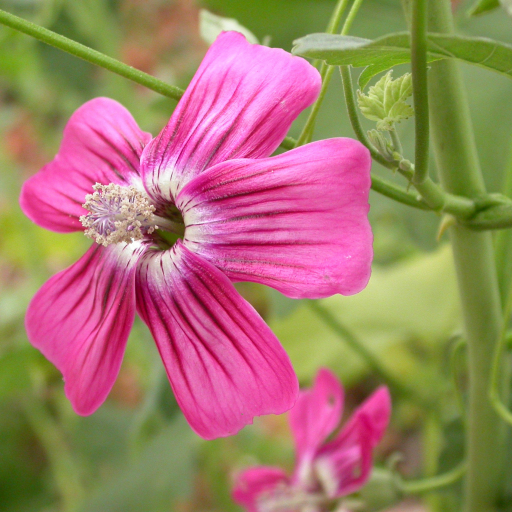
Plant Overview
Known as the Mission Mallow or Island Mallow, this California native is a coastal showstopper that looks like a cross between a hibiscus and a maple tree. Originally found only on the rugged Channel Islands, its striking magenta blooms and rapid growth have made it a favorite for seaside gardens. It’s a resilient survivor that brings a tropical, lush flair to even the windiest Mediterranean climates.
🔍 How to Identify
- 🌸 Vibrant Blooms: Large, five-petaled flowers that are deep pink or magenta, featuring dramatic dark purple "nectar guide" veins radiating from the center.
- 🍁 Maple-like Foliage: Soft, bright green leaves that are "palmate" (hand-shaped) with 5 to 7 lobes, often feeling slightly fuzzy to the touch.
- 🌳 Woody Structure: Unlike many smaller mallows, this species develops a thick, woody trunk over time, growing into a large shrub or even a small tree.
🏡 In Your Garden
- 🌊 Salt & Wind Specialist: This plant is an absolute champion of coastal conditions. It evolved to handle salt spray and heavy winds, making it the perfect living "privacy screen" for beach houses.
- ✂️ The Pruning Puzzle: It grows incredibly fast, which can lead to a "leggy" or thin appearance. To keep it dense and full of flowers, gardeners should prune it back significantly in late fall to encourage new, bushy growth.
- 🐝 Pollinator Magnet: Because it blooms almost year-round in mild climates, it serves as a vital "gas station" for hummingbirds and bees during months when other flowers have gone dormant.
⚠️ Safety & Toxicity
- ✅ Safe Status: The Island Mallow is generally considered non-toxic to humans, cats, and dogs.
- 🧤 Skin Sensitivity: While not poisonous, the fine hairs on the leaves and stems can occasionally cause mild skin irritation for people with very sensitive skin. Wearing gloves during heavy pruning is a good idea.
✨ Fun Fact
The Island Mallow is a "relict" species. Thousands of years ago, it likely covered vast areas of mainland California, but as the climate changed, it became "trapped" on the Channel Islands. It only returned to the mainland when early settlers and botanists fell in love with its flowers and began planting it in Mission gardens!

Detailed Care Instructions
To grow Malva assurgentiflora, also known as island mallow, you can follow these guidelines:
- Choose a suitable location: Malva assurgentiflora prefers full sun, although it can tolerate partial shade. Ensure the soil is well-draining and fertile.
- Propagation: You can start growing Malva assurgentiflora from seeds or cuttings. If using seeds, sow them in a seed-starting tray filled with potting mix. Keep the soil consistently moist until the seeds germinate. If using cuttings, take healthy stem cuttings and root them in a well-draining potting mix.
- Transplanting: Once the seedlings or rooted cuttings have grown to a suitable size, carefully transplant them into larger pots or directly into the garden bed. Space the plants about 12-18 inches apart.
- Watering: Malva assurgentiflora enjoys regular watering, especially during hot and dry periods. However, ensure you don't overwater and allow the soil to become waterlogged, as it can lead to root rot.
- Fertilization: Apply a balanced, slow-release fertilizer once every 4-6 weeks during the growing season to promote healthy growth.
- Mulching: Mulch around the plants to help retain moisture, suppress weeds, and regulate soil temperature.
- Pruning: Regularly prune Malva assurgentiflora to encourage bushy growth and prevent it from becoming leggy. Trim back any dead or damaged stems as needed.
- Pests and diseases: Monitor the plants regularly for any signs of pests, such as aphids or spider mites, and treat them accordingly. Malva assurgentiflora can also be vulnerable to powdery mildew, so ensure good air circulation around the plants and avoid overhead watering.
- Winter care: In colder climates, Malva assurgentiflora may require protection during winter. Mulch around the base of the plants to insulate the roots and consider covering them with a frost cloth or moving potted plants indoors.
With proper care and attention, your Malva assurgentiflora should thrive and produce beautiful flowers.

Place in a bright room that is sun drenched almost all day. Or directly in a south-facing window.

To water this plant, it is important to ensure that the soil is evenly moist but not waterlogged. This can be achieved by watering deeply once or twice a week, depending on the weather conditions and the level of humidity in the area. It is important to let the soil dry out slightly between waterings to prevent root rot. When watering, it is best to water at the base of the plant and avoid getting the foliage wet, as this can lead to fungal growth and disease. If the plant is growing in a container, it is important to ensure that there are drainage holes and to empty the saucer or tray underneath the pot after each watering to prevent water from accumulating. Additionally, if the plant is experiencing wilt or yellowing leaves, it may need more water or it could be a sign of overwatering.
To fertilize this plant, use a balanced fertilizer with equal amounts of nitrogen, phosphorus, and potassium. Be sure to apply the fertilizer evenly around the base of the plant and water thoroughly afterward. Fertilize in early spring before the onset of new growth and again in mid-summer to promote healthy foliage and blooms. Avoid over-fertilizing as this can cause burning of the leaves and damage to the plant.
Malva Assurgentiflora is a type of flowering plant that originates from the Malvaceae family. When planting this particular plant, it is essential to ensure that the soil used is well-draining and fertile. The soil should be rich in organic matter, such as compost and leaf mold. The soil pH should also be neutral to slightly acidic, with a range of 6.0 to 7.0.
It is best to plant Malva Assurgentiflora in a location that receives full sun to partial shade. The plant requires regular watering, and the soil should be kept moist but not soaked. To ensure optimal growth, it is recommended to fertilize the plant with a balanced, slow-release fertilizer in the spring and summer months.
In terms of soil texture, Malva Assurgentiflora prefers a loamy soil that is well-draining. Sandy soils are also suitable, as long as they are amended with organic matter to improve overall fertility. Clay soils may be too heavy and may not drain well, which can lead to root rot and other issues.
Overall, it is important to choose a soil that is rich in nutrients, well-draining, and suitable for the particular growing conditions of Malva Assurgentiflora. With proper care and maintenance, this plant can thrive and produce beautiful, vibrant flowers throughout the growing season.
To propagate this plant, you will need to take stem cuttings during the plant's active growing season. Choose healthy stems that have at least two sets of leaves and measure approximately six inches in length. Cut the stem at a 45-degree angle using sharp and sterile pruning shears. Remove the lower set of leaves, leaving only the top set. Dip the cut end of the stem in rooting hormone powder and gently tap off any excess. Fill a small container with a well-draining potting mix and moisten it. Make a hole in the center of the soil and insert the cutting about two inches deep, gently patting the soil around it to secure it in place. Cover the container with a clear plastic bag or plastic wrap to create a mini-greenhouse environment. Place the container in a bright area, but avoid direct sunlight. Keep the soil moist but not waterlogged. After about four to six weeks, the stem should have established roots, and you can remove the plastic covering. Over time, the plant will begin to grow and develop into a healthy new plant.








