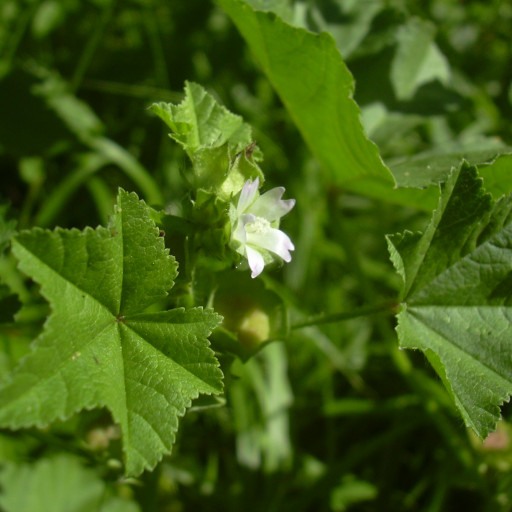
Plant Overview
Known affectionately as "Cheeseweed" because its seed pods look like tiny, segmented wheels of gourmet cheese, Malva parviflora is a resilient traveler from the Mediterranean. While many modern gardeners view it as a persistent weed, it has a long history as a survival food and a soothing medicinal herb. This plant is a true "pioneer," often being the first to colonize cracked sidewalks or neglected garden corners with its tough, umbrella-like leaves.
🔍 How to Identify
- 🍃 The Leaves: Broad, circular, and slightly lobed with 5 to 7 shallow points. They look like miniature green umbrellas and have a distinctive "crinkled" texture where the stem meets the leaf blade.
- 🌸 The Flowers: Very small and subtle, usually pale pink or white. They cluster close to the stem at the base of the leaves, rather than blooming on tall stalks.
- 🧀 The "Cheese" Fruit: The most famous feature—a flattened, disc-shaped fruit divided into 10-12 segments. When green and young, these "cheeses" are crunchy and nutty.
🏡 In Your Garden
- 💪 Deep Roots: This plant develops a surprisingly deep and woody taproot very quickly. If you want to remove it, do so while it’s a seedling; once established, it "anchors" into the soil, making it very difficult to pull by hand.
- 🦋 Pollinator Magnet: Though the flowers are tiny, they are rich in nectar and highly attractive to small native bees and the Painted Lady butterfly, which often uses mallow species as a host plant for its caterpillars.
⚠️ Safety & Toxicity
- 🐾 Livestock Warning: While generally safe for humans in small amounts, it can be toxic to cattle, sheep, and horses if consumed in large quantities, leading to a condition known as "mallow staggers."
- 🌱 Nitrate Accumulator: Be cautious about where it grows. Malva parviflora is known to suck up nitrates from the soil. If grown in chemically fertilized lawns or polluted areas, the leaves can concentrate these toxins, making them unsafe to eat.
- 🐱 Pets: Generally non-toxic to cats and dogs, though the high fiber content can cause mild stomach upset if they graze on it excessively.
✨ Fun Fact
Before modern chemistry gave us gelatin and corn syrup, the gooey sap (mucilage) from the roots of the Mallow family was whipped with sugar to create the very first "Marshmallows"! While the Marsh Mallow (Althaea officinalis) was the primary choice, our Little Mallow contains similar soothing properties.

Detailed Care Instructions
To grow Malva parviflora, also known as Cheeseweed or Little Mallow, you can follow these steps:
- Choose a suitable location: Malva parviflora requires full sun to partial shade. Choose a spot in your garden that receives at least 6 hours of direct sunlight per day. Ensure that the location has well-draining soil.
- Prepare the soil: Before planting, prepare the soil by loosening it using a garden fork or a tiller. Remove any weeds or large rocks from the area. Adding compost or well-rotted manure to improve the soil quality is beneficial, but it is not necessary for this plant.
- Sow the seeds: You can sow Malva parviflora seeds directly into the soil outdoors after the last frost date in your area. Make small holes about 1/4 inch deep and sow the seeds 2-3 inches apart. Cover the seeds lightly with soil.
- Watering: Keep the soil moist but not waterlogged. Water the seeds immediately after planting and continue to water regularly, especially during dry periods. Avoid over-watering, as it can lead to root rot.
- Thin the seedlings: Once the seedlings start to grow, thin them out to give each plant enough space to grow. Thin them to a distance of around 12-18 inches apart.
- Mulching: Apply a layer of organic mulch around the plants to help retain moisture in the soil, suppress weeds, and provide insulation to the root system.
- Care and maintenance: Malva parviflora is relatively low-maintenance. Monitor for pests and diseases and treat accordingly. Regularly remove any weeds that may compete with the plant. Prune back the plant after blooming to promote bushier growth.
- Harvesting: Once the plant reaches maturity, usually after about 8-10 weeks, you can harvest the leaves and tender stems for various culinary or medicinal uses. Harvesting often can encourage continuous growth and flowering.
Remember to check if Malva parviflora is considered an invasive species in your region before planting, as it has been known to spread aggressively in some areas.

Place in a bright room that is sun drenched almost all day. Or directly in a south-facing window.

To water this particular plant, it is important to first feel the soil to see if it is dry to the touch. If the soil is dry, slowly water around the base of the plant, making sure to avoid the leaves as this can cause damage or potential disease. You can either use a watering can or a hose with a gentle stream. Ensure that the water penetrates deeply to encourage healthy root growth and prevent waterlogging. Monitor the plant throughout the season and adjust watering frequency as necessary.
To fertilize this plant, you should use a balanced fertilizer with equal amounts of nitrogen, phosphorus, and potassium. Apply the fertilizer in the early spring before new growth appears and again in mid-summer. Use a slow-release granular fertilizer or a liquid fertilizer diluted in water. Apply the fertilizer around the base of the plant, being careful not to get any on the leaves. Water the plant thoroughly after fertilizing. Avoid over-fertilizing as this can damage the plant.
Malva Parviflora plant thrives in well-draining soil that is rich in nutrients. The ideal soil composition for this plant is in the range of slightly acidic to neutral. It would be best if you used loamy soil, which is a mix of sand, silt, and clay in almost equal proportions. You can prepare it by mixing organic matter such as compost or aged manure to improve its fertility and water-holding capacity. Avoid heavy soils that can retain water for long periods as they can lead to root rot and other fungal diseases. Opt for a potting mix containing perlite, vermiculite, peat moss, or coconut coir for container gardening, as they are lightweight and well-draining. Do not use heavy garden soil in pots as it can easily compact and suffocate the roots. Remember to water the plant regularly to keep the soil moist but not waterlogged.
Propagation of this plant can be done by taking stem cuttings or by seed.
To propagate using stem cuttings, select a healthy stem with a few leaves and cut it from the base of the plant. Remove the leaves from the bottom 1-2 inches of the stem and dip the cut end into rooting hormone powder. Plant the cutting into a well-draining potting soil, water it well, and cover it with a plastic bag to create a humid environment. Keep the cutting in a bright, but indirect light and keep the soil moist until roots begin to form.
To propagate using seed, wait until the flowers have wilted and small seedpods have formed. Collect the seedpods and allow them to dry out on a paper towel for a few days. Once dry, open the seedpods and collect the small black seeds inside. Sow the seeds in a well-draining potting soil, cover them lightly with soil, and water well. Keep the soil moist and place the container in a bright location. The seeds should germinate within 1-2 weeks.








