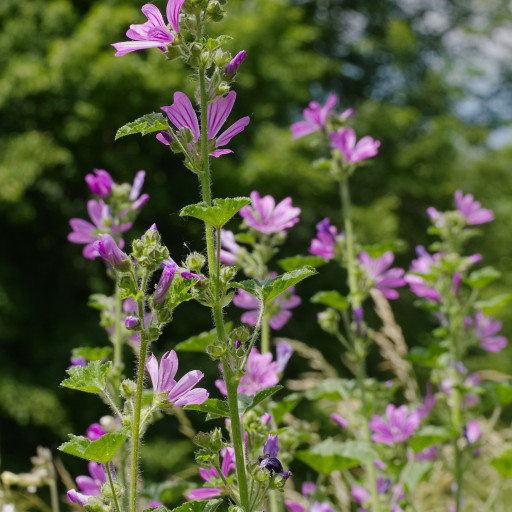
Plant Overview
Often called "Common Mallow" or "Cheeses," this vibrant wildflower is a staple of cottage gardens and wild meadows alike. Its striking purple-veined petals look as if they have been delicately painted by hand, serving as a natural neon sign for passing pollinators. Historically, it was a beloved "potherb," used for centuries in kitchens and apothecaries across Europe and Asia.
🔍 How to Identify
- 🌸 The Petals: Five notched, heart-shaped petals ranging from pale lilac to deep reddish-purple. Each petal features three to five distinct dark stripes (nectar guides) that point toward the center.
- 🍃 The Foliage: Leaves are circular or kidney-shaped with five to seven shallow, toothy lobes. They have a soft, slightly fuzzy texture and grow on long stalks.
- 🧀 The "Cheese" Fruit: After the flower fades, it produces a flat, circular seed pod that looks remarkably like a miniature wheel of green cheese, giving the plant its whimsical nickname.
🏡 In Your Garden
- 🚜 Hardy Pioneer: This plant is an expert at colonizing "disturbed" ground. Whether it’s a crack in the sidewalk or a neglected corner of your garden, it thrives in well-drained soil and full sun.
- 🥕 The Taproot Factor: Malva sylvestris develops a deep, sturdy taproot very quickly. This makes it incredibly drought-tolerant, but it also means it hates being moved. Once you plant it, let it stay put, as transplanting often shocks the system.
- 🦋 Pollinator Magnet: It is a high-value plant for honeybees and butterflies. If you are looking to create a "wild" aesthetic while supporting local biodiversity, this is a top-tier choice.
⚠️ Safety & Toxicity
- ✅ Generally Safe: Common Mallow is non-toxic to humans, cats, and dogs. In fact, many foragers use the young leaves and "cheese" pods in salads.
- 🧪 Nitrate Caution: Be aware that Mallows are "accumulator" plants. If grown in soil heavily treated with synthetic chemical fertilizers or near industrial runoff, the leaves can store high levels of nitrates, which can be unhealthy if consumed in large quantities.
✨ Fun Fact
🎨 The Color of History: The English word for the color "mauve" was actually taken directly from the French name for this plant (Mauve). Before the mid-19th century, this specific shade of light purple didn't even have its own name in the English language!

Detailed Care Instructions
| Color | Pink |
| Soil Ph | Acid, Neutral, Alkaline |
| Invasive | Weed |
| Toxicity | Non-Toxic |
| Soil Type | Sandy, Loamy, Clay, Well-Drained, Moist But Well-Drained |
| Bloom Time | Late Summer, Fall |
| Plant Type | Herbaceous, Perennial |
| Mature Size | 3–4 Feet |
| Native Area | Europe, Western Asia And Northern Africa |
| Sun Exposure | Partial Shade, Full Shade |
| Hardiness Zones | 4-8 |
To grow Malva Sylvestris, also known as common mallow or high mallow, follow these steps:
- Choose the right location: Malva Sylvestris prefers full sun but can tolerate some shade. Make sure the planting area has well-drained soil.
- Prepare the soil: Amend the soil with organic matter like compost or well-rotted manure to improve drainage and fertility. Break up any clumps of soil and remove any weeds or grass.
- Sow the seeds: Scatter the Malva Sylvestris seeds evenly over the prepared soil or sow them in rows. Cover them lightly with a thin layer of soil.
- Watering: Keep the soil consistently moist but not waterlogged. Water the seeds gently to avoid washing them away.
- Germination: Malva Sylvestris seeds typically germinate in 10-14 days. During this period, ensure the soil stays evenly moist.
- Thinning: Once the seedlings have grown to a couple of inches tall, thin them out, leaving about 12-18 inches of space between each plant. This helps to prevent overcrowding and encourages healthy growth.
- Maintenance: Regularly water the plants, especially during dry spells. Mulching around the base of the plants will help retain soil moisture and suppress weeds. Remove any weeds that compete for nutrients.
- Pruning: Prune the plants in spring or after the blooming season to encourage bushier growth and more flowering. Cut down the stems to a few inches above the ground.
- Harvesting: You can harvest the leaves, flowers, or roots of Malva Sylvestris for culinary or medicinal purposes. Harvest young leaves and flowers for salads, stews, or dried herb use.
- Propagation: Malva Sylvestris can also be propagated through root division or softwood cuttings. Divide the clumps of the plant in early spring or take 4-6 inch softwood cuttings in late spring or early summer.
By following these steps, you can successfully grow Malva Sylvestris and enjoy its beautiful flowers and potential culinary or medicinal benefits.

Place in a bright room that is sun drenched almost all day. Or directly in a south-facing window.

To water this plant, ensure the soil remains moist, but not waterlogged. Water the plant at the base, avoiding wetting the foliage. Allow the soil to dry slightly between waterings, but do not let it completely dry out. Adjust watering frequency based on the amount of sunlight, humidity, and temperature in the plant's location. Use room temperature or lukewarm water to prevent shocking the plant's roots. Consider using a watering can or drip irrigation system for more precise watering.
To fertilize this plant, apply a balanced fertilizer in early spring before new growth begins. Water thoroughly after application. Repeat fertilization in mid-summer if necessary. Don't over-fertilize as it can lead to excessive growth and weak stems.
The best type of soil for this plant variety is a well-draining soil that is rich in nutrients. The soil should have a slightly acidic pH, typically between 6.0 and 6.5. A mixture of peat moss, sand, and compost can help ensure that the soil is properly aerated and enriched with organic matter. It is important to also ensure that the soil is capable of holding moisture while still allowing excess water to drain away, as this can help prevent waterlogging and root rot. Regular fertilization with a balanced fertilizer can also help ensure that the plant receives the nutrients it needs to thrive.
To propagate this plant, take softwood cuttings in the late spring or early summer. Choose healthy stems with several sets of leaves and a non-flowering tip. Cut just below a node (the point where the leaves meet the stem) with a sharp, clean knife. Remove the leaves from the bottom half of the cutting, leaving only a few at the top. Dip the cut end in rooting hormone (if desired) and plant it in a container filled with a well-draining soil mix. Keep the soil moist and the cutting in a warm, bright location, out of direct sunlight. After a few weeks, the cutting should develop roots and can be transplanted into a larger pot or out into the garden.
Common pests of the mallow include Spider mites, aphids, thrips. Make a habit of checking your mallow frequently for pests so that any infestations can be caught and managed early.








