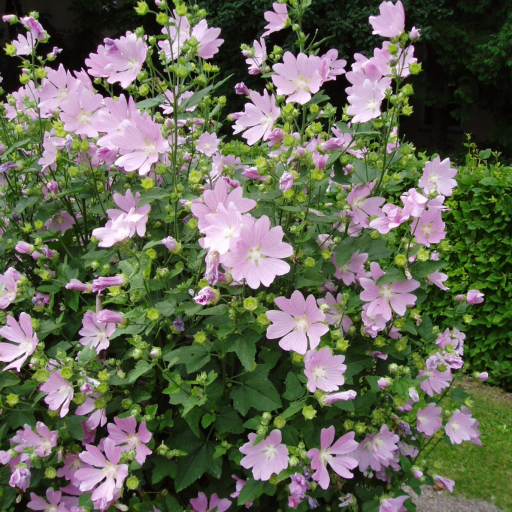
Plant Overview
Often called the Thuringian Mallow or Tree Mallow, this hardy perennial is the "sturdy cousin" of the delicate hibiscus. Standing tall and proud, it transforms from a modest base into a towering cloud of pink blossoms in a single season. Native to Central and Eastern Europe, it is beloved by cottage gardeners for its ability to fill space quickly with romantic, old-world charm.
🔍 How to Identify
- 🌸 The Blooms: Features five-petaled, heart-shaped flowers that range from soft baby pink to a deep lilac, often accented by darker magenta veins radiating from the center.
- 🍃 The Foliage: The leaves are a distinct grayish-green, soft to the touch due to a fine layer of downy hairs, and are typically divided into three to five shallow lobes.
- 📏 The Stature: It grows in a shrub-like fashion, often reaching heights of 5 or 6 feet, with multiple sturdy stems branching out from the base.
🏡 In Your Garden
- 🌱 Deep Roots: This plant develops a significant taproot early on. Because of this, it "hates" being moved once established; pick its permanent home carefully to avoid transplant shock.
- ☀️ The Lean Diet: While it loves sun, it actually prefers "lean" or poor soil. If the soil is too rich or over-fertilized, the plant grows too fast and becomes "floppy," requiring unsightly stakes to stay upright.
- 🦋 Pollinator Hub: It is a high-traffic area for bumblebees and butterflies, who are drawn to the nectar-rich centers that stay open throughout the mid-summer heat.
⚠️ Safety & Toxicity
- ✅ Status: Generally considered non-toxic and safe for home gardens.
- 🐾 Details: There are no known toxic effects for dogs, cats, or horses. However, like many members of the Mallow family, the plant can accumulate nitrates if grown in heavily chemically-fertilized soil, so it’s best treated as an ornamental rather than a forage plant.
✨ Fun Fact
The Malva thuringiaca is a member of the Malvaceae family, making it a botanical cousin to some of the world’s most famous plants, including okra, cotton, and the cocoa tree (the source of chocolate)!

Detailed Care Instructions
To grow Malva Thuringiaca plant, follow these steps:
- Choose a location: Malva Thuringiaca prefers full sun to partial shade. Select a spot in your garden that receives at least 6 hours of direct sunlight each day.
- Prepare the soil: Malva Thuringiaca prefers well-draining soil. Amend the soil with organic matter, such as compost, to improve drainage and fertility. Remove any weeds or grass from the planting area.
- Sow seeds: Malva Thuringiaca can be directly sown in the garden after the danger of frost has passed. You can also start seeds indoors 6-8 weeks before the last frost date and then transplant them outside once the plants are sturdy enough. Sow the seeds about ¼ inch deep and space them 12-18 inches apart.
- Water regularly: Keep the soil consistently moist but not waterlogged. Water the plants thoroughly whenever the top inch of soil feels dry to the touch.
- Mulch: Apply a layer of mulch around the base of the plants to help retain moisture and suppress weed growth. Avoid mulching too close to the stems to prevent rot.
- Provide support: Malva Thuringiaca plants may benefit from staking or trellising, especially if they grow tall and top-heavy. Install stakes or trellis early in the growing season to avoid damaging the roots later.
- Fertilize: Apply a balanced, slow-release fertilizer once or twice during the growing season to provide the plants with necessary nutrients. Follow the instructions on the fertilizer package for the recommended dosage.
- Prune as needed: Remove any dead or damaged leaves as well as spent flowers to encourage further blooming. Light pruning can also help maintain a more compact and tidy appearance.
- Monitor for pests and diseases: Keep an eye out for common pests like aphids, caterpillars, or snails, and take appropriate action if detected. Additionally, watch for signs of diseases such as powdery mildew, and treat as necessary.
- Enjoy the blooms: Malva Thuringiaca should start blooming in late spring or early summer and continue until fall. The large, colorful flowers are sure to add beauty to your garden.

Place in a bright room that is sun drenched almost all day. Or directly in a south-facing window.

To water this plant, you should let the top layer of soil become slightly dry before watering, as it does not enjoy constantly wet conditions. When it is time to water, you should pour water slowly and evenly over the soil until it begins to drain out of the bottom of the pot. Avoid getting water on the leaves, as this can encourage the growth of mold and disease. It is also important not to let the plant sit in stagnant water, so try to empty any excess water out of the saucer beneath the pot. Finally, be sure to adjust your watering schedule based on the temperature and humidity of your environment, as these factors can affect the plant's water needs.
The plant should be fertilized with a balanced fertilizer in the early stages of growth. Once established, switch to a fertilizer with a higher phosphorus content to promote flower production. Fertilize every two to three weeks during the growing season, following package instructions for application rate. Avoid over-fertilization, as this can lead to weak and spindly growth. Water thoroughly after fertilizing to prevent the fertilizer from burning the roots.
Malva Thuringiaca plant prefers well-drained soil that is rich in organic matter and has a slightly acidic to neutral pH. It is important to avoid soil that is compacted or waterlogged as the plant will not thrive in these conditions. A mixture of sandy loam, compost, and perlite can be used to create a suitable growing medium for the Malva Thuringiaca plant. Additionally, the plant can benefit from the addition of a slow-release fertilizer to provide a steady supply of nutrients over time. It is important to regularly monitor soil moisture levels and to water the plant as needed to prevent drought stress.
To propagate this plant, you can take stem cuttings during the summer months. Select healthy stems that are 4-5 inches long and have 2-3 sets of leaves. Remove the lower set of leaves and dip the cut end into rooting hormone powder. Plant the cutting in a pot of sterile, well-draining soil and keep it in a bright, warm location. Water the cutting regularly, ensuring the soil stays moist but not waterlogged. Once roots have formed and new growth appears, you can transplant the cutting into a larger pot or into your garden.








