Plant Overview
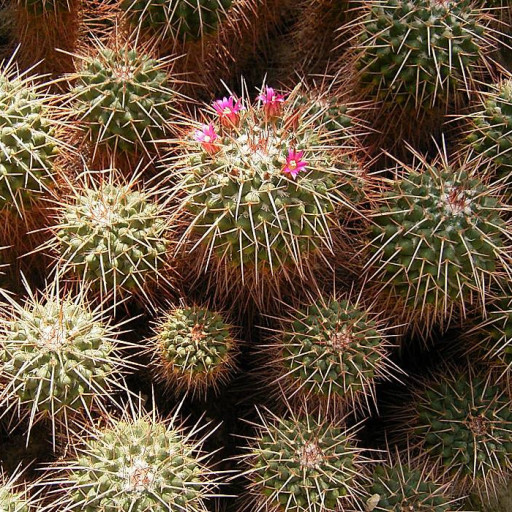
Known affectionately as the "Mother of Hundreds," this Mexican native is a master of multiplication. It forms dense, sprawling mounds of small, spine-covered globes that eventually resemble a miniature mountain range inside a pot. In its natural habitat, it clings to limestone hills, showcasing a rugged resilience that makes it a favorite for beginner succulent collectors.
🔍 How to Identify
- 🌵 The Mounds: Unlike solitary cacti, this species grows in tight clusters of bluish-green stems that can eventually form large, impressive domes.
- 📐 Angular Tubercles: The body is covered in prominent, four-sided bumps (tubercles) rather than ribs, giving the plant a distinct geometric texture.
- 🌸 Crown of Flowers: During the blooming season, it produces small, bell-shaped flowers in shades of deep pink or purplish-red that form a colorful "halo" around the top of each stem.
- ⚔️ Needle Work: It features a mix of short, chalky-white radial spines and longer, stouter central spines that often have dark, reddish-brown tips.
🏡 In Your Garden
- 🏜️ Space to Spread: Because it offsets so aggressively, this plant prefers shallow, wide "bowl" containers over deep pots. This allows the "hundreds" of baby pups to root properly and expand the colony.
- 💎 Mineral Grit: In the wild, it thrives in limestone-rich crevices. Adding a handful of limestone grit or extra perlite to your soil mix provides the sharp drainage its sensitive root system requires to prevent rot.
⚠️ Safety & Toxicity
- 🩹 Physical Hazard: Mammillaria compressa is not chemically toxic, but its spines are sharp and persistent. They can easily puncture skin or snag on loose clothing.
- 🐾 Pet & Child Safety: While non-poisonous if nibbled, the spines pose a significant risk for eye or mouth injuries. It is best displayed on a high shelf or in a protected rockery away from curious paws and hands.
✨ Fun Fact
The "Mother of Hundreds" gets its name because a single central plant can produce dozens of offsets in a single season, eventually creating a colony so dense that it's nearly impossible to see the soil beneath it!

Detailed Care Instructions
| Soil Ph | Acidic |
| Humidity | Dry |
| Lighting | Full Sun |
| Soil Type | Sandy, Well-Drained |
| Bloom Time | Summer |
| Difficulty | Medium |
| Plant Type | Cactus |
| Hibernation | Cold Period |
| Native Area | Mexico |
| Temperature | 17°C - 27°C |
| Sun Exposure | Full Sun |
| Hardiness Zones | 9-11 |
Growing Mammillaria compressa, also known as the Button Cactus or Pincushion Cactus, can be a rewarding experience. Here's a step-by-step guide on how to grow this plant:
- Light and location: Place your Mammillaria compressa in a location that receives bright, indirect sunlight for at least 6 hours a day. This cactus species can tolerate some direct sunlight, but be cautious as too much sun exposure can cause sunburn.
- Temperature and humidity: Mammillaria compressa thrives in temperatures ranging from 60°F to 85°F (15°C to 29°C). It prefers a dry and low humidity environment, so it's important to ensure adequate ventilation to prevent excessive moisture buildup.
- Potting and soil: Select a well-draining pot that has drainage holes. Use a cactus or succulent-specific potting mix or create your own by combining regular potting soil with coarse sand and perlite in a ratio of 2:1:1. The well-draining soil prevents the risk of root rot.
- Watering: Mammillaria compressa is a relatively drought-tolerant cactus. Allow the soil to dry out completely between waterings, then water thoroughly until it drains from the bottom of the pot. During the winter months, reduce watering and water sparingly.
- Fertilization: Fertilize your Mammillaria compressa once a month during the growing season (spring and summer) with a balanced cactus fertilizer diluted to half the recommended strength. Avoid feeding during winter dormancy.
- Pruning and grooming: Prune any dead or damaged parts of the plant using sterilized pruning tools. Be careful with the spines as they can be sharp and cause injury. Gently remove any dust or debris by brushing it off with a soft paintbrush.
- Propagation: Mammillaria compressa can be propagated by seeds, offsets, or stem cuttings. Seeds can be sown in well-draining soil, and offsets can be separated and replanted into their individual pots. Stem cuttings can be rooted in a well-draining soil mixture until they develop roots.
- Pest and disease control: Mammillaria compressa is generally resistant to common pests and diseases. However, occasionally, it may suffer from scale insects, mealybugs, or fungal infections. Monitor the plant regularly and treat any infestations promptly using appropriate organic or chemical methods.
Remember to handle the cactus with care as it has sharp spines that can cause injury. With proper care and attention to its needs, your Mammillaria compressa plant should thrive and grow well.

Place in a bright room that is sun drenched almost all day. Or directly in a south-facing window.

To water this plant, you should let the soil dry out completely in between waterings. Use a watering can or a spout to avoid getting water on the body of the plant. Water the soil directly and avoid getting water on the plant's leaves or stem, as this may cause the plant to rot. Ensure that excess water drains out of the pot to prevent waterlogging. Water the plant sparingly during winter months when the plant is in a dormant phase.
- Choose a fertilizer with balanced nutrients, such as a 10-10-10 formulation.
- Dilute the fertilizer with water according to the package instructions.
- Apply the fertilizer to the soil around the base of the plant, taking care not to get it on the leaves or spines.
- Water the plant immediately after fertilizing to help distribute the nutrients into the soil.
- Repeat fertilizing once every two to three months during the growing season, which typically runs from spring to fall.
- Reduce or eliminate fertilizing during the winter months when the plant is dormant and growth slows down.
Mammillaria compressa is a type of cactus plant that requires well-draining soil to thrive. The ideal soil should be a mixture of coarse sand, perlite or pumice, and a small amount of peat moss or well-rotted compost. The sand and perlite or pumice help with drainage and aeration, which are essential for preventing root rot and promoting healthy root growth. The addition of peat moss or compost helps to provide some organic matter and nutrients for the plant. The pH of the soil should range between 6.0 and 7.0. It's also important to avoid using heavy or compacted soil, as it can lead to waterlogged conditions and damage the plant's roots. In summary, Mammillaria compressa requires a well-draining, aerated, and nutrient-rich soil to grow and thrive.
To propagate this plant, you will need to first allow the offsets, or young plants that grow from the parent plant, to grow until they are approximately one-third the size of the adult plant. Then, carefully remove the offsets from the parent plant with a clean, sharp knife, making sure to sever the connecting tissue without damaging either plant. Allow the cut to dry for a few days before replanting the new plant in well-draining soil. Water the new plant frequently but sparingly until it establishes roots and begins to grow. It is important to use caution when propagating this plant, as it has delicate structures that can be easily damaged.
Common pests of the mother of hundreds include Scale insect, mealybugs, spider mites, thrips. Make a habit of checking your mother of hundreds frequently for pests so that any infestations can be caught and managed early.








