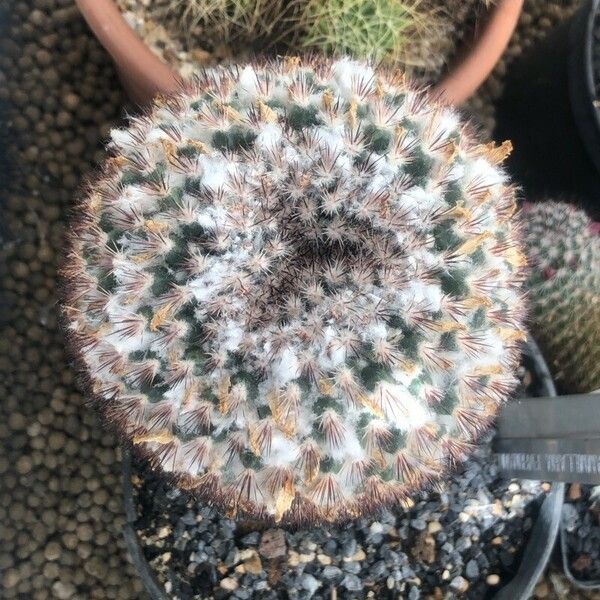
Plant Overview
Known as the Evermann’s Pincushion, this Mexican native is a true gem of the Baja California Sur deserts. It often grows as a solitary, frosted globe, but over time, it can form charming clusters that look like a collection of fuzzy white orbs nestled among rocks. In its natural habitat, it survives harsh coastal winds and intense sun, making it a rugged yet beautiful addition to any desert-themed collection.
🔍 How to Identify
- 🌵 Body Shape: A globose to short-cylindrical stem that stays relatively small, usually reaching about 3 to 5 inches in diameter.
- ❄️ The "Snow" Effect: The plant is densely wrapped in fine, white radial spines that give it a frosted appearance, while stouter, dark-tipped central spines provide a sharp contrast.
- 🌸 The Flower Crown: Like many Pincushion cacti, it produces tiny, bell-shaped flowers in shades of cream or pale pink that emerge in a perfect circle near the top, resembling a floral tiara.
🏡 In Your Garden
- 🏜️ Drainage is King: Hailing from rocky, arid slopes, this cactus has zero tolerance for "wet feet." It requires a very gritty mineral mix and a pot with large drainage holes to prevent the base from rotting.
- ☀️ Sun and Spines: It craves bright, direct light. Intense sun actually encourages the plant to grow thicker, whiter spines as a natural "sunscreen," whereas low light will cause it to stretch and lose its compact shape.
- 💤 The Winter Drought: To mimic its natural environment and encourage spring blooming, it needs a cool, bone-dry resting period during the winter months.
⚠️ Safety & Toxicity
- 🛡️ Non-Toxic Status: The Evermann’s Pincushion is generally considered non-toxic to cats, dogs, and humans.
- ⚔️ Physical Hazard: While it lacks the "jumping" barbs of some other cacti, the spines are very sharp and can easily puncture skin or snag on clothing and fur. It is best kept on a high shelf away from curious pets or children.
✨ Fun Fact
🎓 This species was named in honor of Barton Warren Evermann, a famous American ichthyologist (fish scientist) who led several scientific expeditions to the islands in the Gulf of California where this cactus was first documented!

Detailed Care Instructions








