Plant Overview
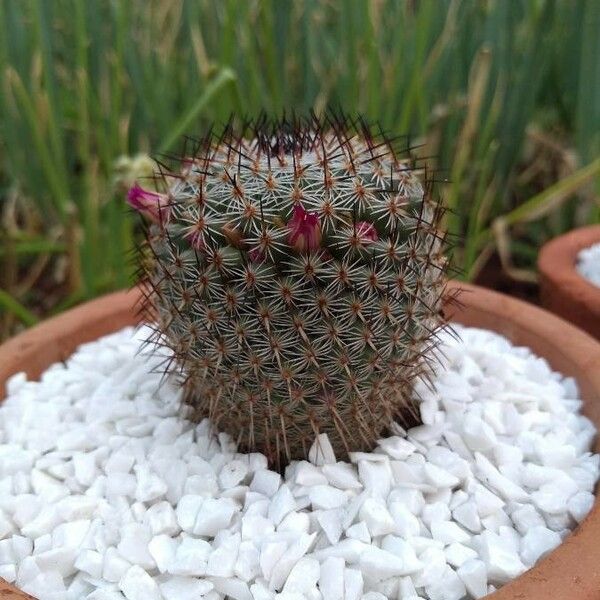
Named after the Aztec god of war and the sun, Mammillaria huitzilopochtli is a formidable beauty from the cliffs of Oaxaca and Puebla, Mexico. This cactus looks like a tiny, armored warrior, encased in a dense layer of dark spines that protect its soft, green body from the harsh sun. It is highly prized by collectors for its architectural symmetry and its habit of producing a perfect "crown" of flowers.
🔍 How to Identify
- 🌵 Body Shape: It begins as a solitary, globe-like sphere but slowly elongates into a cylindrical "club" shape as it matures.
- 🪡 Spine Armor: The plant is covered in a dense network of 25-30 white radial spines, topped with 2-4 dark, almost black, central spines that give it a "shadowed" appearance.
- 🌸 The Ring of Fire: In late winter or early spring, a ring of small, deep carmine or rose-red flowers emerges from the woolly "axils" near the top of the plant.
🏡 In Your Garden
- 🏜️ Limestone Lover: In the wild, it grows on steep limestone walls. In a pot, it demands a very gritty, mineral-based substrate; ordinary potting soil will hold too much moisture for its sensitive roots.
- ☀️ Sun Stress: To keep the dark spines looking intense and the body compact, it needs a very bright spot. If it doesn't get enough light, it will stretch (etiolate) and lose its warrior-like stature.
- 💤 Winter Rest: This cactus requires a completely dry resting period during the cold months. Watering it when it’s dormant is the fastest way to cause rot.
⚠️ Safety & Toxicity
- 🛡️ Non-Toxic: Good news for pet owners—this species is not chemically toxic to cats, dogs, or humans if accidentally nibbled.
- 🌵 Mechanical Injury: While not poisonous, its "armor" is very effective. The spines are stiff and sharp; always use thick gardening gloves or a "towel wrap" technique when repotting to avoid painful punctures.
✨ Fun Fact
- ⚔️ The War God: The name "Huitzilopochtli" is notoriously difficult to pronounce for beginners (weet-zeel-oh-POCHT-lee), but it carries heavy history. The Aztecs believed their war god guided them to find the eagle on the cactus, which is the symbol on the modern Mexican flag!

Detailed Care Instructions
| Lighting | Full Sun |
| Hardiness Zones | Min 10B |
To grow a Mammillaria Huitzilopochtli plant, follow these steps:
- Choose the right pot: Select a pot that has drainage holes at the bottom to allow excess water to escape. Make sure the pot is slightly larger than the plant's root system to allow for expansion.
- Soil mix: Use a well-draining soil mix specifically formulated for cacti and succulents. You can find pre-mixed ones at your local gardening store, or create your own by combining equal parts potting soil, perlite, and sand.
- Planting: Gently remove the plant from its nursery pot and place it into the new pot, ensuring the roots are spread out and not cramped. Fill the remaining space with the soil mix, gently packing it around the roots.
- Light: Place the Mammillaria Huitzilopochtli plant in a spot that receives bright sunlight for at least 6-8 hours a day. A south-facing window is usually ideal. If growing indoors, provide additional artificial grow lights if needed.
- Temperature: Mammillaria Huitzilopochtli plants prefer temperatures between 60-85°F (15-30°C) during the growing season. Protect them from frost and extreme temperatures.
- Watering: These plants have low water requirements. Water sparingly, allowing the soil to dry out almost completely between waterings. Too much water can lead to root rot. In winter, reduce watering frequency further, as the plant goes dormant.
- Fertilizer: Feed the plant with a balanced, water-soluble fertilizer specifically formulated for cacti and succulents, following the manufacturer's instructions. Apply during the growing season (spring/summer) and avoid fertilizing in winter.
- Propagation: Mammillaria Huitzilopochtli can be propagated through offsets or seeds. Offset propagation involves gently separating the baby plants that form around the base and replanting them in separate pots. Seeds can be sown in well-draining soil mix and kept warm and moist until they germinate.
- Maintenance: Regularly inspect your plant for signs of pests or diseases. Remove any dead or rotting parts promptly. You may need to repot the plant every few years to provide fresh soil and allow for growth.
Remember, each plant is unique, so closely monitor your Mammillaria Huitzilopochtli plant and adapt your care routine to its specific needs.

Place in a bright room that is sun drenched almost all day. Or directly in a south-facing window.

To properly water this cactus plant, you should first ensure that the succulent soil mix has fully dried out between watering sessions. When watering, pour water directly onto the soil around the base of the plant, being careful to avoid getting water on the leaves and stem. Allow the soil to absorb the water, and then drain off any excess water from the saucer or pot. It is important not to overwater this plant, as too much moisture can lead to root rot and other issues. In general, aim to water this cactus once every few weeks during the growing season, and less frequently during the winter months.
To fertilize the plant, mix a balanced fertilizer (10-10-10) with water according to the instructions on the package. Use a watering can to pour the solution at the base of the plant until the soil is moist. Repeat once a month during the growing season (spring and summer) and reduce to once every two months during the dormant season (fall and winter). Avoid fertilizing during periods of drought or extreme heat.
Mammillaria Huitzilopochtli plant requires well-draining soil with good aeration and moisture retention capabilities. The soil should be slightly acidic, with a pH level of around 6.0 to 7.0. Sandy loam soil mixed with coarse perlite or pumice is ideal, as it promotes good drainage and prevents waterlogging. Additionally, the soil should be rich in nutrients, including nitrogen, phosphorus, and potassium, to support optimal growth and development of the plant. A recommended soil mix for Mammillaria Huitzilopochtli consists of two parts of sand, one part of perlite, and one part of peat moss.
To propagate this plant, select a healthy and mature specimen from which to take cuttings. Using a clean and sharp pair of scissors or pruning shears, cut a small section of the stem just below a cluster of spines. Allow the cutting to dry and callus for a few days before planting it in a well-draining soil mixture. Water the cutting sparingly and keep it in a warm and brightly lit location, such as a sunny windowsill. Within a few weeks, new roots should begin to form and the cutting will start to grow. It is important to avoid over-watering the newly propagated plant as it can lead to root rot. Once the plant has established itself, it can be repotted into a larger container and cared for like a mature plant.
Common pests of the mammillaria huitzilopochtli include Scale insect, mealybugs, spider mites, thrips. Make a habit of checking your mammillaria huitzilopochtli frequently for pests so that any infestations can be caught and managed early.








