Plant Overview
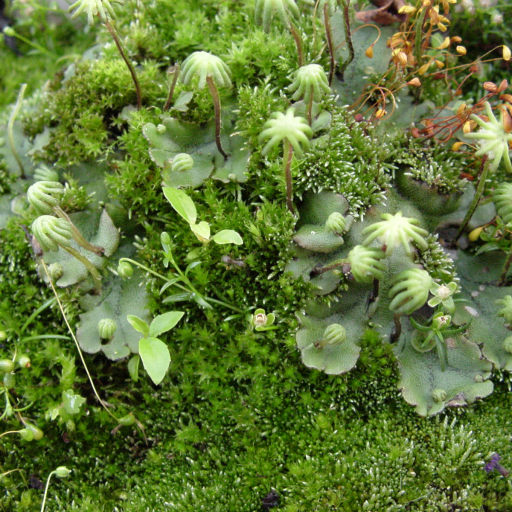
Known as the Common Liverwort or Umbrella Liverwort, Marchantia polymorpha is a living fossil that has survived for hundreds of millions of years. This resilient green carpet predates the dinosaurs and belongs to a primitive group of plants that lack a vascular system. Its unique appearance—featuring tiny "umbrellas" and "cups"—makes it look like a miniature alien landscape growing in the dampest corners of your garden.
🔍 How to Identify
- 🌿 The Thallus: Instead of leaves, it grows as a flat, leathery green ribbon (thallus) that spreads across the ground in a distinctive Y-branching pattern.
- 🥤 Gemma Cups: Look for tiny, circular cups on the surface of the green mat. These hold small green "eggs" (gemmae) which are splashed out by raindrops to start new plants.
- ⛱️ Umbrella Stalks: During reproduction, it sends up stalks that look like tiny palm trees. The male structures are flat-topped discs, while the female structures look like miniature umbrellas with drooping "fingers."
🏡 In Your Garden
- 💧 Moisture Indicator: This liverwort is nature’s way of telling you that your soil is consistently wet and likely compacted. It thrives where other plants might drown, making it a perfect indicator for drainage issues.
- 🧪 Nutrient Lover: It is often found in greenhouses or highly fertilized pots. It loves high levels of nitrogen and will quickly colonize bare, damp soil that has been recently treated with fertilizer.
- 🧱 Urban Colonizer: Unlike most plants, it can grow directly on damp brick, stones, or flowerpot rims, using tiny hair-like structures called rhizoids to anchor itself instead of deep roots.
⚠️ Safety & Toxicity
- ✅ Safe Status: Marchantia polymorpha is considered non-toxic to humans, dogs, and cats.
- 🚶 Slippery Hazard: While not poisonous, it grows in dense, waxy mats. If it establishes itself on garden paths or wooden decks, it can become extremely slippery and hazardous when wet.
✨ Fun Fact
The name "Liverwort" comes from the ancient "Doctrine of Signatures." Because the plant's lobed shape resembles a human liver, medieval herbalists believed it was a divine sign that the plant could be used to treat liver ailments!

Detailed Care Instructions

Place in a window with dappled sun or a spot in the middle of a room. Or directly in a window facing west or east.

To properly water this plant, it is important to consider its habitat and natural moisture requirements. Marchantia polymorpha typically grows in damp environments, such as along stream banks or in damp soil. As a result, it requires consistent access to water, but also must not be waterlogged or exposed to standing water for extended periods.
When watering Marchantia polymorpha, it is best to use a gentle stream of water to avoid dislodging the thallus (the leaf-like structures that form the plant's body) or creating waterlogged conditions. The soil should be kept consistently moist but not waterlogged, allowing water to penetrate the top layer of soil without pooling or forming puddles. Depending on the climate and humidity of the environment, watering may be required more frequently during dry periods or warm weather. It is important to monitor the moisture level of the soil and adjust watering as necessary to provide the Marchantia polymorpha with optimal growing conditions.
Without the need of fertilizer, these plants can thrive and bloom. If a plant requires fertilization, it will display indicators of nutrient insufficiency, such as yellowing leaves. It is safe to apply slightly diluted fertilizers in these circumstances. Over fertilizing, on the other hand, should be avoided because excess nutrients might cause plant mortality. Slow-release fertilizers are therefore advised for these plants.
You may use All Purpose Plant Food for your Common Liverwort
Marchantia Polymorpha plants thrive in a specific type of soil that contains a balanced mix of organic matter, minerals, and nutrients. The ideal soil for this plant should be well-draining, aerated, and able to retain moisture without becoming waterlogged. It should also have a pH level between 5.5 and 7.5.
To create the perfect soil for your Marchantia Polymorpha plant, start by mixing together equal parts of peat moss, perlite, and sand. This will help to improve drainage and aeration while also providing the plant with essential nutrients.
Next, add a small amount of compost to the mix to boost the soil's organic matter content. This will help to improve the soil's ability to retain moisture and provide a steady supply of nutrients to the plant.
Finally, adjust the pH level of the soil as needed using lime or sulfur. This will help to ensure that the soil is within the optimal range for your Marchantia Polymorpha plant to thrive.







