Plant Overview
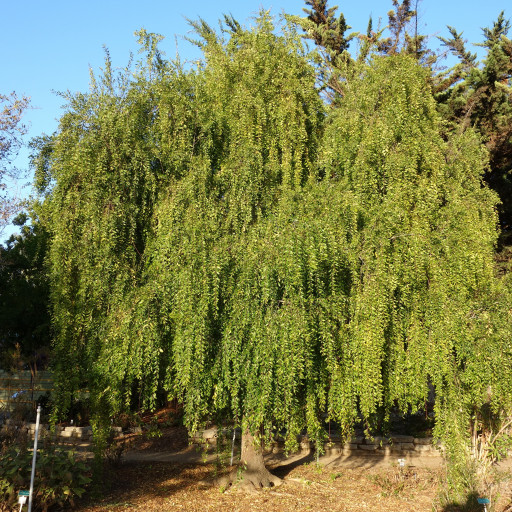
Known as the "Mayten Tree" or the "Evergreen Willow," this elegant South American native brings a sense of soft, cascading grace to the landscape. Unlike the traditional Weeping Willow, which loses its leaves in winter and can be quite messy, the Mayten stays vibrant and green year-round. It is a prized specimen for those who want a "romantic" garden aesthetic without the high-water demands of a swamp-dwelling tree.
🔍 How to Identify
- 🌿 Graceful Foliage: Small, lance-shaped leaves that are bright green with finely serrated edges. They have a leathery feel, which is a key giveaway that it is an evergreen and not a true willow.
- 💧 Weeping Habit: Long, pendulous branches that drape elegantly toward the ground, creating a soft, shimmering effect when the wind blows.
- 🍒 Hidden Fruit: Small, inconspicuous greenish flowers give way to tiny orange or red capsules that split open to reveal a single seed covered in a fleshy red coat.
🏡 In Your Garden
- 🏗️ Establishment & Roots: The Mayten develops a deep taproot, which makes it remarkably drought-tolerant once established. However, this means it absolutely hates being moved—choose its "forever home" carefully to avoid transplant shock.
- 🌬️ The "Willow" Alternative: It is an excellent choice for modern landscapes because it provides the weeping look without the invasive, water-seeking root systems that typically destroy pipes and sidewalks.
- ☀️ Sun & Drainage: It thrives in full sun and well-drained soil. While it is hardy, it can suffer in heavy clay or areas where water pools, as it prefers "dry feet" compared to its lookalikes.
⚠️ Safety & Toxicity
- ✅ General Status: Maytenus boaria is generally considered non-toxic to humans and common household pets.
- 🐾 Mild Caution: While not poisonous, the leathery leaves can be difficult to digest. If a curious dog or cat eats a large amount of the foliage, they may experience minor stomach upset or vomiting simply from the fiber content.
✨ Fun Fact
🐂 The species name boaria comes from the Latin word for "oxen" or "cattle." In its native Chile, the tree is a favorite snack for livestock; farmers often plant it specifically so that cattle can graze on the nutritious, evergreen leaves during the dry summer months when grass is scarce.

Detailed Care Instructions
To grow a Maytenus Boaria plant, also known as the Mayten Tree or Green Wave Tree, follow these steps:
- Choose a suitable location: Maytenus Boaria prefers full sun to partial shade. Select a location with well-draining soil and enough space for the plant to grow.
- Prepare the soil: The plant thrives in various soil types, but it prefers slightly acidic to neutral soil. Ensure good drainage by adding organic matter like compost or peat moss to the soil before planting.
- Plant the tree: Dig a hole that is slightly wider and deeper than the root ball of the plant. Place the root ball into the hole and backfill it with soil, gently firming it around the roots. Water the tree thoroughly after planting.
- Watering: Maytenus Boaria plants appreciate regular watering, especially during the first year of growth. However, they are drought-tolerant once established. Water deeply about once a week, allowing the soil to dry out between waterings.
- Mulching: Apply a layer of mulch around the base of the tree to help conserve moisture, regulate soil temperature, and suppress weed growth. Leave space around the trunk to prevent the mulch from touching the bark, which can cause rot.
- Pruning: Prune the plant regularly to maintain its desired shape and remove any dead or damaged branches. Pruning is best done in late winter or early spring before new growth begins.
- Fertilizing: Maytenus Boaria generally does not require much fertilization. However, applying a balanced slow-release fertilizer in spring can help promote healthy growth. Follow the instructions on the fertilizer packaging for proper application.
- Pests and diseases: This plant is relatively pest and disease resistant. However, keep an eye out for aphids, scale insects, or spider mites, and treat them with appropriate insecticides if necessary.
- Propagation: Maytenus Boaria can be propagated by seeds or cuttings. Collect seeds from mature fruits and plant them in a seed-starting mix. Cuttings can be taken from semi-hardwood shoots in late summer or early autumn.
- Winter protection (optional): In colder regions, providing some winter protection may be necessary. Mulch heavily around the base of the tree to insulate the roots, and consider wrapping the trunk and lower branches with burlap during the coldest months.
Remember to research and follow specific care instructions for your specific climate and growing conditions, as they may vary.

Place in a bright room that is sun drenched almost all day. Or directly in a south-facing window.

Maytenus Boaria plant requires regular watering in order to maintain its health and growth. The amount of water needed by the plant depends on various factors such as the season, climate, soil type, and age of the plant. However, as a general rule, it is recommended to water the plant deeply once a week during the growing season.
While watering, care should be taken so as not to get water on the leaves as it can lead to leaf drop or disease. A good way to water the plant is to use a soaker hose or a watering can, and to direct the water towards the base of the plant. This will allow the water to penetrate the soil and reach the roots, where it is needed the most.
In addition, it is important to ensure that the soil around the plant remains moist but not waterlogged. Overwatering can lead to root rot, which can be fatal to the plant. To avoid this, it is recommended to use well-draining soil that allows excess water to drain away.
During the winter months, when the plant is dormant, watering should be reduced to avoid waterlogging and ensure the plant's survival. It is best to allow the soil to dry out slightly between waterings.
In summary, Maytenus Boaria plant requires regular watering, deep watering once a week during the growing season, and moist but not waterlogged soil. Care should be taken to water at the base of the plant and avoid wetting the leaves.
- Start by choosing a balanced fertilizer that contains equal amounts of nitrogen, phosphorus, and potassium (NPK).
- Apply the fertilizer during the active growing season, which is typically in the spring and summer months.
- Use a slow-release fertilizer to avoid over-fertilizing and burning the plant's roots.
- Follow the manufacturer's instructions for dosage and application method.
- Apply the fertilizer evenly around the plant's base and water thoroughly afterward to help the nutrients penetrate the soil.
- Avoid fertilizing during the plant's dormant season, which is typically in fall and winter.
- Monitor the plant's growth and adjust the fertilization schedule as needed to maintain healthy growth.
Maytenus Boaria belongs to a family of evergreen trees and shrubs. The plant requires a well-draining soil medium that is slightly acidic with a pH between 5.5 to 6.5. The soil should be rich in organic matter and have good water retention capacity to ensure that the plant receives a steady supply of nutrients and water. The plant is adaptable to different soil types, including loams and sandy soil, as long as the soil drains well and doesn't retain too much moisture. The ideal soil mix would be a combination of peat or compost, sand, and perlite or vermiculite to ensure proper drainage. The plant also prefers full sun to partial shade.
Maytenus Boaria plant can be propagated through several methods such as seed propagation, cutting propagation, and layering propagation.
Seed propagation involves collecting seeds from mature fruits, soaking them in water for several hours, and then sowing them in a well-draining soil mix. The seeds should be covered with a thin layer of soil and kept moist until germination occurs.
Cutting propagation involves taking stem cuttings from the parent plant and rooting them in a well-draining soil mix. Cuttings should be taken from healthy branches with several nodes and leaves. The bottom end of the cutting should be dipped in rooting hormone before being planted in the soil. The cuttings should then be placed in a warm and humid environment until roots form.
Layering propagation involves bending a lower branch of the parent plant to the ground and covering it with soil. The branch should then be kept moist until roots form. Once the roots have formed, the branch can be cut from the parent plant and planted in a new location.
Regardless of the propagation method used, it is important to keep the new plants well-watered and in a shaded area for several weeks until they have become established.








