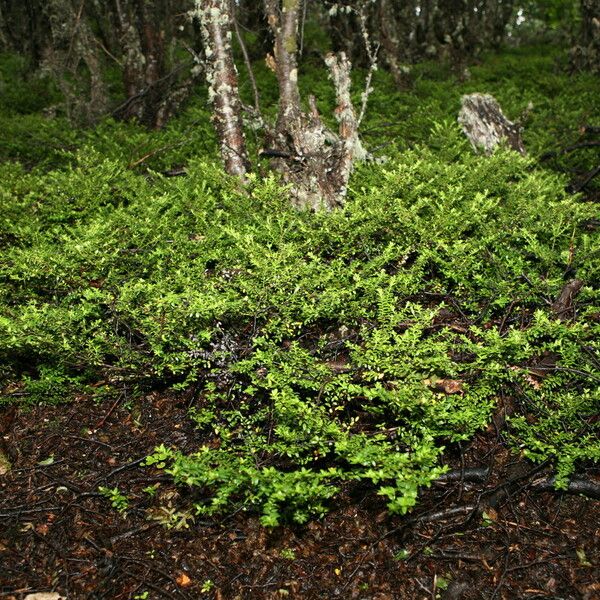
Plant Overview
Hailing from the cool, temperate rain forests of Chile and Argentina, Maytenus disticha is a sculptural evergreen often nicknamed the "Two-rowed Mayten" or "Chilean Boxwood." It is prized by enthusiasts for its architectural precision and its ability to stay lush and vibrant even when the rest of the garden has gone dormant. In its native habitat, it forms dense thickets that provide essential shelter for woodland birds.
🔍 How to Identify
- 🌿 The Leaf Arrangement: The most striking feature is its "distichous" growth—the small, leathery leaves are arranged perfectly in two opposite, flattened rows along the stems, resembling a green ladder or a fern frond.
- 🍃 Texture and Sheen: The leaves are tiny (usually less than an inch), oval-shaped, and possess a polished, waxy sheen that reflects light beautifully in shaded areas.
- 🌸 Subtle Blooms: It produces very small, inconspicuous greenish-yellow flowers in the leaf axils, which are easily missed but provide a delicate fragrance in late spring.
🏡 In Your Garden
- ✂️ A Topiary Favorite: Because of its slow growth and dense branching, this plant is a dream for "living sculptures." It responds exceptionally well to shearing and can be shaped into tight globes, cubes, or formal hedges.
- 🏔️ Andean Resilience: Unlike many delicate evergreens, the Two-rowed Mayten is quite hardy. It prefers well-draining, slightly acidic soil and can tolerate the dappled light of a woodland garden or the bright, indirect sun of a patio.
- 💧 Establishment Phase: While mature plants are relatively drought-tolerant, young specimens have a sensitive root system. Avoid frequent transplanting, as they prefer to settle in and expand their roots undisturbed.
⚠️ Safety & Toxicity
- 🟢 General Safety: Maytenus disticha is generally considered non-toxic to humans and common household pets like cats and dogs.
- 🧤 Skin Sensitivity: While not poisonous, the dense, twiggy nature of the plant can be "scratchy." It is always a good idea to wear gardening gloves when pruning or shaping the plant to avoid minor skin abrasions.
✨ Fun Fact
The species name disticha is derived from the Greek word distichos, which literally means "in two rows." This mathematical precision in its leaf placement is a biological strategy to ensure every leaf gets maximum exposure to sunlight without shading the ones below it!

Detailed Care Instructions
To successfully grow Maytenus disticha plant, also known as the "Christmasberry" or "Cape Mayten," follow these steps:
- Climate and location: The Maytenus disticha plant is native to South Africa and prefers a Mediterranean or subtropical climate. It needs full sun to partial shade, and temperatures around 60-75°F (15-24°C). Ensure the location is well-drained.
- Soil requirements: The plant thrives in well-draining soil with a pH between 6 and 7.5. It can tolerate various soil types but prefers rich, loamy soil. Adding organic matter to the soil before planting will help improve its fertility and drainage.
- Planting: Choose a healthy sapling from a reputable nursery or propagate from seeds or cuttings. Plant the sapling or insert the cutting about 1-2 inches (2.5-5 cm) deep in the soil, making sure it is firmly planted. Space multiple plants about 3-6 feet (1-2 meters) apart, as they can grow into large shrubs or small trees.
- Watering: Water the plant regularly, especially during its initial growth phase, to establish a strong root system. Avoid overwatering, as excessively soggy soil can lead to root rot. Once established, the plant is drought-tolerant and requires less watering.
- Mulching: Apply a layer of organic mulch around the base of the plant to help retain moisture, suppress weed growth, and provide insulation during temperature fluctuations.
- Pruning: Prune the plant when necessary to maintain a desired shape or remove dead or damaged branches. Early spring is the best time for pruning.
- Fertilization: Although Maytenus disticha is generally considered low-maintenance, it can benefit from occasional fertilization. Apply a balanced, slow-release fertilizer in spring and early summer, following the package instructions.
- Pest and disease control: The Christmasberry plant is relatively resistant to pests and diseases. However, keep an eye out for aphids, spider mites, or leaf spot diseases. If necessary, use appropriate organic or chemical treatments to control these issues.
- Propagation: Maytenus disticha can be propagated through seeds or cuttings. Collect seeds from mature berries and sow them in well-draining soil during spring or autumn. For cuttings, take a 6-8 inch (15-20 cm) stem cutting in spring or summer, remove the lower leaves, and plant it in moist, well-draining soil with the cut end dipped in rooting hormone.
Following these steps should help you successfully grow Maytenus disticha plants. Remember to research and follow specific care guidelines based on your climate and local conditions, as slight variations may be necessary.
Maytenus Disticha is a type of plant that requires a specific method for watering to ensure its health. One way to water it is to check the soil moisture level regularly and only water when the top inch of soil is dry. Avoid over-watering, as this can lead to root rot or fungal diseases.
When watering, be sure to water the base of the plant and avoid getting water on the foliage. Use a watering can or a hose with a gentle spray nozzle to water slowly and evenly. Water in the morning or early evening to reduce evaporation and prevent the foliage from burning in the sun.
During the growing season, fertilize the plant with a balanced fertilizer every two to three weeks to promote healthy growth. However, avoid fertilizing during the dormant season.
Overall, it is important to pay attention to the plant's needs and adjust watering based on the environment and weather. With proper care, Maytenus Disticha can thrive and beautify any space.
To fertilize this plant, use a balanced fertilizer with equal amounts of nitrogen, phosphorous, and potassium every four to six weeks during the growing season. It is important not to over-fertilize, as this can lead to burning of the roots and foliage. Spread the fertilizer evenly around the base of the plant, taking care not to get it on the leaves or stems. Water the plant thoroughly after fertilizing to ensure the nutrients are absorbed.
Maytenus Disticha plant prefers well-drained soil with a slightly acidic pH level. The ideal soil mix for this plant is a mixture of loam and sand, which allows for good drainage and aeration. It is also recommended to mix in some organic matter, such as compost or peat moss, to help retain moisture and provide nutrients. Avoid using heavy clay soils or soils with high salinity levels, as these can be detrimental to plant growth and health. It is important to maintain the proper soil moisture levels for Maytenus Disticha, as both dry and waterlogged soil can lead to plant stress and damage.
Maytenus Disticha can be propagated through various methods such as taking stem cuttings and layering. For stem cuttings, select healthy and mature stems with at least two or three nodes. Remove the lower leaves and dip the cut end in rooting hormone. Plant the cutting in a moist soil mix and keep it in a warm and humid environment with indirect light. After a few weeks, roots should start to develop and the cutting can be transplanted into a larger container or garden bed.
For layering, find a low branch that can be bent down to soil level. Create a small wound on the branch where it touches the ground and cover it with soil. Secure the branch to the soil with stakes or pins and keep the soil moist. After a few months, roots should develop at the wound site and the new plant can be separated from the parent plant and transplanted into a new location.
It is important to note that Maytenus Disticha may take some time to establish and grow, so patience and consistent care is important in the propagation process.








