Plant Overview
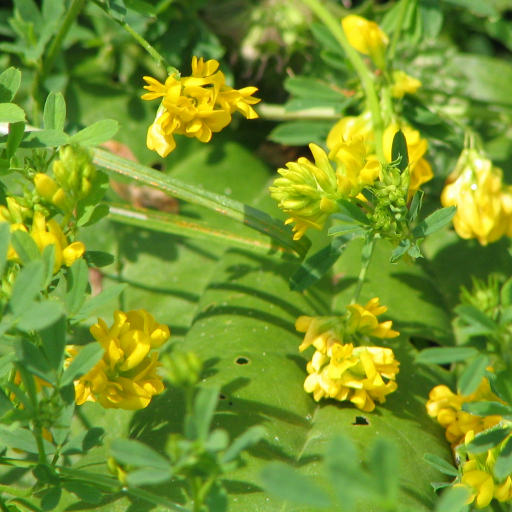
Often called the Yellow Lucerne or Sickle Medick, this hardy perennial is the rugged, golden-hued cousin of the famous Alfalfa. While Alfalfa is known as the "queen of forages," Medicago falcata is the wild survivor, frequently found decorating dry grasslands and roadsides with its clusters of sunny blooms. It has traveled from the steppes of Eurasia to become a worldwide symbol of persistence and soil restoration.
🔍 How to Identify
- 🌼 Golden Clusters: It produces small, pea-like flowers that grow in dense, elongated racemes. Unlike its purple-flowered relatives, these are always a bright, vibrant yellow.
- ☘️ Trifoliate Leaves: The foliage consists of three narrow leaflets (clover-like) with tiny teeth near the tips. The central leaflet usually sits on a slightly longer stalk than the side ones.
- 🌙 Sickle Pods: Its most defining feature is the seed pod, which curves into a distinct sickle or crescent shape rather than the tight spirals seen in other Medick species.
🏡 In Your Garden
- 🏗️ Soil Architect: This plant is a powerful nitrogen-fixer. It works with specialized soil bacteria to pull nitrogen from the air and "fertilize" the ground, making it a perfect companion for rehabilitating poor soil.
- 🌵 Drought Warrior: It possesses an incredibly deep taproot that allows it to thrive in sandy, stony, or alkaline soils where other plants would wither. Because of this root, it hates being transplanted—once it's in the ground, it's there to stay!
- 🦋 Pollinator Magnet: It is a high-value source of nectar for bumblebees and butterflies. If you are looking to support local biodiversity, this "wild" look is much more beneficial than a manicured lawn.
⚠️ Safety & Toxicity
- ✅ Generally Safe: Yellow Lucerne is non-toxic to humans and common household pets like dogs and cats.
- 🐄 Livestock Note: While it is used as high-quality forage, it can occasionally cause "bloat" in ruminants (like cows or sheep) if they overconsume it when it is very lush. For the average gardener, however, it poses no risk.
✨ Fun Fact
[🧬] The Rainbow Hybrid: When the yellow-flowered Medicago falcata meets the purple-flowered Medicago sativa in the wild, they create a hybrid called "Sand Lucerne." This crossbreed can produce flowers in stunning, "impossible" colors, including muddy greens, deep blues, and variegated bronze!

Detailed Care Instructions
To grow Medicago falcata, commonly known as yellow-flowered alfalfa, you can follow these steps:
- Seed selection: Choose high-quality seeds from a reputable supplier. Ensure they are free from any diseases or impurities.
- Soil preparation: The plant prefers well-draining soil with a pH range of 6-7. The area should also receive full sun. Prepare the soil by removing any weeds, rocks, or debris and loosening it with a tiller or garden fork.
- Sowing seeds: Directly sow the seeds into the prepared soil after the last frost date in your area. Follow the recommended planting depth, usually around 1/4 inch deep. Sow the seeds evenly, spaced about 6 inches apart. For larger plantings, you can also use mechanical seed drills.
- Watering and maintenance: Water the freshly sown seeds gently to avoid displacing them. Keep the soil consistently moist until the seeds germinate, usually within 7-10 days. Once established, water the plants deeply but infrequently, allowing the top few inches of soil to dry out before watering again. Avoid overwatering, as it can lead to root rot.
- Fertilization: Medicago falcata is a nitrogen-fixing plant, so it usually does not require additional fertilization. However, a low-phosphorus, high-potassium fertilizer can be applied in small amounts if necessary.
- Weed control: Regularly remove any weeds that compete with the young plants for nutrients and water. Mulching around the base of the plants can also help suppress weed growth.
- Harvesting and pruning: Medicago falcata can be harvested when it reaches the desired height, usually around 8-12 inches tall. Use sharp shears or a scythe to cut the plants just above the base. They will regrow and produce multiple harvests in a growing season. Pruning can also help maintain a compact and bushy shape.
- Pest and disease management: Medicago falcata is generally resistant to pests and diseases, but occasional aphid or mite infestations may occur. Monitor the plants regularly and use organic pest control methods if necessary.
By following these steps, you should be able to successfully grow Medicago falcata plants and enjoy their beautiful yellow blossoms.

Place in a bright room that is sun drenched almost all day. Or directly in a south-facing window.

Medicago Falcata is a type of plant that requires regular watering to maintain its health and vigor. However, it is important to water the plant in a controlled manner to avoid over or under-watering.
One effective way to water Medicago Falcata is to use a watering can or hose to slowly pour water around the base of the plant, ensuring that the water penetrates deeply into the soil. It is important to avoid watering the leaves or flowers, as this can promote the growth of fungi or other diseases.
Another approach is to water the plant deeply once a week, allowing the soil to dry out slightly between watering sessions. This helps prevent water logging, which can cause damage to the roots.
Additionally, it is important to ensure that the plant is well-drained and not sitting in standing water. This can be achieved by placing the plant in a well-draining container or raised bed, or by adding drainage holes to the soil.
Overall, Medicago Falcata requires consistent, moderate watering to thrive and produce healthy, vibrant foliage and blooms.
- Choose a balanced fertilizer with equal amounts of nitrogen, phosphorus, and potassium.
- Apply the fertilizer in early spring, just as new growth begins to emerge.
- Use a slow-release fertilizer to avoid burning the plant.
- Follow the manufacturer's instructions for the recommended amount of fertilizer based on the size of the plant.
- Water the plant thoroughly after applying the fertilizer to help it absorb the nutrients.
- Repeat fertilizing every 4-6 weeks during the growing season.
- Avoid fertilizing during periods of drought or high temperatures.
When it comes to planting Medicago Falcata, it is important to select the appropriate soil mix in order to ensure proper growth and development. The ideal soil type for Medicago Falcata is well-draining and moderately fertile, with a pH level anywhere between 6.0 and 7.5.
In terms of composition, the soil should consist of a mix of organic matter, such as compost or peat moss, and inorganic materials, such as sand or gravel. This will promote good drainage while also ensuring that the plant has access to necessary nutrients.
When planting Medicago Falcata, it is always a good idea to prepare the soil beforehand by loosening it and removing any rocks, roots, or debris that may hinder root growth. Adding a layer of organic matter to the soil can also improve its overall fertility and texture.
Overall, the key to successful growth and blooming of Medicago Falcata is to provide it with a soil mix that is well-draining, moderately fertile, and has the appropriate pH level.
Medicago Falcata is a plant species that belongs to the Medicago genus and the Fabaceae family. This plant species can be propagated in several ways which include seed propagation, vegetative propagation, and cuttings.
Seed propagation is the most common way of propagating Medicago Falcata. This can be done by collecting the seeds from the plant and planting them in a pot or in the garden. The seeds should be planted in well-draining soil and kept moist until they germinate, which usually takes about two weeks.
Vegetative propagation can be done by dividing the plant. The plant can be gently dug up and separated into smaller plants. These smaller plants can then be replanted in separate pots or in the garden. This method is best done in the spring or fall when the plant is not actively growing.
Cuttings can also be used to propagate Medicago Falcata. This is done by taking a cutting from the plant and planting it in soil. The cutting should be taken from a healthy, vigorous part of the plant. The cutting should be dipped in rooting hormone before being planted in soil. It should be kept moist until it develops roots.
Overall, propagating Medicago Falcata can be done in several ways, including seed propagation, vegetative propagation, and cuttings. Each method has its advantages and disadvantages, but all are effective at producing new plants.








