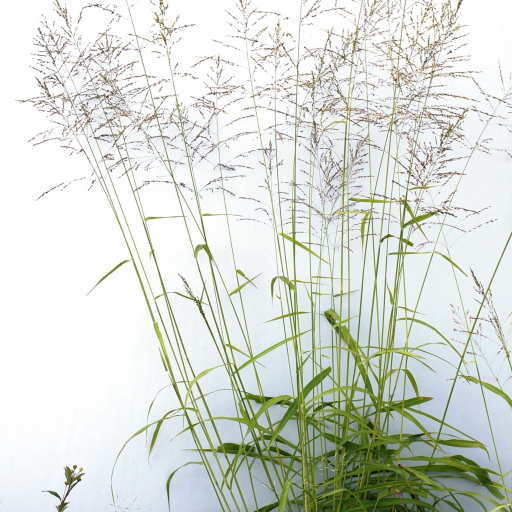
Plant Overview
Often called the "King of Forage," Megathyrsus maximus, or Guinea Grass, is a towering emerald giant that commands attention in tropical landscapes. While it originated in the African savannas, its resilient nature has allowed it to travel the world, often growing taller than a grown human in just a single season. Whether it’s swaying in a sun-drenched pasture or standing guard at the edge of a garden, its massive, fountain-like silhouette is unmistakable.
🔍 How to Identify
- 🌾 Growth Habit: It forms dense, upright clumps (tussocks) that can reach impressive heights of 10 feet (3 meters), making it one of the largest grasses you'll encounter.
- 🌿 The Leaves: Look for long, sword-shaped blades that are vibrant green with a distinct, pale white midrib running down the center.
- ☁️ Seed Panicles: The flowering top is a large, open, and airy spray—resembling a green, branched firework—that turns a light golden-brown as it matures.
- 🦵 Hairy "Knees": If you examine the nodes (the joints on the stem), you will often find a characteristic ring of fine, soft hairs.
🏡 In Your Garden
- 🚜 The Ultimate Competitor: This grass has an incredibly aggressive, fibrous root system. While this makes it exceptionally drought-tolerant, it also means it will "hog" water and nutrients, easily outcompeting smaller ornamental plants nearby.
- ✂️ Maintenance Nuance: Because it grows so fast, it requires regular "haircuts" if kept in a managed landscape. If left to go to seed, it can quickly spread to areas where it wasn't invited, so deadheading the plumes is key for control.
⚠️ Safety & Toxicity
- 🐾 Livestock Assessment: Generally safe and highly nutritious for cattle and horses. However, in rare cases of extreme drought followed by sudden rain, it can accumulate nitrates which may be harmful to grazing animals.
- 🧤 Physical Irritant: The leaf edges can be surprisingly sharp, and the fine hairs on the stems may cause "grass itch" or mild skin redness for those with sensitive skin. It’s best to wear gloves when pruning.
✨ Fun Fact
The genus name Megathyrsus literally translates to "large wand" in Greek, referring to the giant, wand-like flowering stalks that dance in the wind. For decades, it was classified as Panicum, but it was eventually given its own "Mega" genus because of its unique genetic blueprint!

Detailed Care Instructions
To grow Megathyrsus Maximus, also known as Guinea grass, follow these steps:
- Select a suitable location: Guinea grass thrives in full to partial sun and prefers well-draining soil. Choose an area where the plant will have enough space to grow, as it can reach a height of 8-10 feet (2.4-3 meters).
- Prepare the soil: Clear the area of any weeds or grass. Loosen the soil and remove any rocks or debris. Incorporate organic matter into the soil, such as compost or well-rotted manure, to improve fertility.
- Planting method: Guinea grass can be propagated from seeds, stem cuttings, or through rhizome division. Seeds can be sown directly into the prepared soil, spaced 1-2 feet (30-60 cm) apart. Ensure the seeds are covered with a thin layer of soil. Stem cuttings can be planted about 4-6 inches (10-15 cm) deep, with at least two leaf nodes buried beneath the soil. Rhizome divisions can be obtained from mature plants and should be planted at a depth of 1-2 inches (2.5-5 cm).
- Watering: Keep the soil moist but not waterlogged during the initial growth phase. Once established, Guinea grass is drought-tolerant and requires minimal watering. Water deeply but infrequently, allowing the soil to dry out slightly between waterings.
- Fertilization: Apply a balanced fertilizer, such as a 10-10-10 or 15-15-15 formulation, before planting or during the growing season to promote healthy growth. Follow the instructions on the fertilizer packaging for application rates.
- Weed control: Regularly remove any weeds that compete with the Guinea grass for nutrients, water, and sunlight. Mulching around the plants can help suppress weed growth.
- Pruning: Guinea grass can grow tall and become leggy. Prune it periodically to maintain a desirable height and encourage a bushier growth. Cut back the older stems to stimulate new growth.
- Pest and disease control: Guinea grass is relatively resistant to pests and diseases. However, monitor the plants for any signs of infestation or infection. If necessary, treat with appropriate insecticides or fungicides following the manufacturer's instructions.
- Harvesting: You can harvest Guinea grass when it reaches a height of about 4-5 feet (1.2-1.5 meters). Cut the grass about 6 inches (15 cm) above the ground using sharp gardening tools. The cuttings can be used as animal forage or for other purposes, such as mulching.
By following these steps, you can successfully grow Megathyrsus Maximus and enjoy its benefits as a forage plant or ornamental grass.
Megathyrsus maximus is a type of grass that requires regular watering to maintain its health. To water this plant, it is important to ensure that the soil remains consistently moist but not water-logged. This can be achieved by watering deeply but infrequently, rather than watering lightly and frequently. It is also important to water early in the morning or in the evening when the temperature is cooler to avoid evaporation and to allow the water to soak into the soil. Avoid overhead watering as this can lead to fungal diseases. Instead, use drip irrigation or a soaker hose to water the plants at the base. It is also important to avoid water splashing on the foliage as this can lead to sunburn or water damage. Regular monitoring of the soil moisture level is important to ensure that the plant receives enough water without being over-watered.
To fertilize this plant, begin by selecting a balanced fertilizer with an equal ratio of nitrogen, phosphorus, and potassium. Mix the fertilizer with water according to the instructions on the package, and apply it to the soil around the base of the plant. As a general guideline, fertilize this plant once every three to four weeks during the growing season, and reduce or stop fertilization during the winter months. Avoid over-fertilizing as this can cause damage to the plant and harm the surrounding soil.
Megathyrsus Maximus plant prefers a specific type of soil that is rich in nutrients and well-draining. The soil should be loamy and slightly acidic with a pH range of 6.0 - 6.8. The plant grows well in soils that are fertile and have good organic matter content. It needs well-draining soil that retains moisture but does not become waterlogged. Sandy soils can be improved by adding organic matter before planting to increase water retention and fertility. The plant also prefers soils that are slightly alkaline, but not too much because excessive alkalinity can lead to salt buildup and nutrient deficiencies. Heavy clay soils may require amending with sand and organic matter before planting to ensure proper drainage. Overall, it is essential to choose a soil that can provide the necessary water, nutrients, and drainage for the Megathyrsus Maximus plant to thrive.
To propagate this plant, cut a stem about 4 inches long from a mature, healthy plant. Ensure that the cutting has at least two nodes and make a clean cut just below one of the nodes. Remove the leaves from the bottom third of the stem. Dip the cut end of the stem in a rooting hormone, if desired, to encourage root growth. Plant the cutting in a well-draining potting mix and keep the soil moist but not waterlogged. Place the pot in a warm, bright location but out of direct sunlight. After a few weeks, the cutting should develop roots and new growth. Once the plant has established a good root system, it can be transplanted into a larger pot or into the ground.








