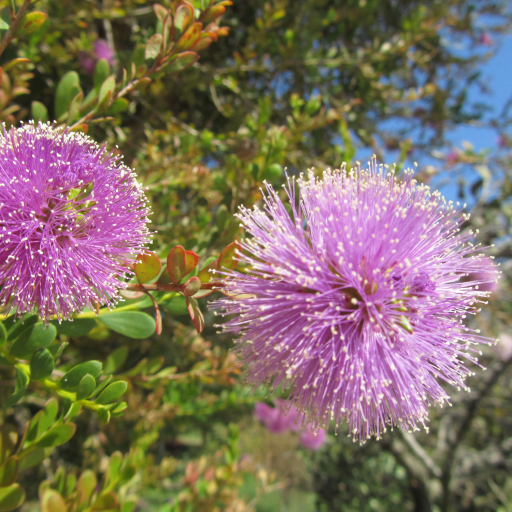
Plant Overview
Often called the Showy Honey-myrtle, this Australian native looks like it stepped right out of a Dr. Seuss illustration. With its fluffy, lavender "pom-pom" flowers and rugged, peeling bark, it provides a whimsical yet architectural touch to any landscape. It is a favorite among coastal gardeners for its ability to thrive where salty winds and sandy soils make other plants wither.
🔍 How to Identify
- 🌸 The "Pom-Pom" Blooms: The most striking feature is the globular flower heads, which emerge as vibrant mauve or purple and slowly fade to white, often tipped with gold-colored pollen.
- 🍂 Papery Bark: The trunk and branches are wrapped in thick, white, spongy bark that peels away in artistic, paper-like layers, providing year-round visual interest.
- 🍃 Foliage Shape: It features small, oval-to-oblong gray-green leaves that are smooth to the touch and release a mild, herbal scent when crushed.
🏡 In Your Garden
- 🌊 Coastal Warrior: This plant is incredibly salt-tolerant and wind-resistant. It is the perfect choice for a "living screen" or windbreak in seaside gardens where salt spray is a constant challenge.
- ✂️ Shape and Structure: While it can grow into a large, spreading shrub, it is easily trained into a small decorative tree. To prevent it from becoming "leggy," give it a light pruning immediately after the flowering season ends.
- ☀️ Sun and Drainage: It thrives in full sun and requires well-draining soil. It is notoriously tough once established, capable of surviving extended dry spells thanks to its Western Australian heritage.
⚠️ Safety & Toxicity
- 🐾 Pet Safety: The Showy Honey-myrtle is generally considered non-toxic to dogs, cats, and horses, making it a "worry-free" addition to family backyards.
- 🧴 Essential Oils: Like many members of the Melaleuca genus (such as Tea Tree), the leaves contain aromatic oils. While not poisonous, the crushed foliage may cause very mild skin irritation in humans with extreme sensitivities.
✨ Fun Fact
- 🏝️ The species name nesophila is derived from the Greek words nesos (island) and philos (loving). This "Island Lover" nickname refers to its original discovery on the islands of the Recherche Archipelago off the southern coast of Australia.

Detailed Care Instructions
To grow Melaleuca Nesophila, also known as pink melaleuca or showy honey-myrtle, follow these steps:
- Climate requirements: Melaleuca Nesophila is native to Western Australia and grows well in Mediterranean or subtropical climates. It prefers full sun but can tolerate some shade.
- Soil requirements: The plant thrives in well-draining soils, such as sandy or loamy soil types. Ensure the soil pH is slightly acidic to neutral (around 6.5-7.5).
- Watering: While Melaleuca Nesophila is drought-tolerant once established, it requires regular watering during the first few months until it develops a strong root system. After that, water deeply but infrequently, allowing the soil to dry out between waterings.
- Planting: Choose a suitable location with enough space for the plant to grow and spread. Dig a hole larger than the root ball, mix some organic matter like compost or well-rotted manure into the soil, and place the plant in the hole. Backfill with soil and firm gently around the base. Leave a slight depression around the plant to collect water.
- Mulching: Apply a layer of organic mulch around the plant to help retain moisture, suppress weeds, and regulate soil temperature.
- Fertilizing: Melaleuca Nesophila doesn't require a lot of fertilization. However, you can apply a slow-release fertilizer in spring to promote healthy growth.
- Pruning: Trim any dead or diseased branches, and shape the plant as desired after the flowering season is over. This will help maintain a tidy and compact shape.
- Pests and diseases: Melaleuca Nesophila is generally pest and disease resistant, but keep an eye out for aphids, mealybugs, or scale insects. If issues arise, use an organic insecticidal soap or consult a local garden center for appropriate treatments.
- Propagation: Melaleuca Nesophila can be propagated from semi-hardwood cuttings taken during spring or early summer. Remove the lower leaves, dip the cut ends in rooting hormone, and plant them in a well-draining potting mix. Keep the cuttings moist and provide some shade until they develop roots.
Remember, gardening practices may vary based on your specific location, so it's beneficial to refer to local gardening resources for additional guidance or advice.

Place in a bright room that is sun drenched almost all day. Or directly in a south-facing window.

Sure, here's how to water Melaleuca Nesophila without using its common names:
Melaleuca Nesophila is a plant that requires adequate watering to grow and thrive. To water it properly, you should first assess the soil moisture level by inserting your finger about an inch deep into the soil. If it feels dry, it's time to water. However, avoid overwatering as this plant is sensitive to water-logged conditions.
Use a watering can or hose with a gentle flow to water the plant. Direct the water flow towards the base of the plant and avoid getting water on the leaves or flowers. Water early in the morning or late in the day to prevent evaporation and ensure that the plant has ample time to absorb the moisture before any potential hot weather.
The frequency of watering will depend on factors such as the plant's size, the temperature, and the humidity levels in the environment. In general, Melaleuca Nesophila requires watering once or twice a week, but always pay attention to the soil's moisture level before watering. Additionally, if your Melaleuca Nesophila is planted in a pot, ensure that there are drainage holes and that excess water can escape to prevent waterlogging.
To fertilize this plant, apply a slow-release fertilizer evenly around the soil in the springtime. Add an additional layer of compost or organic matter on top of the soil to provide additional nutrients. Water thoroughly after fertilizing. Avoid over-fertilization, as this plant prefers nutrient-poor soil.
Melaleuca Nesophila prefers a well-draining soil that is slightly acidic with a pH ranging from 5.5 to 6.5. A soil mixture that is high in organic matter and contains coarse sand or perlite is ideal. It is important to avoid heavy clay soils or soils that retain too much moisture, as this can lead to root rot and other problems. Adding compost or other organic matter to the soil can help improve its structure and provide the plant with nutrients. Regular watering is necessary, but it is important not to overwater and to allow the soil to dry out slightly between waterings.
To propagate this plant, you will need to gather its seeds from the mature fruit capsules. It is important to make sure the fruit capsules are completely dry before removing the seeds. Once you have the seeds, soak them in water for 24 hours to soften the seed coat.
After soaking, plant the seeds in small pots filled with a well-draining potting mix. Cover the seeds lightly with soil and water them well. Place the pots in a warm, bright area but avoid direct sunlight as it may dry out the soil.
Keep the soil moist but not waterlogged and within 2 to 4 weeks, you should see the seedlings emerging from the soil. It is ideal to keep the seedlings indoors until they have grown to a decent size as this will provide them with the best growing environment.
Once the seedlings have grown to a decent size, they can be transplanted into a larger pot or directly into the ground. When transplanting, make sure to provide enough space between plants to encourage healthy growth. With proper care, Melaleuca Nesophila will grow into a beautiful and healthy plant.








