Plant Overview
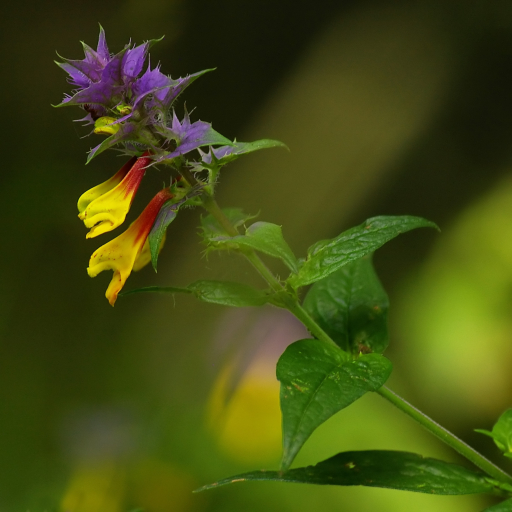
Known as the "Night and Day" plant in many parts of Europe, Melampyrum nemorosum is a striking woodland beauty that looks like it was painted by a whimsical artist. This herbaceous annual is famous for its dramatic color contrast, featuring golden-yellow blossoms tucked beneath vivid violet-purple leaves. It is a semi-parasitic plant, meaning it lives a bit of a double life—it creates its own energy through the sun but also "borrows" nutrients from the roots of neighboring grasses and trees.
🔍 How to Identify
- 💜 Vibrant Bracts: The most eye-catching feature is the cluster of bright violet or deep purple bracts (modified leaves) at the top of the stem, which protect the flowers.
- 💛 Tubular Flowers: Beneath the purple crown, the actual flowers are tubular, bright yellow, and slightly curved, appearing in pairs.
- 🍃 Opposite Foliage: Lower down the stem, the leaves are simple, lance-shaped, and green, arranged in opposite pairs.
🏡 In Your Garden
- 🌿 The Hemiparasitic Habit: Unlike most garden plants, Wood Cow-wheat is difficult to grow in pots because it needs a "host" plant. In the wild, it attaches its roots to nearby grasses or trees to siphon off extra water and minerals.
- 🐜 Ant Ambassadors: This plant has a special relationship with ants. Its seeds have a small, fatty attachment (an elaiosome) that ants love; they carry the seeds back to their nests, effectively "planting" the next generation of flowers across the forest floor.
⚠️ Safety & Toxicity
- 🟢 Low Risk: Melampyrum nemorosum is generally considered non-toxic to touch and is not known for causing skin irritation.
- 🐾 Ingestion Warning: Like many members of the Orobanchaceae family, it contains small amounts of aucubin (an iridoid glycoside). While not typically lethal, it should not be ingested by humans, pets, or livestock, as it can cause digestive discomfort or more serious issues if consumed in large quantities.
✨ Fun Fact
In Sweden, this plant is famously called "Natt och dag" (Night and Day). The name was popularized by the famous botanist Carl Linnaeus, who was struck by the "light" of the yellow flowers appearing against the "darkness" of the purple bracts.

Detailed Care Instructions

Place in a bright room that is sun drenched almost all day. Or directly in a south-facing window.

Some plants require more regular watering than others, which should be done every few days. It's critical to maintain the soil moist all of the time. The water requirements of the same plant placed in pots with varying sizes will differ. Because the water in the smaller pot evaporates faster than the water in the larger pot, it will require more watering. Regardless of pot size, the surface should constantly be maintained moist.








