Plant Overview
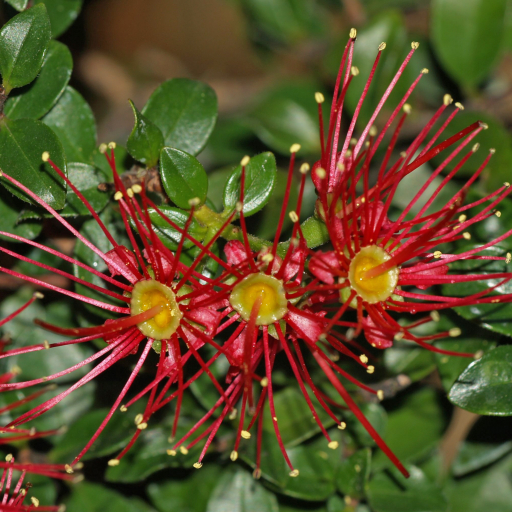
Known as the Crimson Rata, this New Zealand native is a show-stopping climber that paints coastal cliffs and forest canopies in shades of deep scarlet. It is often called the "Carmine Rata" for its brilliant, almost glowing pom-pom flowers that appear in late spring. Unlike its massive tree relatives, this species often starts its life as a delicate vine, hugging the textures of trees and rocks with its "fingertip" roots to reach for the sunlight.
🔍 How to Identify
- 🔴 The Blooms: Features dense clusters of bright crimson flowers that look like tiny, vibrant fireworks. These are actually made up of hundreds of long, colorful stamens rather than traditional petals.
- 🍃 Foliage: The leaves are small, rounded, and leathery. They are a deep, glossy green on top and slightly paler underneath, arranged in neat pairs along the stem.
- 🪵 Growth Form: It is a "metamorphic" grower; it begins as a slender, woody vine using aerial roots to climb, but can also be trained into a rounded, bushy shrub in garden settings.
🏡 In Your Garden
- 🧗 The Climbing Logic: Because it uses aerial roots to cling, it is a "non-twining" climber. It loves a textured surface like a stone wall or a rough-barked tree. It prefers to have its roots kept cool and shaded while its foliage basks in the sun.
- 💧 Soil & Drainage: Coming from rocky coastal environments, it hates "wet feet." It requires extremely well-draining soil. If planted in heavy clay, it is prone to root rot, so consider mounding the soil or using a raised bed.
⚠️ Safety & Toxicity
- ✅ Safe Status: Metrosideros carminea is generally considered non-toxic to humans, cats, and dogs.
- 🧤 Pruning Note: While not poisonous, the wood is very dense and "iron-like." Always use sharp, clean bypass pruners to avoid crushing the stems, which can lead to dieback or fungal infections in the plant.
✨ Fun Fact
The genus name Metrosideros comes from the Greek words metra (heartwood) and sideron (iron), referring to the incredibly hard, heavy timber produced by these plants. In New Zealand, the nectar from these crimson flowers is a primary "energy drink" for native nectar-hunting birds like the Tui!

Detailed Care Instructions

Place in a bright room that is sun drenched almost all day. Or directly in a south-facing window.

Water-loving plants flourish in wet or sloppy soil and near ponds. The extensive root system enables these plants to absorb plenty of water. The surface of the soil should be kept moist at all times. Place your pot in a container filled with water to guarantee that plants get enough water. If the ground becomes dry, it is recommended that you water it well. Plants in smaller pots will need to be watered more frequently. Water the soil in which the plant is standing thoroughly using a watering can.








