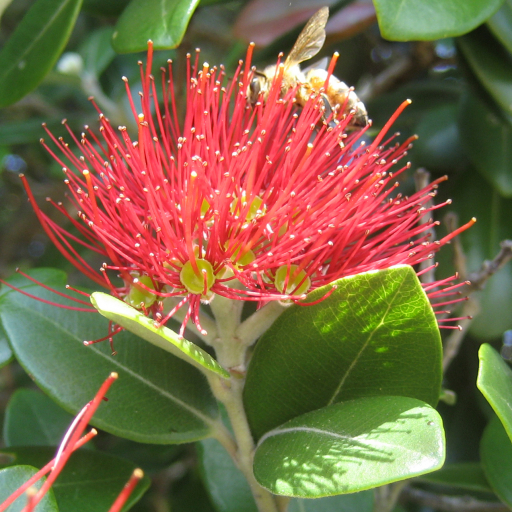
Plant Overview
The Kermadec Pōhutukawa, often called the "Kermadec Christmas Tree," is a resilient island dweller native to the volcanic Kermadec Islands. While it looks remarkably like the famous New Zealand mainland Pōhutukawa, this variety is slightly more compact and has the magical ability to bloom sporadically throughout the entire year. It is a legendary survivor, known for clinging to rugged coastal cliffs and laughing in the face of salty sea gales.
🔍 How to Identify
- 🍃 The Foliage: Look for small, oval, and leathery leaves. Unlike many other trees, these leaves have a distinctively blunt or rounded tip and a subtle silvery-white "felt" on the undersides to protect against salt.
- 🔴 The "Bottlebrush" Blooms: The flowers are vibrant crimson tufts composed of hundreds of long, needle-like stamens. They look like tiny explosions of red fireworks scattered across the deep green canopy.
- 🌳 Aerial Roots: As the tree matures, it may grow "beards" of reddish-brown roots hanging from the branches. In the wild, these roots reach for the ground to provide extra stability against heavy winds.
🏡 In Your Garden
- 🌊 Salt & Wind Specialist: This is a superstar for seaside gardens. It is exceptionally tolerant of salt spray and coastal winds, making it an ideal choice for a privacy screen or windbreak where other plants might wither.
- 🪴 Pot Friendly: Because it grows more slowly and remains smaller than its mainland cousins, it is a popular choice for large ornamental containers. It thrives in well-draining soil but hates "wet feet," so ensure your pot has plenty of drainage holes.
⚠️ Safety & Toxicity
- 🐾 Pet Safety: Good news for pet owners! The Kermadec Pōhutukawa is generally considered non-toxic to cats, dogs, and horses.
- 🐝 Bee Magnet: While the plant isn't toxic, its nectar-rich flowers are irresistible to bees. If you or your children have bee stings allergies, be mindful of where you plant it, as it will be very "busy" during blooming season.
✨ Fun Fact
The Kermadec Pōhutukawa is a true pioneer; in its native habitat, it is often one of the first plants to colonize bare lava flows. It can grow out of solid volcanic rock, using its specialized root system to find moisture in the tiny cracks of cooled magma!

Detailed Care Instructions

Place in a bright room that is sun drenched almost all day. Or directly in a south-facing window.

Watering requirements for this plant depend on several factors such as the plant's size, soil type, humidity, and environmental conditions. However, generally, it requires regular watering, especially during the growing season. The soil should always be moist but not waterlogged. To achieve this, you can water the plant deeply once or twice a week, depending on the dryness of the soil. You should also ensure that the water penetrates the soil to reach the plant's roots. Avoid overwatering the plant as this can cause root rot and other fungal diseases.
During the colder months or when the plant is not actively growing, you can reduce the frequency of watering to avoid waterlogging. It's best to water the plant in the morning or evening to reduce water loss through evaporation.
Additionally, you may want to consider the humidity levels around the plant since this plant thrives in a humid environment. You can increase humidity levels around the plant by misting it with water or placing a tray of water near it. Finally, ensure that the plant has good drainage to prevent waterlogging and root rot.
Metrosideros Kermadecensis plant requires a well-draining soil mix that is rich in nutrients. It prefers a slightly acidic to neutral soil pH and should be planted in a location that receives ample sunlight. The soil mix should contain a blend of organic materials such as peat moss, compost, and well-aged manure, mixed with coarse sand or perlite to improve drainage. It is important to avoid using heavy clay soils or soils that have poor drainage, as this can cause root rot and damage to the plant. A good rule of thumb is to create a soil mix that is loose and crumbly, allowing water to penetrate quickly and easily. Additionally, the soil should be regularly fertilized with a balanced fertilizer to promote healthy growth and flowering.








