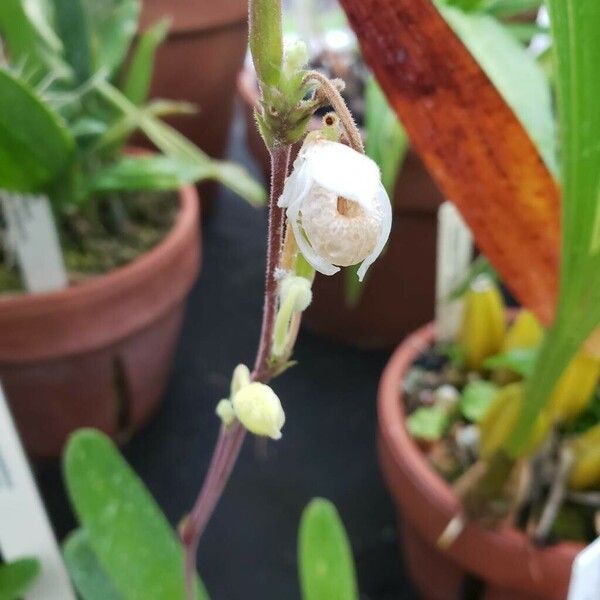
Plant Overview
Known as one of the rarest orchids on Earth, Mexipedium xerophyticum was discovered as recently as 1990 in a single, remote location in Oaxaca, Mexico. Its name translates to "dry-loving Mexican foot," a nod to its unique ability to thrive on sun-drenched limestone cliffs where other orchids would quickly wither. This "living fossil" is a crown jewel for specialized collectors due to its fascinating evolutionary history and delicate beauty.
🔍 How to Identify
- 🍃 Stiff Foliage: It features compact, fan-shaped clusters of leathery, silvery-green leaves that feel much tougher and more "succulent-like" than typical tropical orchids.
- 🍓 Creeping Stolons: Unlike most slipper orchids that grow in tight clumps, this species sends out long, horizontal runners (stolons) to establish new plantlets, similar to how a strawberry plant spreads.
- 🌸 Miniature Blooms: The flowers are tiny and elegant, featuring a white or pale pink "slipper" pouch and delicate petals that open in succession on a tall, wiry stem.
🏡 In Your Garden
- 🪨 Mineral Roots: In nature, it is a lithophyte, meaning it grows on rocks. To keep it happy at home, use a gritty, well-draining mix rich in limestone or calcium-based gravel rather than traditional soggy orchid bark.
- ☀️ Bright & Airy: This plant craves significantly more light than its Paphiopedilum cousins. It enjoys bright, filtered sunlight and requires excellent air circulation to mimic the breezes of its native Mexican cliffs.
⚠️ Safety & Toxicity
- ✅ Non-Toxic: Mexipedium xerophyticum is generally considered non-toxic to humans, cats, and dogs.
- 💎 Fragile Rarity: While safe for pets, the plant is extremely slow-growing and physically fragile. The primary "danger" is to the plant itself; its runners can be easily snapped, and it is highly sensitive to chemical fertilizers.
✨ Fun Fact
Shortly after its discovery in 1990, a devastating wildfire swept through its only known habitat, nearly wiping the entire species off the face of the planet. It was saved from extinction only because a few botanical gardens had already begun laboratory propagation from the original discovery.

Detailed Care Instructions
To grow Mexipedium xerophyticum, also known as the Dwarf Mexican Slipper Orchid, follow these steps:
- Light: Place the plant in bright but indirect sunlight. Avoid placing it in direct sunlight as it can lead to leaf burn.
- Temperature: Keep the plant in a temperature range of 65-75°F (18-24°C) during the day and about 60-65°F (15-18°C) at night. It can tolerate slightly cooler temperatures but avoid extreme hot or cold conditions.
- Humidity: Maintain moderate humidity levels around the plant. Use a humidity tray, group plants together, or mist the leaves regularly to increase humidity.
- Watering: Water the plant thoroughly and allow excess water to drain away. It is important to maintain moist but not wet soil. Avoid letting the plant sit in standing water.
- Fertilization: Use a balanced orchid fertilizer diluted to half-strength during the growing season. Apply it every two to four weeks. During the rest period, reduce or stop fertilization.
- Potting: Mexipedium xerophyticum prefers well-draining growing media. Consider using a mixture of orchid bark, sphagnum moss, and perlite. Repot the plant every 1-2 years to replace the aging growing media.
- Rest period: In winter, reduce watering and allow the plant to have a short rest period. This helps stimulate healthy blooming in the following season.
- Blooming: Mexipedium xerophyticum produces small, colorful flowers that emerge from the base of the plant. Blooming typically occurs in late winter or early spring. Be patient, as it can take a few years for the plant to mature and bloom.
Keep in mind that Mexipedium xerophyticum is a rare and endangered species, so it may be difficult to acquire. Additionally, it requires specific conditions and care, making it more suitable for experienced orchid enthusiasts.
Mexipedium xerophyticum is a rare and unique species of orchid native to Mexico. Here are detailed instructions on how to properly water this plant without using its common names:
- Understand the watering needs: Mexipedium xerophyticum is a xerophytic plant, which means it thrives in arid environments with low water availability. Mimicking its natural habitat is crucial for its successful cultivation.
- Consider the potting medium: This orchid requires a well-draining potting medium that allows excess water to flow out easily. Use a mixture of porous materials such as bark, sphagnum moss, or perlite.
- Determine the watering frequency: Watering should be infrequent and careful. Mexipedium xerophyticum prefers to dry out between watering sessions, as excessive moisture can lead to root rot and other issues. Typically, watering once every 1-2 weeks is sufficient.
- Monitor the moisture levels: Before watering, it is essential to check the moisture level of the potting medium. Insert your finger into the soil about an inch deep; if it feels dry, it is time to water the plant. If it is still slightly damp, wait a few more days before watering.
- Use the right technique: When watering, avoid drenching the entire potting medium. Instead, focus on thoroughly moistening the root zone. Pour water gently and slowly at the base of the plant, allowing it to trickle down and soak the roots.
- Drain excess water: After watering, ensure that excess water drains completely from the pot. Empty the saucer or cache pot to prevent the plant from sitting in stagnant water, which can lead to root rot.
- Observe the plant's response: Mexipedium xerophyticum will exhibit signs of thirst, such as slightly wrinkled pseudobulbs or leaves, when it requires water. Regularly monitor the plant for any changes, and adjust your watering regimen accordingly.
Remember, each plant's water requirements may vary based on its size, growth stage, and environmental conditions. It is crucial to observe and adapt your watering routine to meet the specific needs of your Mexipedium xerophyticum.
- Choose a well-draining potting mix: Mexipedium xerophyticum requires a potting mix that provides good drainage. Use a mix of peat moss, perlite, and orchid bark to ensure proper aeration and prevent waterlogged roots.
- Water sparingly: This plant is adapted to dry environments, so avoid overwatering. Only water when the top inch of the potting mix feels dry to the touch. Ensure that excess water drains out completely, and never let the plant sit in standing water.
- Provide indirect light: Mexipedium xerophyticum prefers bright, indirect light. Place it near a window that receives filtered sunlight, or use artificial grow lights if natural light is limited. Avoid direct sunlight, as it can scorch the leaves.
- Maintain optimal temperature and humidity: This plant thrives in warm temperatures, ideally between 70-80°F (21-27°C) during the day and slightly cooler at night. Keep it away from drafty areas and sudden temperature fluctuations. Mexipedium xerophyticum appreciates moderate humidity levels, around 50-60%. You can increase humidity by placing a tray of water near the plant or using a humidifier.
- Fertilize sparingly: Mexipedium xerophyticum does not require frequent fertilization. Use a balanced orchid fertilizer with a ratio of around 20-20-20. Dilute the fertilizer to half the recommended strength and apply it every two to three months during the growing season (spring and summer). Avoid fertilizing during the winter months when the plant is dormant.
- Prune with care: Trim any dead or yellowing leaves using sterilized pruning shears. This helps maintain the health and appearance of the plant.
- Provide airflow: Adequate air circulation is important to prevent fungal and bacterial diseases. Avoid overcrowding the plant with other species and ensure that there is some space around it for good airflow.
Remember, Mexipedium xerophyticum is a rare and threatened orchid species, so it is important to handle it with caution and provide it with the specific care it needs.
Mexipedium xerophyticum, a rare and unique orchid species, thrives when grown in a well-draining soil mixture that replicates its natural habitat. This exceptional plant requires a specific type of soil that allows adequate airflow and moisture management.
The ideal soil composition for Mexipedium xerophyticum consists of a blend that is optimized for its arid environment. It should have a relatively high level of porosity to prevent excessive water retention, which can lead to root rot. This makes a well-draining soil crucial for the plant's overall health and development.
Furthermore, Mexipedium xerophyticum appreciates a soil mixture with a good balance of organic matter and inorganic components. The organic matter provides essential nutrients while also contributing to the soil's moisture-retention capacity. Inorganic components, such as perlite or pumice, aid in enhancing drainage and preventing compaction.
To achieve these desired soil conditions, a recommended potting mix would include a combination of materials such as coarse sand, perlite, coconut coir, and a small portion of organic matter such as composted bark. The coarse sand and perlite increase drainage capacity, preventing the soil from becoming waterlogged, while the coconut coir helps retain moisture without causing the soil to become compact. The organic matter contributes to the plant's nutritional needs without adversely affecting drainage.
It is worth noting that Mexipedium xerophyticum is not particularly tolerant of alkaline or salty soils. Therefore, it is advisable to avoid using soil mixes that contain high levels of alkaline ingredients or using water sources with high mineral content, as these can negatively impact the plant's health.
In conclusion, providing Mexipedium xerophyticum with a soil mixture that replicates its natural habitat is vital for its overall growth and survival. A well-draining potting mix comprising of coarse sand, perlite, coconut coir, and a small portion of organic matter, while avoiding alkaline or salty soils, can help ensure the best conditions for this rare orchid species to flourish.
Mexipedium xerophyticum can be propagated through a process known as division. Here is a detailed explanation of how to propagate this plant without using its common names:
- Start by preparing the necessary tools and materials, including a clean, sharp knife or pruning shears, a clean pot or container, a well-draining potting mix specifically formulated for orchids, and a rooting hormone (optional).
- Carefully remove the Mexipedium xerophyticum plant from its current pot, being cautious not to damage the roots or the main stem.
- Gently shake off excess soil from the roots and examine the plant for natural divisions or clusters of healthy growth.
- Locate areas on the plant where natural separations occur, potentially indicating the presence of separate plants or individual growth sections. These divisions may appear as clusters of growth with distinct root systems.
- Select a division that appears strong and healthy, ensuring it has its own set of roots. Separate this division from the main plant with a sharp knife or pruning shears. Take care to make clean cuts to avoid unnecessary damage.
- Once the division has been separated, immediately place it into a clean pot or container filled with the well-draining potting mix. Ensure that the roots are adequately covered but avoid burying the main stem too deeply.
- Firmly press the potting mix around the roots, providing stability for the newly propagated plant.
- Water the newly potted division thoroughly, ensuring that the potting mix is evenly moist but not waterlogged. Allow any excess water to drain out of the pot.
- If desired, apply a rooting hormone to the cut section of the new division. This can enhance root growth and promote faster establishment, although it is not essential for propagation.
- Place the potted division in a warm and humid environment with indirect light. Avoid direct sunlight, as it can cause leaf burn.
- Monitor the moisture levels of the potting mix, ensuring it remains evenly moist. However, be cautious not to overwater, as this may lead to root rot.
- Provide the propagated Mexipedium xerophyticum plant with regular care, including proper watering, suitable light conditions, and appropriate fertilization according to the specific needs of the plant species.
With proper care and maintenance, the propagated division should eventually develop into a fully established and independent plant, retaining the unique characteristics and attributes of Mexipedium xerophyticum.








