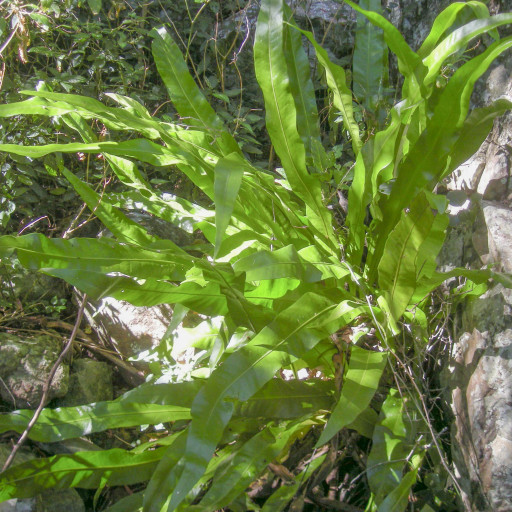
Plant Overview
Commonly called the Green Flame Fern or the Climbing Bird’s Nest Fern, this resilient tropical beauty looks like a cluster of vibrant, leathery ribbons reaching for the sun. Originating from the warm regions of Africa, Asia, and Polynesia, it is a favorite for indoor gardeners who want the lush look of a fern without the "diva" attitude of more delicate species. In various cultures, its sturdy green fronds are seen as symbols of endurance and hidden strength.
🔍 How to Identify
- 🌿 The Fronds: Unlike the "feathery" look of many ferns, these leaves are thick, strap-shaped, and feel slightly like parchment or light leather.
- ✨ The Texture: The surface of the leaf is often glossy and a bright, limey-green, sometimes featuring wavy or ruffled edges depending on the specific variety.
- 🟤 The Sori: On the underside of mature leaves, you will find "punctatum" (dots)—tiny, reddish-brown spore cases scattered irregularly like a map of the stars.
🏡 In Your Garden
- ☁️ Humidity is Key: While it is tougher than a Boston Fern, it still dreams of the tropics. If your leaf tips start to look "toasted" or crispy, it’s a sign that your indoor air is too dry and it needs a pebble tray or a humidifier.
- 🪵 Natural Climber: In the wild, this plant is an epiphyte, meaning it grows on tree trunks or rocks. Because of this, it hates sitting in heavy, soggy mud. Use a chunky orchid bark or a very airy potting mix to keep its roots "breathing."
⚠️ Safety & Toxicity
- 🐾 Pet Friendly: Good news for pet parents! The Microsorum punctatum is generally considered non-toxic to cats and dogs.
- 👶 Child Safe: It is safe for households with children, though the spores on the back of the leaves can sometimes be messy or cause very minor skin tickles if handled roughly by curious hands.
✨ Fun Fact
The name Microsorum is derived from the Greek words mikros (small) and sorus (heap), which refers to the tiny, pinpoint-sized clusters of spores that give the plant its "punctured" or dotted appearance!

Detailed Care Instructions
To grow a Microsorum Punctatum plant, also known as the "Dragon's Tail Fern," follow these steps:
- Choosing a suitable planting location: Dragon's Tail Ferns thrive in medium to low light conditions. Select an area that receives indirect sunlight or provide some shade if the light is too bright. They also prefer a humid environment, so placing them near a bathroom or kitchen with higher humidity levels can be beneficial.
- Preparing the pot: Select a well-draining pot with drainage holes at the bottom to avoid root rot. Use a potting mix that retains moisture but also allows excess water to drain. A mixture of peat moss, perlite, and potting soil is recommended.
- Transplanting: Gently remove the Dragon's Tail Fern from its nursery pot and loosen the roots. Place it in the new pot and add the potting mix around the roots, ensuring it is firmly in place but not too compacted. Leave some space between the rim of the pot and the soil surface for watering.
- Watering: The soil should be kept consistently moist, but avoid overwatering as it can lead to root rot. Water the plant thoroughly when the top inch of soil feels dry. Use room temperature water to prevent shock to the plant.
- Humidity: Microsorum Punctatum plants appreciate higher humidity levels. You can increase humidity by misting the foliage regularly with water or placing a tray of water near the plant to allow evaporation.
- Fertilizing: Apply a balanced houseplant fertilizer at half strength every two to four weeks during the growing season (spring to summer). Reduce or eliminate fertilization during the dormant period (fall to winter).
- Pruning: Trim yellow or brown fronds close to their base. By removing dead or dying fronds, you can promote new growth.
- Propagation: If you want to expand your Dragon's Tail Fern collection, you can propagate the plant through division. Carefully divide the plant into smaller sections, ensuring each section has healthy roots and fronds. Plant the divisions in separate pots following the same steps mentioned earlier.
By following these instructions, you can successfully grow a Microsorum Punctatum plant and enjoy its lush, tropical foliage.

Place in a window with dappled sun or a spot in the middle of a room. Or directly in a window facing west or east.

To water this plant, you should first check the soil's moisture level by sticking your finger about an inch into the soil. If the soil feels dry, it is time to water. Use lukewarm water to avoid shocking the roots, and water until the excess water starts to drain out of the bottom of the pot. Allow the soil to dry out somewhat before watering again. Be careful not to overwater, as this can lead to root rot and other issues. It is also important to ensure that the plant is not sitting in standing water, as this can lead to waterlogging.
To fertilize this plant, use a balanced, water-soluble fertilizer that is low in nitrogen. Dilute the fertilizer to half strength and apply it every two weeks during the growing season. Avoid fertilizing during the winter months when the plant is dormant. Always water the plant thoroughly before and after fertilizing to prevent root burn.
The ideal soil for Microsorum punctatum plant should be well-draining and rich in nutrients. It is recommended to use a soil mixture that is composed of equal parts of peat moss, perlite, and vermiculite. This soil mixture provides good aeration for the roots and retains moisture in the soil, which is important for the growth of this plant. Additionally, it is important to avoid using heavy clay or sandy soils, as they can either suffocate the roots or allow the soil to dry out too quickly, respectively. It is also recommended to fertilize the plant regularly using a balanced fertilizer to provide additional nutrients for healthy growth.
Microsorum Punctatum is a popular plant species that can be propagated through several methods. The first step is to identify a healthy parent plant. Once identified, select a few healthy fronds that have a few leaves growing on them. Using a sharp, sterilized pair of scissors or pruning shears, cut off the fronds from the plant, making sure to avoid damaging the parent plant.
Next, prepare the potting soil mixture using a combination of peat moss, perlite, and vermiculite. Fill a small container or terrarium with the potting soil mixture and water it thoroughly. Then, make a hole in the soil using a pencil or your finger where you will be placing the cuttings.
Once the potting soil has been prepared, dip the cut end of the frond in rooting hormone powder or rooting solution. This will help the cuttings to develop roots. Place the cuttings in the prepared soil and gently press the soil around the base of the cutting to ensure that it is in contact with the soil.
Cover the container with a clear plastic bag or a plastic lid and place it in a well-lit area, but away from direct sunlight. Keep the soil moist by misting it regularly with water but avoid overwatering as this will cause the plant to rot. After a few weeks, the cuttings should start to develop roots.
Once the roots have grown to about 2-3 inches in length, you can transplant the new plant to a larger pot or give it away to a friend. Propagating Microsorum Punctatum is an easy and rewarding process that allows you to create new plants from an established parent plant.
Common pests of the fishtail fern include Scale insect, mealybugs, spider mites, aphids. Make a habit of checking your fishtail fern frequently for pests so that any infestations can be caught and managed early.








