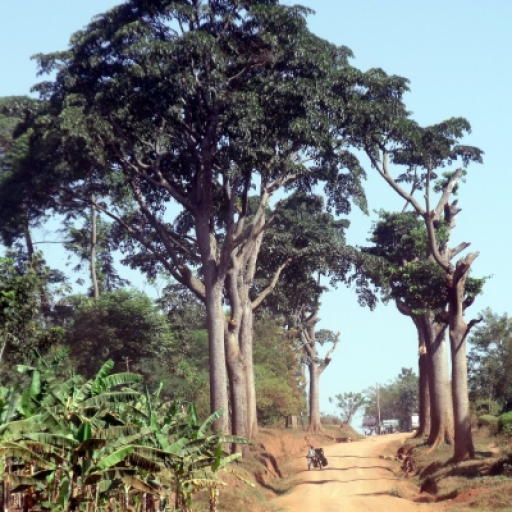
Plant Overview
Often called the "Iroko" or "African Teak," Milicia excelsa is a legendary giant of the African rainforest. In many West African cultures, this tree is revered as the "King of the Forest," whispered to be inhabited by powerful spirits that protect the land. Beyond its mythical status, it is an ecological powerhouse, reaching staggering heights and providing a vital canopy for diverse wildlife.
🔍 How to Identify
- 🌳 The Trunk: A massive, straight pillar that can reach up to 50 meters. The bark is thick, grey-to-dark brown, and often features rectangular scales or fissures.
- 🍃 The Leaves: Large, broadly elliptic leaves with a slightly asymmetrical base. They have a rugged, sandpaper-like texture on top and prominent, yellowish veins underneath.
- 💧 The Sap: If the bark is nicked, the tree bleeds a thick, milky white latex that eventually hardens and turns yellowish.
🏡 In Your Landscape
- 🏗️ Space Requirements: This is not a plant for a standard suburban backyard. Because it develops an incredibly deep and wide-reaching root system, it needs vast open spaces to prevent damage to underground pipes or building foundations.
- ☀️ Growth Habits: While it starts as a fast-growing sapling, it requires full sun to reach its potential. It is remarkably resilient to drought once established, but young trees are often targeted by "gall flies," which can cause distinctive bumps on the leaves.
⚠️ Safety & Toxicity
- 🛡️ General Safety: Milicia excelsa is considered non-toxic to humans and pets in terms of accidental ingestion.
- 🧴 Skin Irritation: The milky latex (sap) can be a skin irritant for some people. It is best to wear gloves if pruning or handling fresh wood to avoid "woodcutter's dermatitis," a mild allergic reaction.
✨ Fun Fact
In Yoruba folklore, the Iroko tree is said to be the home of a powerful spirit. It was traditionally believed that anyone who saw the "Iroko Man" face-to-face would lose their mind, so woodcutters would often perform special rituals and leave offerings before daring to harvest its prized, golden-brown timber.

Detailed Care Instructions
To grow Milicia Excelsa, also known as African teak or Iroko, you can follow these steps:
- Climate and location: African teak is a tropical tree native to West Africa, so it requires warm climates with temperatures between 68-86°F (20-30°C) and high humidity. Choose a location with full sun exposure.
- Soil: The tree prefers well-draining soil rich in organic matter. It can grow in a variety of soils, including sandy, loamy, or clay soil.
- Watering: African teak requires regular watering during the growing season, especially when it is young and establishing its root system. However, it can tolerate some drought once mature. Ensure that the soil is moist but not waterlogged.
- Planting: If you are starting from seeds, soak them in warm water for 24 hours before planting to increase germination rate. Plant the seeds about 1 inch deep in a pot or directly in the ground. If planting in pots, use a well-draining potting mix.
- Sunlight: Place the potted seedlings or tree in a location with full sun exposure. African teak requires at least 6 hours of direct sunlight each day for proper growth.
- Fertilizer: African teak benefits from occasional fertilization. Use a balanced, slow-release fertilizer formulated for trees or apply compost or well-rotted manure around the base of the tree once or twice a year.
- Pruning: As the tree grows, you may need to prune it to promote proper shape and remove any dead or diseased branches. Pruning is best done during the dormant season.
- Pests and diseases: African teak is generally resistant to pests and diseases. However, keep an eye out for common garden pests, such as aphids or caterpillars, and treat them accordingly.
- Patience: African teak is a slow-growing tree, so it requires patience. It can take several years for the tree to reach its full height and form.
Remember to check your local regulations and guidelines before planting African teak, as it may be invasive in some regions.

The Milicia Excelsa plant requires regular watering, which should be performed carefully to avoid any waterlogging in its root system. It is ideal to thoroughly water the plant only when the topsoil feels dry to the touch. To check the soil moisture level, use a soil moisture meter or insert your finger about 2-3 inches deep into the soil.
When watering, make sure to pour the water slowly and evenly over the soil, allowing time for the water to be absorbed. It is recommended to avoid watering from above, as this may cause water to collect in the crown of the plant, which can lead to the development of rot and other issues.
During the growing season or at warmer temperatures, the plant may require more frequent watering, whereas in the dormant season or at cooler temperatures, it may require less frequent watering. Always be mindful to observe the plant's growth and adjust watering frequency and quantity accordingly. Over-watering or under-watering can both harm the plant, so it is essential to maintain balanced and consistent moisture levels.
For best results, fertilize Milicia Excelsa regularly during the growing season. Use a balanced, slow-release fertilizer with a nitrogen-phosphorus-potassium ratio of 10-10-10 or 20-20-20. Apply the fertilizer around the base of the plant, making sure to not get any on the leaves or stems. Water the plant thoroughly after fertilizing to help distribute nutrients evenly to the roots. Avoid over-fertilizing, as this can cause the plant to become stressed and lead to burn on the leaves.
The Milicia Excelsa plant prefers a well-draining soil mix that contains a combination of organic matter and sand. The soil pH should range from slightly acidic to neutral, with a pH level between 6.0 and 7.0 being ideal. It is recommended to use a soil mix that is enriched with nutrients such as nitrogen, phosphorus, and potassium to promote healthy growth. Additionally, the soil should be kept moist, but not waterlogged, as the plant does not tolerate soggy roots. Overall, the soil should provide good drainage, adequate nutrients, and retain moisture to ensure optimal growth and development of the Milicia Excelsa plant.
To propagate this plant, you can take stem cuttings that are approximately 4-6 inches in length. Make sure the cutting has at least one node (where the leaves meet the stem) and remove any leaves from the bottom of the cutting. Dip the cut end of the stem in rooting hormone and plant it in a well-draining soil mix. Keep the soil moist and provide bright, indirect light. Once the cutting has rooted and new growth appears, you can gradually acclimate it to more light and less moisture.








