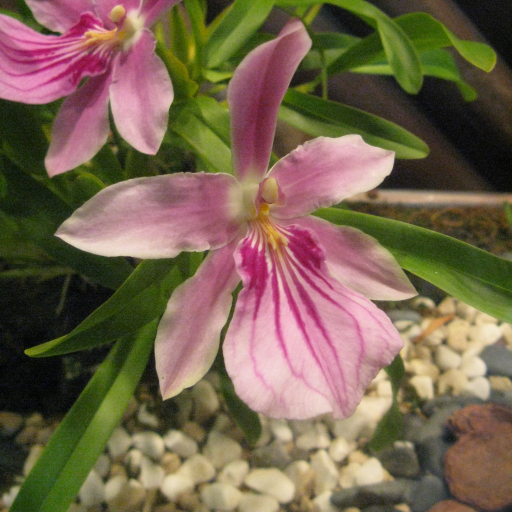
Plant Overview
Known as the "Showy Miltonia," this Brazilian beauty is a crown jewel for orchid enthusiasts. Often referred to as a "True Miltonia" to distinguish it from the cooler-growing Pansy Orchids (Miltoniopsis), it is famous for its oversized, flat blooms that look like hand-painted silk. In the wild, it spends its life perched on tree branches, soaking up the dappled sunlight of the South American rainforests.
🔍 How to Identify
- 🌸 The "Pansy" Bloom: Large, flat flowers that can reach up to 4 inches across. They typically feature creamy-white petals with a massive, striking purple or rose-pink "lip" (labellum) decorated with darker veins.
- 🍃 Flattened Pseudobulbs: The base of the plant consists of yellowish-green, compressed oval shapes that store water. These grow spaced out along a creeping horizontal stem.
- 🌿 Light Green Foliage: Two thin, strap-shaped leaves emerge from the top of each pseudobulm. The foliage often has a slightly yellowish tint, which is a normal trait for this species and not necessarily a sign of ill health.
🏡 In Your Garden
- 🪴 The Wanderer: Because this orchid grows on long, creeping rhizomes, it tends to "walk" right out of its pot. It is much happier in a wide, shallow bulb pan or mounted on a piece of cork bark where its roots can roam freely.
- ☁️ Humidity & Airflow: It craves high humidity (around 60-70%) but hates "wet feet." If the air is too stagnant, the thin leaves can develop spotting. Providing a gentle breeze from a nearby fan mimics its airy forest canopy habitat.
⚠️ Safety & Toxicity
- ✅ Pet Friendly: Miltonia spectabilis is considered non-toxic to cats, dogs, and horses. It is an excellent choice for a "worry-free" indoor jungle.
- 🛑 Sap Sensitivity: While not poisonous, some individuals with very sensitive skin may experience mild irritation if they come into contact with the sticky sap (nectar) sometimes produced by the flower spikes.
✨ Fun Fact
The variety Miltonia spectabilis var. moreliana is a dark-mode version of this plant; it produces deep, plum-purple flowers so rich and saturated they are often used in breeding to create "black" orchid hybrids!

Detailed Care Instructions

Place in a bright room that is sun drenched almost all day. Or directly in a south-facing window.
The relative humidity levels between 30 and 50 percent are ideal for these plants. They exhibit unpleasant symptoms when the moisture content in the environment is unfavorable. Avoid letting the air temperature rise too high or low and use a humidifier, whenever possible. Misting is also beneficial, although frequent watering is also necessary. The optimal relative humidity will promote plant growth.








