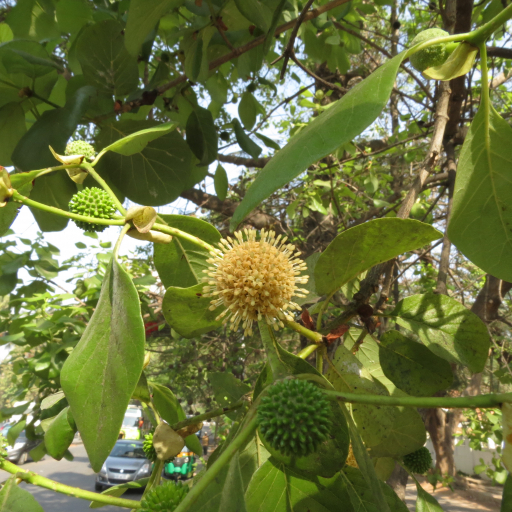
Plant Overview
Often referred to as the Kaim or Small-leaf Kadamba, Mitragyna parvifolia is a majestic deciduous tree native to the fertile landscapes of the Indian subcontinent and Southeast Asia. A proud member of the Rubiaceae (Coffee) family, it is a close botanical cousin to the famous Kratom tree, though it possesses a much gentler, more ornamental character. In its native habitat, it is often found standing tall along riverbanks, providing a leafy canopy that has been celebrated in traditional folklore for centuries.
🔍 How to Identify
- 🍃 The Foliage: The leaves are opposite, usually oval or heart-shaped, and significantly smaller than those of its cousins. They have a smooth texture and prominent pale veins that create a beautiful ladder-like pattern.
- 🟡 The "Alien" Blooms: One of its most striking features is the inflorescence—tiny, fragrant, yellow or greenish flowers clustered into perfect, spherical "puffball" heads.
- 🪵 The Bark: As the tree matures, its bark becomes a pale greyish-brown, often peeling in small, irregular scales to reveal a smoother layer beneath.
🏡 In Your Garden
- 💧 Water & Roots: While it is surprisingly drought-tolerant once established, the Kaim tree truly thrives in moist, well-draining soil. It develops a deep, sturdy root system, meaning it prefers to stay where it is planted; frequent transplanting can lead to "root shock."
- 🌳 Spacial Awareness: This is not a plant for a small indoor pot! In a garden setting, it needs plenty of room to stretch its branches. It’s an excellent choice for a large backyard where it can provide deep shade and act as a natural air purifier.
⚠️ Safety & Toxicity
- 🟢 Status: Generally safe for touch and handling.
- 🐕 Details: While not listed as a "poisonous" plant like nightshade, it contains various alkaloids. To be safe, keep curious pets and toddlers from chewing on the leaves or fallen bark, as ingesting large amounts of raw plant material can cause digestive upset.
✨ Fun Fact
In ancient Indian literature and mythology, this tree is often associated with the Hindu deity Krishna. It is frequently confused with the "true" Kadamba tree (Neolamarckia cadamba), leading to its charming nickname, the "Little Kadamba."

Detailed Care Instructions
Mitragyna parvifolia plant can be watered by soaking the soil evenly with water. Make sure you do not overwater the plant as it can lead to rotting of the roots. Allow the top layer of soil to dry out before watering again. You can also mist the plant occasionally to maintain humidity levels around it. Watering should be done early in the morning or late afternoon to avoid extreme heat during the day. Avoid getting water on the leaves as it may cause damage to them. Ensure that the water used is not too cold or too hot as extreme temperatures can affect the growth of the plant.
The Mitragyna Parvifolia plant requires a soil that is rich in nutrients and minerals. It is recommended to use a well-draining soil mix to avoid waterlogging and root rot. The soil should be slightly acidic to neutral with a pH range of 5.5 to 7.0. Additionally, it is ideal to add organic matter such as compost, peat moss, or vermiculite to enhance soil structure and moisture-holding capacity. The plant prefers moist soil, but overwatering should be avoided as it can lead to fungal diseases. The soil should be kept consistently moist but not waterlogged, and it is advisable to allow the topsoil to dry slightly before watering. Overall, a nutrient-rich, well-draining, slightly acidic to neutral soil with an added organic matter is ideal for the successful growth of Mitragyna Parvifolia.








