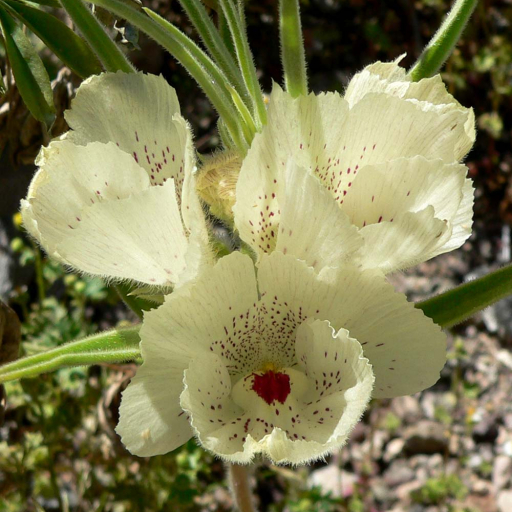
Plant Overview
Known as the Ghost Flower, this desert dweller is one of the most clever "tricksters" of the American Southwest. It earns its spectral nickname from its pale, almost translucent petals that seem to glow against the harsh, dark desert pavement. Native to the Mojave and Sonoran deserts, it has evolved a fascinating survival strategy: it mimics the appearance of other nectar-rich flowers to lure in bees, even though it offers no nectar reward of its own.
🔍 How to Identify
- 👻 The "Ghostly" Glow: The flowers are a delicate, creamy pale yellow or white, often appearing paper-thin and translucent when the sun hits them.
- 🎨 Intricate Markings: If you peek inside the cup-shaped flower, you’ll see a cluster of small, maroon or purple spots concentrated at the base, designed to look like a group of female bees to attract males.
- 🌿 Hairy Foliage: The leaves and stems are covered in fine, glandular hairs, giving the plant a slightly greyish-green, fuzzy appearance that helps it retain moisture.
🏡 In Your Garden
- 🏜️ The Desert Specialist: Because it is a true desert annual, it thrives in sandy, well-draining soil and "washes." It is rarely found in traditional gardens because its seeds require very specific cues—usually a precise amount of winter rainfall—to germinate.
- 🌞 Sun Worshiper: It requires intense, direct sunlight. In the wild, it grows in open flats and rocky slopes where other plants might wither, using its deep taproot to anchor itself against desert winds.
⚠️ Safety & Toxicity
- ✅ Generally Safe: Mohavea confertiflora is not known to be toxic to humans or common household pets.
- 🌵 Handle with Care: While it isn't poisonous, the plant is delicate. In its natural habitat, it is best enjoyed from a distance to avoid crushing the fragile desert crust (biological soil crust) that supports its growth.
✨ Fun Fact
The Ghost Flower is a master of "Bait and Switch" pollination. It looks almost identical to the Mentzelia involucrata (Blazing Star) plant, which produces tons of nectar. Bees can’t tell the difference, so they land on the Ghost Flower first, pollinating it for free before realizing there’s no snack waiting for them!

Detailed Care Instructions
To grow Mohavea confertiflora, also known as the ghost flower or desert snapdragon, follow these steps:
- Climate: Mohavea confertiflora is native to desert regions of California and Arizona. It thrives in hot and dry climates, so ensure you live in a suitable area to grow this plant.
- Soil: Choose well-draining soil with sandy or gravelly texture, as this mimics the natural desert environment. Amend the soil with organic matter to improve water retention.
- Planting: Plant Mohavea confertiflora seeds or seedlings in late winter or early spring. This allows the plant to establish its roots before the hot summer months. Dig a hole slightly larger than the root ball, place the plant in the hole, and backfill with soil, firming it gently around the roots.
- Watering: Water the plant deeply right after planting and then, during the growing season, water sparingly, allowing the soil to dry out between each watering. Mohavea confertiflora is adapted to survive in desert conditions and can tolerate drought.
- Sunlight: Provide full sun exposure to the ghost flower, as it needs bright sunlight to thrive. Make sure it receives at least 6-8 hours of direct sunlight each day.
- Fertilization: Mohavea confertiflora doesn't require heavy fertilization. However, you can apply a balanced, low-nitrogen fertilizer in early spring, following the package instructions.
- Pruning: Prune the plant after it finishes flowering to promote a more compact and bushy shape. Remove any dead or damaged branches and cut back leggy growth to maintain the desired form.
- Propagation: To propagate Mohavea confertiflora, collect seeds from the plant in the fall. Allow them to dry completely before sowing them in the following spring.
- Pest and disease control: Mohavea confertiflora is generally pest-free. However, keep an eye out for common garden pests like aphids or spider mites. Treat any infestations with organic or chemical pest control methods as necessary.
Remember, growing Mohavea confertiflora may require patience, as it is a slow-growing plant. Be mindful of your local climate and make adjustments to provide the best conditions for its growth.
Mohavea Confertiflora is a type of plant that requires regular watering to keep it healthy and thriving. It is important to make sure that the soil is moist but not too wet, as this can lead to root rot and other problems. Generally, it is recommended to water this plant once or twice a week, depending on the climate and the conditions of the soil.
When watering, it is best to use a gentle stream of water from a watering can or hose to avoid disturbing the soil or damaging the leaves of the plant. Be sure to avoid getting water on the flowers, as this can cause them to wilt and die prematurely.
If you are unsure of how much water to give your Mohavea Confertiflora, you can test the soil moisture level by inserting a moisture meter or simply sticking your finger into the soil. If the soil feels dry to the touch, it is time to water your plant.
It is also important to note that Mohavea Confertiflora prefers well-draining soil and should not be left in standing water. If you notice that water is collecting at the bottom of the pot or planter, be sure to empty it out to prevent root rot and other problems.
To fertilize the Mohavea Confertiflora plant, apply a balanced, water-soluble fertilizer every 2-3 weeks during the growing season. Use a low-nitrogen fertilizer to avoid burning the plant. Dilute the fertilizer according to package instructions, and water the plant immediately after fertilizing to prevent fertilizer burn. Avoid fertilizing during the dormant season.
The ideal soil for this particular plant is well-draining with a lower pH level and minimal nutrient content compared to other plants. It prefers sandy or rocky soil that is not overly rich in organic matter. The plant's natural habitat is typically in desert or dry regions, and soil that is too moist can lead to root rot. A mixture of sand, gravel, and clay is often recommended for optimal growth. Additionally, adding lime or sulfur may be necessary to adjust the pH level of the soil.
First, select a mature and healthy Mohavea Confertiflora plant with several branches.
Next, take a sharp and sterilized pair of pruning shears and cut a stem from the plant at a 45-degree angle, just below a node where leaves emerge.
Remove any leaves from the bottom two-thirds of the stem, leaving a few at the top.
Dip the cut end of the stem in rooting hormone powder, which can be found at most nurseries or garden centers.
Then, plant the stem in a pot filled with a well-draining soil mix.
Water the soil thoroughly and cover the pot with a plastic bag to create a humid environment.
Place the pot in a warm, bright spot, away from direct sunlight.
Make sure to keep the soil moist but not waterlogged.
Within a few weeks, new growth should appear, indicating that your Mohavea Confertiflora plant has successfully propagated.








