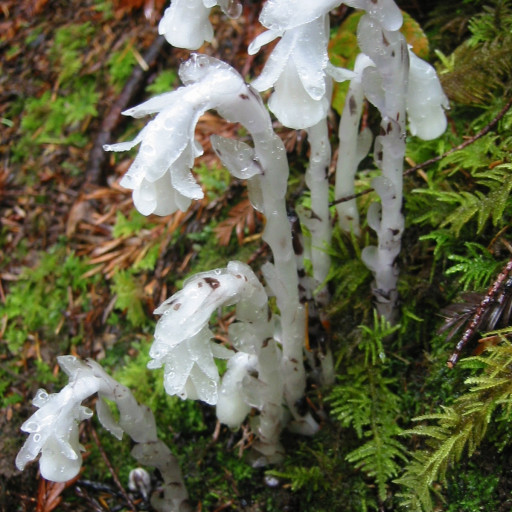
Plant Overview
Often called the "Ghost Pipe" or "Corpse Plant," Monotropa uniflora is one of nature’s most hauntingly beautiful mysteries. Unlike almost every other plant you know, it lacks chlorophyll, giving it a waxy, translucent white appearance that glows against the dark forest floor. In folklore, it was often associated with spirits and was said to grow where a person’s spirit paused to rest.
🔍 How to Identify
- 👻 The Color: The entire plant is a ghostly, waxy white, though it may occasionally show tinges of pale pink or small black flecks as it ages.
- 🔔 The Flower: A single, bell-shaped flower sits atop each stem. It starts out "nodding" toward the ground and gradually turns upward as it prepares to release its seeds.
- 🍂 The Leaves: You won't find green leaves here; instead, the stem is covered in tiny, translucent scales that look like crystalline armor.
🌲 Habitat & Ecology
- 🍄 The Hidden Thief: Because it cannot photosynthesize, this plant is a "mycoheterotroph." It survives by stealing nutrients from underground fungi that are already attached to the roots of large trees like Oaks and Pines.
- 🌑 Deep Shade Dweller: Look for it in the dampest, darkest parts of mature forests. It often emerges after heavy summer rains, popping up through thick leaf litter where other plants would starve for light.
⚠️ Safety & Toxicity
- 🚫 Cautionary Status: While not considered "deadly" like some white mushrooms it mimics, it is generally considered inedible and potentially toxic if consumed in large quantities.
- 🐾 Pet & Child Safety: It contains grayanotoxins and salicylic acid. It is best to admire this plant with your eyes only, as ingestion can cause stomach upset or more serious reactions in pets and small children.
✨ Fun Fact
Even though it looks like a mushroom, the Ghost Pipe is a true flowering plant and a distant relative of the Blueberry! It evolved to give up the "hard work" of making food from sunlight, opting instead to live entirely off the energy of the forest’s fungal network.

Detailed Care Instructions
| Humidity | High |
| Lighting | Shade |
| Toxicity | Poisonous |
| Difficulty | Hard |
Growing Monotropa uniflora, commonly known as ghost pipe or corpse plant, can be a challenging task due to its specific growing requirements. Here are some steps to help you grow this unique plant:
- Habitat: Ghost pipe is a mycoheterotrophic plant, meaning it lacks chlorophyll and obtains its nutrients from the roots of nearby fungi. It typically grows in damp, shaded forests with rich organic soil. To replicate its natural habitat, choose a suitable location with similar conditions.
- Soil: The plant prefers slightly acidic, humus-rich soil. Prepare the planting area by adding organic matter such as leaf mold or compost. Ensure good drainage as excessive moisture can harm the plant.
- Propagation: Monotropa uniflora can be propagated by sowing seeds or through transplanting rhizomes (underground stems). If using seeds, sow them in the fall, as this plant relies on natural fungal symbiosis for growth. Transplanting rhizomes collected from the wild might be more successful, as they already have established fungal associations.
- Shade: Ghost pipe requires shade or filtered sunlight. Find a location that provides protection from direct sunlight, preferably under a dense canopy or near tall trees.
- Watering: Keep the soil evenly moist. Avoid waterlogging, which can lead to root rot. The plant prefers consistent moisture but not excessive watering.
- Fungal association: Ghost pipe relies on a specific type of mycorrhizal fungi for its survival. To encourage fungal symbiosis, try adding soil from the area where ghost pipe naturally grows or working with the local fungi. Maintaining the right fungal associations is crucial for the plant's growth.
- Patience and observation: Growing ghost pipe can be a slow process. It can take several years for the plant to establish and bloom, so be patient and observe its growth regularly.
Remember, Monotropa uniflora may not thrive in all climates or regions. It is essential to research and understand the specific requirements of this plant in your area for successful cultivation.

Place in a dark room with little light, like a dark bedroom or a spot far away from a window or directly in a north-facing window.

One way to water this plant is to slowly pour water at the base of the stem, ensuring that the soil is moist but not waterlogged. It is important to not wet the foliage as this can cause damage to the plant. It is recommended to water the plant infrequently, only when the soil has become dry to the touch. It is also important to ensure that the plant is not exposed to prolonged periods of drought, as this can cause the plant to wilt and ultimately die.
To fertilize this plant, use a balanced, water-soluble fertilizer diluted to half strength. Apply the fertilizer once a month during the growing season, from spring to early fall. Avoid over-fertilizing, as it can lead to nutrient burn and damage to the plant's roots. Water the plant deeply after fertilizing to ensure that the nutrients reach the roots.
The soil should be rich in organic matter and have good drainage. A mix of sphagnum moss, perlite, and pine bark is often recommended. It is important to avoid using soil that is too dense or heavy, as this can cause water to pool and lead to root rot. Additionally, the plant prefers acidic soil with a pH between 4.0 and 6.0.
To propagate this plant, you will need to locate ripe seedpods in the late summer or early fall. Collect the seedpods and store them in a cool, dry place until the following spring. In the spring, prepare a potting mix of equal parts peat moss, perlite, and vermiculite. Moisten the mix and fill a small seed tray with it.
Sow the seeds on the surface of the potting mix, and cover them with a fine layer of vermiculite. Place the tray in a location with bright, indirect light and keep the soil moist but not waterlogged. It may take several weeks for the seeds to germinate, so be patient.
Once the seedlings have grown several inches tall and have developed a few sets of true leaves, they can be transplanted into individual pots. Use the same potting mix as before and keep the soil moist. Gradually acclimate the plants to brighter light and the outdoors over several weeks.
Monotropa uniflora can also be propagated by root division. Dig up the plant in the fall or early spring and gently separate the roots into several sections. Replant each section into a small pot filled with the same potting mix as before. Keep the soil moist and the plant in bright, indirect light.








