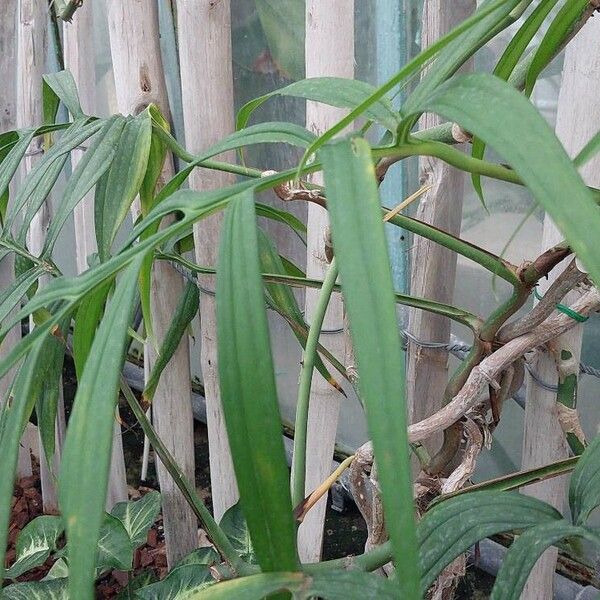
Plant Overview
Known as the "Pinnate Monstera," this elegant climber from the rainforests of Ecuador and Peru is a master of disguise. Unlike its famous cousin, the Swiss Cheese Plant, Monstera subpinnata doesn't bother with holes; instead, it features leaves so deeply divided they look like delicate green feathers or palm fronds. It is a prized jewel for collectors who want the tropical "jungle look" without the massive, heavy foliage of more common species.
🔍 How to Identify
- 🌿 Pinnate Foliage: The most striking feature is the "split" leaf. Each leaf is divided into several long, narrow leaflets that attach to a central midrib, giving it a fern-like or palm-like appearance.
- 📏 Growth Habit: It is a vining hemiepiphyte, meaning it starts its life on the ground but quickly seeks a tree trunk to climb toward the canopy light.
- 🟢 Stem Texture: The stems are relatively slender and flexible compared to other Monsteras, often showing visible nodes where aerial roots emerge to grip onto surfaces.
🏡 In Your Garden
- 🧗 Support is Essential: Because this plant is a natural climber, it will "leggy" and produce smaller leaves if left to trail. Providing a moss pole allows the aerial roots to dig in, which signals the plant to produce larger, more dramatic foliage.
- 🌬️ Air & Humidity: This species is native to humid tropical forests. It performs best when humidity is kept above 60%. If the air is too dry, the tips of those delicate leaflets will quickly turn brown and crispy.
- 🪴 Aroid Mix: It hates "wet feet." Avoid standard potting soil; instead, use a chunky mix of orchid bark, perlite, and coco coir to ensure oxygen reaches the roots.
⚠️ Safety & Toxicity
- 🐾 Toxic to Pets: Monstera subpinnata contains insoluble calcium oxalate crystals, which are sharp at a microscopic level.
- 🚫 Symptoms: If chewed or swallowed by cats, dogs, or humans, it causes immediate mouth pain, swelling of the throat, and gastrointestinal distress. It is best kept on high shelves or mounted on poles out of reach of curious paws and children.
✨ Fun Fact
While most Monsteras are famous for fenestrations (the holes in the middle of the leaf), Monstera subpinnata is one of the rare species that has evolved to be almost entirely "shredded." This adaptation helps the plant withstand heavy tropical downpours and high winds by letting the elements pass right through the leaves without tearing them!

Detailed Care Instructions
| Humidity | Normal |
| Lighting | Part Sun |
| Difficulty | Medium |
| Temperature | 18°C - 35°C |
| Hardiness Zones | 9B - 11 |

Place in a window with dappled sun or a spot in the middle of a room. Or directly in a window facing west or east.

To water this particular plant, you should first observe the soil to see if it's dry. It's essential not to overwater it since it may lead to root rot. For the best results, you should water it once the top few inches of soil feel dry. When watering, ensure that the water reaches the roots and doesn't sit on top of the soil. You can achieve this by watering slowly and allowing the soil to absorb the water before continuing. You can also mist the plant leaves occasionally to keep them moist and hydrated.
These plant needs regular fertilizing during growing seasons. Fertilizing your plants in dormant state during the winter, might result in scorching or browning of the leaf tips. If mature plants display signs of nutrient insufficiency, fertilizer administration is necessary to restore the plant to its previous state.
You may use All Purpose Plant Food or Green Plant Food for your Monstera Subpinnata
Monstera Subpinnata prefers well-draining soil that is rich in organic matter. A mixture of high-quality potting soil, perlite, and peat moss can provide an ideal growing environment for this plant. It is important to avoid using heavy or compacted soils that may retain too much moisture and lead to root rot. Amend the soil with a slow-release fertilizer to provide the plant with essential nutrients over an extended period. Additionally, regularly check the moisture level of the soil and adjust watering accordingly to prevent overwatering or underwatering.
Common pests of the monstera subpinnata include Mealybugs, spider mites, fungus gnats, thrips. Make a habit of checking your monstera subpinnata frequently for pests so that any infestations can be caught and managed early.








