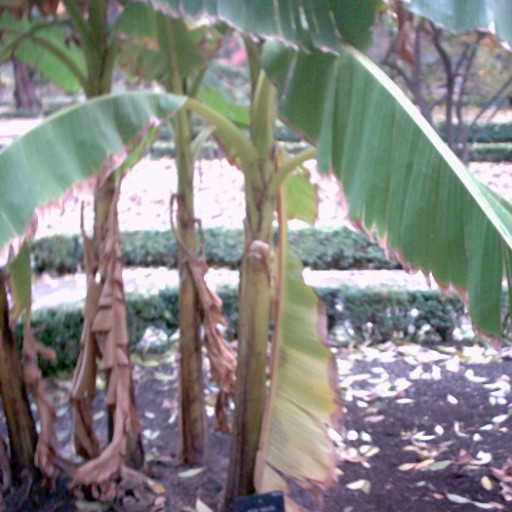
Plant Overview
Known as the "Japanese Fiber Banana," the Musa basjoo is the ultimate dream for gardeners in cooler climates who crave a tropical aesthetic. Despite its delicate, lush appearance, this is the most cold-hardy banana species in the world, capable of surviving freezing winters that would kill most other tropicals. While its name suggests a Japanese origin, it actually hails from the high mountain reaches of China, where it evolved its legendary resilience.
🔍 How to Identify
- 🍃 Lush Foliage: Large, paddle-shaped leaves that can grow up to 6 feet long, featuring a vibrant, lime-green hue with a prominent midrib.
- 🎋 The Pseudostem: It doesn't have a wooden trunk; instead, it forms a "pseudostem" made of tightly wrapped leaf bases that look like a sturdy, green pillar.
- 🍌 Ornamental Fruit: It produces small, creamy-yellow flowers followed by clusters of tiny green bananas that remain small and full of seeds.
🏡 In Your Garden
- 🌬️ Wind Protection: Because the leaves are so large and thin, they can easily shred in high winds. Planting them near a fence or in a sheltered corner keeps the foliage looking pristine and "un-fringed."
- 🍲 Hungry & Thirsty: This plant is a "heavy feeder." To achieve that massive, jungle-like growth in a single season, it requires consistent moisture and a high-nitrogen fertilizer to fuel its rapid expansion.
- ❄️ Winter Strategy: While the leaves will die back at the first frost, the underground rhizome is incredibly hardy. If you cut the stems back and apply a thick layer of mulch (like a warm winter blanket), it will explode back to life in the spring.
⚠️ Safety & Toxicity
- ✅ Safe for All: The Musa basjoo is considered non-toxic to humans, cats, and dogs. It is a very "friendly" addition to family gardens.
- 👕 Staining Sap: While not poisonous, the sap from a cut stem or leaf can be sticky and may leave permanent brown stains on clothing or patio furniture.
✨ Fun Fact
In the Edo period of Japan, the fibers from this plant’s pseudostem were traditionally harvested and processed to weave a lightweight cloth known as bashōfu, which was used to make high-quality summer kimonos!

Detailed Care Instructions
| Humidity | High |
| Lighting | Full Sun |
| Difficulty | Medium |
| Hibernation | Cold Period |
| Mature Size | This Tree Will Be Up To 18' Tall At Maturity. |
| Native Area | They Probably Came From China Originally And Were Introduced To A Chain Of Islands Called The Ryukyu Archipelago Off The Coast Of Japan. |
| Temperature | 24°C - 30°C |
| Hardiness Zones | Zones 4 Or 5 |
To grow a Musa Basjoo plant, follow these steps:
- Find a suitable location: Choose a sunny spot in your garden that receives at least 6-8 hours of direct sunlight per day. The Musa Basjoo plant prefers warm weather and cannot tolerate frost.
- Prepare the soil: Musa Basjoo plants thrive in well-draining soil that is rich in organic matter. Add compost or well-rotted manure to the soil to improve its fertility and drainage.
- Planting: Dig a hole that is wide and deep enough to accommodate the plant's roots. Place the plant in the hole, making sure the crown is at ground level. Backfill the hole with soil and gently firm it around the base of the plant.
- Watering: Keep the soil consistently moist, but not waterlogged. Water the plant deeply whenever the top inch of soil feels dry. Musa Basjoo plants require regular watering, especially during hot and dry periods.
- Mulching: Apply a layer of mulch around the base of the plant to help retain moisture, regulate soil temperature, and suppress weed growth. Use organic mulch, such as wood chips or straw.
- Fertilizing: Feed the plant with a balanced, slow-release fertilizer in the spring and mid-summer. Follow the manufacturer's instructions for proper application.
- Protect from frost: In regions with cold winters, protect the Musa Basjoo plant from freezing temperatures by piling up mulch around the base of the plant, or wrapping it with burlap or frost blankets.
- Pruning: Remove any yellowing or damaged leaves as needed. Leave a few small leaves at the top to help protect the plant through the winter.
- Division: After a few years, the Musa Basjoo plant may produce offsets or "pups" around the base. These can be carefully divided and replanted to propagate new plants.
- Winter care: In colder climates, cut the Musa Basjoo plant down to the ground in late fall or early winter before the first frost. Mulch heavily over the base and cover with a layer of straw or leaves for insulation.
By following these steps, you can successfully grow a Musa Basjoo plant and enjoy its lush green foliage in your garden.

Place in a bright room that is sun drenched almost all day. Or directly in a south-facing window.

To water this plant, first ensure that the soil is dry to the touch before watering. Then, slowly pour water into the soil around the base of the plant, being careful not to water the leaves. Allow the soil to fully absorb the water before applying more, as over-watering can cause the plant to become waterlogged and rot. The frequency of watering will depend on the humidity levels in the plant's environment and the amount of light it receives, but a good rule of thumb is to water once a week. It is also beneficial to mist the plant's leaves with water to increase the humidity around the plant.
To fertilize this plant, you should apply a slow-release fertilizer that is high in potassium and phosphorus. It is recommended to fertilize the plant every 4-6 weeks during the growing season, which is typically from spring to autumn. Avoid over-fertilizing as it can cause damage to the roots and leaves. Additionally, regularly checking the soil's nutrient levels will help ensure that the plant is receiving adequate nutrients.
The type of soil that is suitable for a Musa Basjoo plant is one that is well-draining and rich in organic matter. It should be able to retain moisture but not become waterlogged. A pH range of 5.5-7.0 is ideal for this plant as it prefers slightly acidic to neutral soil.
The soil should be loose and have good aeration to facilitate root growth. Adding perlite or sand can help improve soil drainage while adding compost or aged manure can increase soil fertility. Additionally, adding peat moss or coconut coir can help retain moisture in the soil for longer periods.
It is important to avoid using soil that is too heavy or clay-like as it can hinder root development and suffocate the plant. Similarly, using soil that is too sandy may not retain enough moisture for the plant to thrive.
Overall, an ideal soil for a Musa Basjoo plant would be a well-draining, fertile, and slightly acidic soil that is amended with organic matter and provides ample aeration for the roots to grow.
To propagate this plant, you will need to identify a healthy, mature plant and obtain a fresh rhizome from the base of the main stem. Cut the rhizome into small sections, each with a couple of leaves attached and place them in a well-draining soil mix. Water thoroughly and keep the soil moist, but not too wet. Place the new plants in a warm, shaded area with indirect sunlight until they establish roots and begin to grow. Once the plant has developed a strong root system, it can be transplanted to a larger pot or planted directly in the ground.
Common pests of the japanese banana include Scale insect, mealybugs, spider mites, fungus gnats. Make a habit of checking your japanese banana frequently for pests so that any infestations can be caught and managed early.








