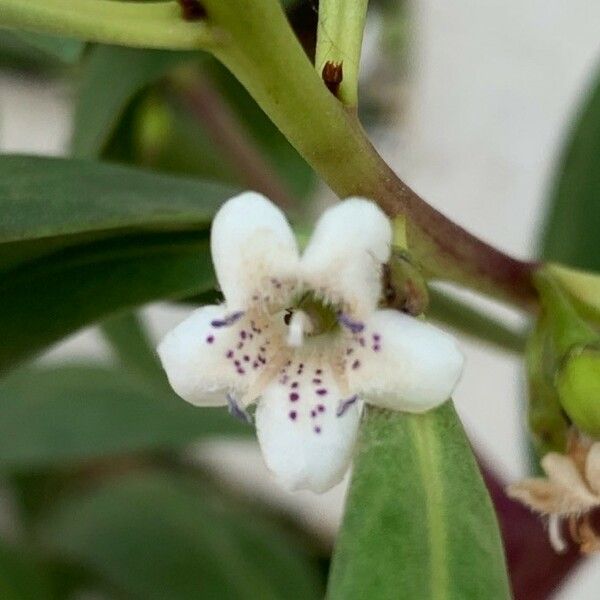
Plant Overview
Known as the Slender-leaf Boobialla or Water Bush, this Australian native is a master of the coast. Its lush, evergreen canopy provides a refreshing splash of green even in the harshest seaside winds. It is a favorite for garden privacy because it grows quickly, creating a dense "living wall" that stands strong against salt and sun.
🔍 How to Identify
- 🍃 Slender Foliage: The leaves are narrow, lance-shaped, and a vibrant, glossy green, living up to its Latin name tenuifolium which literally means "slender leaf."
- ✨ Oil Glands: If you hold a leaf up to the light, you will see tiny, translucent dots; these are oil glands characteristic of the Myoporum family.
- 🌸 Spotted Blooms: In spring and summer, it produces delicate, bell-shaped white flowers that are often decorated with tiny purple speckles in the throat.
- 🟣 Fleshy Fruit: After flowering, small, succulent fruits appear, turning from green to a deep purple or blackish hue as they ripen.
🏡 In Your Garden
- 🌊 Coastal Hero: This plant thrives in salt spray and sandy soils where other plants might wither, making it an ideal windbreak for beach properties.
- ✂️ Privacy Expert: Because it responds exceptionally well to pruning, it is most often used as a thick hedge to block out noise and provide garden seclusion.
- 🚱 Establishment Logic: While it is "tough as nails" once mature, it hates being moved once planted. Its deep root system prefers to be established early in its permanent home to ensure drought resistance.
⚠️ Safety & Toxicity
- 🚫 Toxic Status: Highly toxic to livestock and pets.
- 🐾 The Danger: The plant contains a compound called ngaione, a potent hepatotoxin. If ingested by dogs, cats, or horses, it can cause severe liver damage.
- 🧒 Child Safety: While not usually fatal to humans in tiny amounts, the berries are not edible and should be kept out of reach of small children to prevent stomach upset or poisoning.
✨ Fun Fact
- 🌟 Miniature Lenses: The tiny oil glands in the leaves act like miniature lenses; in the right light, they can make the foliage appear to "shimmer" or glow from within when viewed at a specific angle!

Detailed Care Instructions
To successfully grow Myoporum tenuifolium, also known as the Myoporum tree or fine-leaf Myoporum, follow these steps:
- Choose the right location: Select a spot with well-draining soil and full sun to partial shade. The plant is adaptable to various soil types, including clay, sandy, or loamy soil.
- Planting: Dig a hole that is twice as wide and deep as the root ball of the plant. Loosen the soil at the bottom of the hole to encourage healthy root growth. Place the root ball in the hole, ensuring that the top of the root ball is at ground level. Backfill the hole with soil and gently firm it around the plant. Water thoroughly to help settle the soil.
- Watering: While the plant is establishing its roots, water it regularly, providing deep watering sessions once or twice a week, depending on the weather conditions. Once the plant is established, reduce watering frequency, as Myoporum tenuifolium prefers moderate moisture rather than consistently wet soil.
- Mulching: Apply a layer of organic mulch, such as compost or bark chips, around the base of the plant. This will help retain moisture, suppress weed growth, and protect the roots from extreme temperatures.
- Fertilizing: Fertilize the plant with a slow-release, balanced fertilizer in early spring. Follow the instructions on the fertilizer packaging for proper application rates. Avoid over-fertilizing, as it can lead to excessive growth and weak branches.
- Pruning: Myoporum tenuifolium benefits from regular pruning to maintain a desired shape and size. Prune any dead, diseased, or damaged branches as necessary. Additionally, you can lightly trim the plant to promote bushiness and denser growth. Pruning is best done in late winter or early spring.
- Pests and diseases: Myoporum tenuifolium is generally resistant to pests and diseases. However, occasional aphids, scale insects, or caterpillars may infest the plant. Monitor regularly and treat any pest infestations with appropriate insecticides or environmentally friendly methods.
- Propagation: Myoporum tenuifolium can be propagated from seeds or cuttings. Collect seeds from mature berries and sow them in a well-draining potting mix. To propagate from cuttings, take semi-hardwood cuttings in late spring or early summer. Dip the cut end in a rooting hormone and insert the cutting into a pot filled with a well-draining mix. Keep the cuttings in a warm, partially shaded area and mist them occasionally to promote root growth.
By following these guidelines, you can successfully grow Myoporum tenuifolium and enjoy its beautiful foliage in your garden.

Place in a bright room that is sun drenched almost all day. Or directly in a south-facing window.

To water this plant, you must first check the soil moisture level. You can do this by sticking your finger into the soil up to your second knuckle. If the soil is dry, it's time to water. However, make sure you don't overwater the plant as it can lead to root rot. Water the plant at the base and avoid getting water on the leaves. Allow the water to penetrate the soil to a depth of at least 6 inches. Make sure to let the soil dry out partially before watering again. In hot and dry weather, you may need to water more frequently.
To fertilize this plant, use a balanced fertilizer with NPK ratios of 10-10-10 or similar. Apply the fertilizer in the early spring before new growth begins and again in the mid-summer. Water the plant thoroughly after fertilizing. Avoid over-fertilizing as it can burn the plant.
The recommended soil for planting Myoporum Tenuifolium should be well-draining to prevent waterlogging. The pH level of the soil should be slightly acidic to neutral. The soil should be rich in nutrients and organic matter to support healthy growth. A soil mix consisting of sandy loam, perlite, and compost is ideal for this plant. The soil should be regularly amended with organic matter such as compost or leaf mold to maintain its fertility. It's important to avoid using heavy clay soil or soils that retain moisture for too long, as this could lead to the plant developing root rot.
There are several methods to propagate Myoporum Tenuifolium plant. One way is through stem cuttings. Choose a healthy stem and cut a piece that is about 4-6 inches long. Remove the leaves from the bottom two-thirds of the stem and dip it in rooting hormone. Plant the stem in well-draining soil, and keep it moist and in a warm, bright location.
Another method is through layering. Bury a low branch in soil and keep it moist. Eventually, it will grow roots and can be separated from the parent plant.
Myoporum Tenuifolium can also be propagated through seeds, but it may take longer to see results. The seeds should be planted in well-draining soil and kept moist until they germinate.
Regardless of the method used, it is important to provide the newly propagated plants with proper care and attention until they establish themselves in their new environment.








