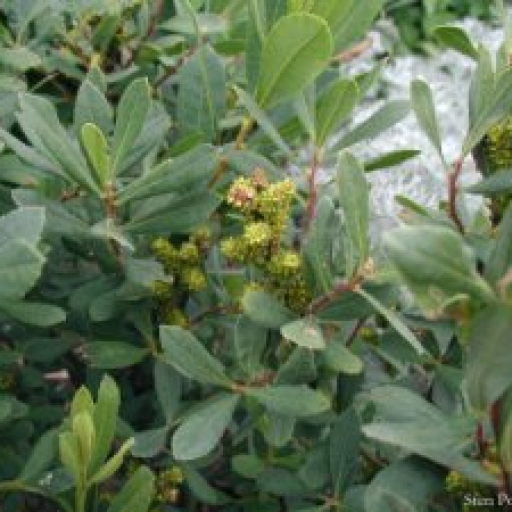
Plant Overview
Known affectionately as Sweet Gale or Bog Myrtle, this aromatic shrub is a treasure of northern wetlands and coastal moors. Long before hops became the standard for brewing, Vikings and medieval brewers used this plant to flavor their "gruit" ales, giving them a spicy, herbal kick. It is a plant deeply tied to folklore, often used in Scotland to ward off midges and bad spirits alike.
🔍 How to Identify
- 🍃 The Leaves: Narrow, wedge-shaped leaves that are wider at the tip than the base. They have a distinct grayish-green hue with a matte, waxy texture.
- 👃 The Scent: If you rub a leaf between your fingers, it releases a powerful, pleasant aroma reminiscent of eucalyptus, cloves, and bay leaves.
- 🕯️ Golden Glands: Upon close inspection, the leaves and yellow catkins are dotted with tiny, glistening golden resin glands that produce the plant's signature oils.
- 🎋 Growth Habit: A multi-stemmed, deciduous shrub that usually stands about 1 to 1.5 meters tall, with dark, reddish-brown bark.
🏡 In Your Garden
- 💧 Wetland Specialist: Unlike most garden shrubs that fear "wet feet," Sweet Gale thrives in waterlogged, acidic soil. It is the perfect choice for the edge of a pond or a bog garden where other plants might drown.
- 🧪 Self-Sufficient: This plant is a "nitrogen fixer." It hosts special bacteria in its roots that turn atmospheric nitrogen into food, allowing it to survive in nutrient-poor, peaty soils where other plants struggle.
- 🛡️ Natural Repellent: Many gardeners plant it near seating areas because the foliage contains essential oils that naturally discourage pesky insects like midges and mosquitoes.
⚠️ Safety & Toxicity
- 🟢 General Safety: Sweet Gale is generally safe to handle and is used in traditional herbal teas and flavorings.
- 🤰 Specific Warning: It should be avoided by pregnant women. Historically, it was used in high concentrations as an abortifacient, and its essential oils can stimulate the uterus.
- 🐾 Pets: While not listed as highly toxic to cats or dogs, the concentrated essential oils in the leaves can cause stomach upset if ingested in large quantities.
✨ Fun Fact
In the Highlands of Scotland, sprigs of Bog Myrtle were traditionally tucked into the folds of kilts and stored with woolens. This wasn't just for the lovely smell—the plant contains a natural chemical that is highly effective at repelling clothes moths!

Detailed Care Instructions
| Lighting | Full Sun |
To successfully grow Myrica gale, also known as sweet gale or bog myrtle, follow these steps:
- Choosing the right conditions: Myrica gale thrives in wet, boggy areas, similar to its natural habitat near water bodies. Prepare a location with consistent moisture, good drainage, and partial to full sun exposure.
- Soil preparation: Amend the soil with organic matter such as compost or peat moss to improve moisture retention and drainage. Ensure the soil is slightly acidic with a pH between 4.5 and 6.5.
- Plant selection and propagation: Obtain Myrica gale plants from a reputable nursery or obtain seeds from a reliable source. Propagation can be done through seeds or from softwood cuttings taken in the early summer.
- Planting: Plant your Myrica gale in early spring or fall. Dig a hole twice the size of the root ball, backfill it with amended soil, and gently firm it around the plant. Keep the plants at least 3 feet apart to allow for proper growth.
- Watering: Myrica gale requires consistent moisture, so make sure the plant receives enough water. Although it prefers wet conditions, avoid waterlogged soil as it can lead to root rot. Water the plant deeply, allowing the soil to dry slightly but not completely.
- Mulching: Apply a layer of organic mulch around the base of the plant to help retain moisture, suppress weed growth, and provide some insulation during extreme temperatures.
- Fertilization: Myrica gale generally does not require heavy fertilization. However, you can apply a balanced, slow-release fertilizer in early spring to promote healthy growth.
- Pruning: Minimal pruning is needed for Myrica gale. Remove any dead, damaged, or diseased branches as needed. Regularly trim back the plant to maintain a compact shape.
- Winter care: Myrica gale is hardy in USDA zones 3-7. In colder regions, protect the plant during winter by covering it with a layer of mulch or burlap to insulate the roots from freezing temperatures.
- Monitor and address pests and diseases: Keep an eye out for common pests like aphids, caterpillars, or fungal diseases. If detected, treat them accordingly using organic methods or approved insecticides/fungicides.
Remember, growing conditions may vary, so it is essential to adapt these instructions to your specific region and environment. Good luck with growing your Myrica gale plant!

Place in a window with dappled sun or a spot in the middle of a room. Or directly in a window facing west or east.

To water this plant, it is important to keep the soil consistently moist but not waterlogged. This can be achieved by watering deeply once a week and letting the top layer of soil dry out slightly between waterings. It is also important to avoid getting water on the leaves and to water at the base of the plant. During the winter months, it is important to water less frequently as the plant will need less moisture.
To fertilize this plant, you should use a slow-release fertilizer with a high nitrogen content. Apply the fertilizer in early spring before new growth appears. Alternatively, you can use a liquid fertilizer every two weeks during the growing season. Be careful not to over-fertilize, as excessive nitrogen can cause shoot growth at the expense of root growth. Finally, water the plant thoroughly after fertilizing to help distribute the nutrients throughout the soil.
Myrica Gale plant prefers a well-drained soil that is slightly acidic. The soil should also be able to retain moisture without becoming waterlogged. It is recommended to mix the soil with some organic matter such as peat or compost to help improve its nutrient content. Additionally, the plant prefers a soil that is rich in nutrients, so it may be beneficial to use a balanced fertilizer. Avoid using heavy clay soils or sandy soils that dry out quickly, as these types of soils are not suitable for Myrica Gale plant growth.
To propagate this plant, take semi-hardwood cuttings from the parent plant in late summer or early autumn. Cut a stem that is 4-6 inches long, remove the lower leaves, and dip the cut end in rooting hormone. Place the cutting in a pot filled with a well-draining soil mix and cover the pot with a plastic bag. Keep the soil moist and place the pot in a shaded area with indirect sunlight. After about 4-6 weeks, the cutting should have developed roots and can be transplanted into a larger container or outside in a protected area.








