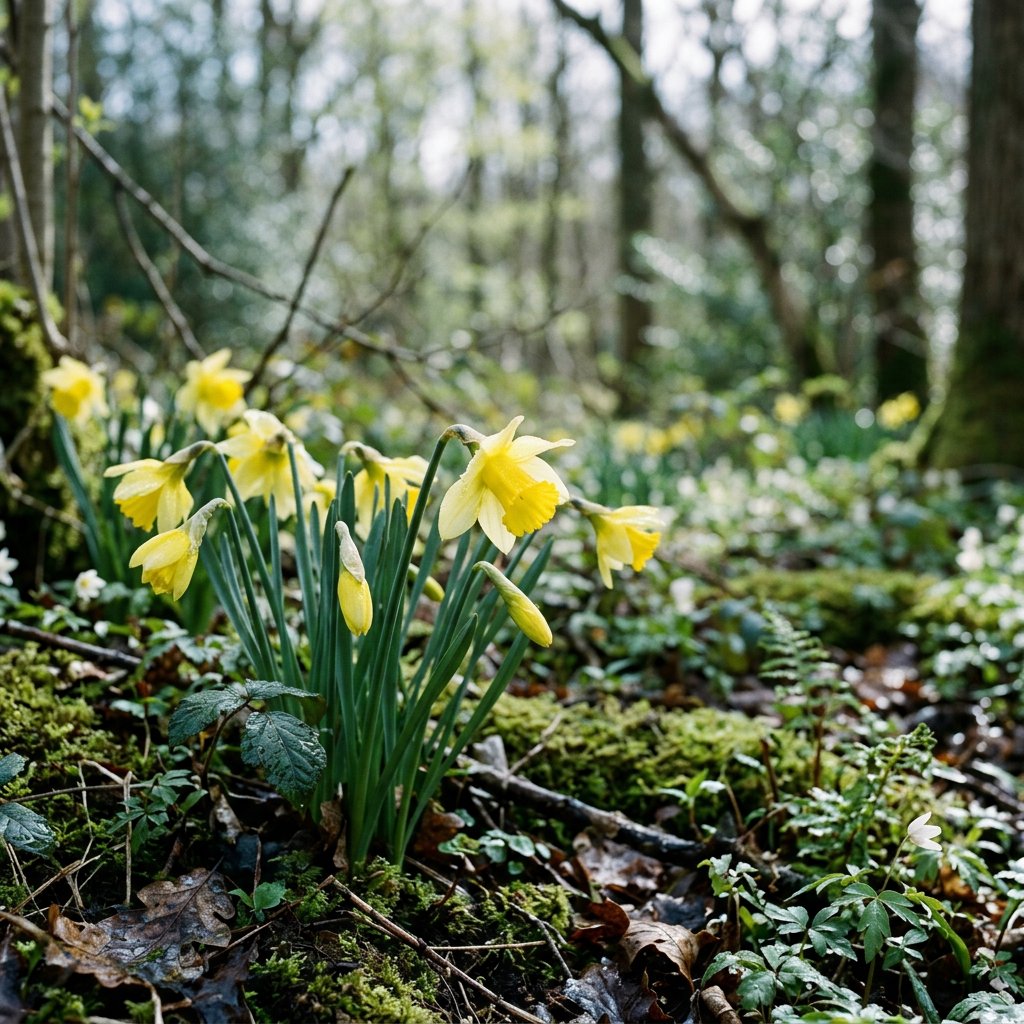
Plant Overview
Known as the "Wild Daffodil" or "Lent Lily," this iconic spring wildflower is the poetic ancestor of the modern garden daffodil. While many cultivated varieties are showy and loud, Narcissus pseudonarcissus carries a delicate, drooping elegance that has inspired centuries of British folklore and Romantic literature.
🔍 How to Identify
- 🌼 The Two-Tone Bloom: Unlike many uniform hybrids, the wild species typically features pale, cream-colored outer petals (the perianth) surrounding a much deeper, bright yellow central "trumpet" (the corona).
- 🍃 Strap-like Foliage: Its leaves are long, flat, and linear with a distinctive grayish-green or "glaucous" waxy coating that helps shed excess rainwater.
- 📐 The Nodding Habit: The flowers often "nod" or tilt slightly downward on their stems, a natural adaptation to protect their pollen from heavy spring showers.
🏡 In Your Garden
- 🌿 The Art of Naturalizing: These are the gold standard for "wilding" a landscape. Unlike complex hybrids that may fade over time, the Wild Daffodil is a long-lived perennial that will slowly spread via bulb offsets and seeds to create a golden carpet.
- ✂️ Post-Bloom Patience: It is vital to resist the urge to tidy up. After the flowers fade, the leaves must be left alone for at least six weeks until they turn yellow; this "recharges" the bulb for next year's bloom.
- 🪵 Woodland Preference: While they love sun, they are naturally adapted to the edges of deciduous forests, meaning they thrive in the dappled light found under trees before the canopy fully fills in.
⚠️ Safety & Toxicity
- 🚫 Toxic if Ingested: All parts of the plant, especially the bulb, contain the alkaloid lycorine. Ingestion causes severe stomach upset, vomiting, and heart rhythm issues.
- 🐾 Pet Warning: Narcissus is highly toxic to dogs, cats, and horses. Be particularly careful if your pet is a "digger," as the bulbs can look deceptively like small onions.
- 🖐️ Daffodil Itch: The sap contains sharp calcium oxalate crystals. Handling cut stems can cause skin irritation or a rash, so sensitive gardeners should wear gloves.
✨ Fun Fact
The famous poet William Wordsworth was walking along the shore of Ullswater in 1802 when he spotted a belt of these specific wild daffodils. This encounter inspired his most famous poem, "I Wandered Lonely as a Cloud," forever cementing this flower as a symbol of the English countryside.

Detailed Care Instructions
| Color | Gray-Green Stems And Leaves With Pale Yellow To Silvery-Grey Petals And A Darker Yellow Inner Trumpet |
| Soil Ph | Acidic |
| Humidity | Normal |
| Lighting | Full Sun |
| Toxicity | Poisonous |
| Soil Type | Sandy, Loamy, Heavy Clay-Type Soils That Are Well-Draining |
| Bloom Time | Early Spring |
| Difficulty | Medium |
| Plant Type | Bulbous Perennial |
| Mature Size | 13 Inches High And1.5 Inches To 2.5 Inches Wide |
| Native Area | Western Europe; West Portugal, East Germany, And North Of England And Wales |
| Temperature | 10°C - 24°C |
| Sun Exposure | Semi-Shaded To Full Sun |
| Hardiness Zones | 4-8 |
To grow Narcissus Pseudonarcissus, also known as the wild daffodil or Lent lily, you can follow these steps:
- Choose the right location: Narcissus Pseudonarcissus prefers well-drained soil and full sunlight to partial shade. Select a spot in your garden with these conditions.
- Prepare the soil: Ensure the soil is loose and well-draining. If the soil is heavy clay or compacted, consider adding organic matter like compost or well-rotted manure to improve drainage.
- Plant the bulbs: The best time to plant Narcissus Pseudonarcissus bulbs is in autumn, ideally between September and November. Dig holes that are about three times deeper than the height of the bulb. Place the bulbs with the pointed end facing upwards and cover them with soil. Space each bulb about 4-6 inches apart.
- Watering: After planting the bulbs, water the area thoroughly. Watering is especially important during dry spells or if you're planting in containers. However, avoid overwatering, as excessive moisture can cause bulb rot.
- Fertilization: Narcissus Pseudonarcissus bulbs generally don't need much fertilization. However, if you feel your soil is lacking in nutrients, you can apply a balanced slow-release fertilizer in early spring.
- Mulching: Applying a layer of mulch around the planted bulbs can help to retain moisture, suppress weed growth, and insulate the bulbs during extreme temperature variations.
- Care and maintenance: Narcissus Pseudonarcissus plants are generally low-maintenance. However, keep an eye out for pests and diseases and take appropriate action if needed. Remove any faded flowers or seed heads to divert energy back into the bulb for next year's growth.
- After blooming: Once the flowers have faded in spring, allow the foliage to die back naturally. This process helps to replenish the energy reserve in the bulb for the following year. Avoid cutting the foliage until it has turned yellow or brown.
By following these steps and providing the appropriate care, your Narcissus Pseudonarcissus plant should thrive and produce beautiful flowers in the spring.

Place in a bright room that is sun drenched almost all day. Or directly in a south-facing window.

To water this particular plant, you should ensure the soil is moist but not waterlogged. It is important to avoid overwatering, as it may lead to root rot. The plant requires sufficient watering during its active growth period but should be allowed to dry out slightly during dormancy. To achieve this, ensure the soil dries out between watering sessions. It is also recommended to water from below, using a saucer or tray.
This plant requires fertilization during its growing season. Use a balanced fertilizer with equal amounts of nitrogen, phosphorus, and potassium. Apply the fertilizer every four to six weeks, following the manufacturer's instructions for dosage and application method. Avoid applying fertilizer during periods of drought or when the soil is dry. Water the plant thoroughly after fertilizing.
The ideal soil for growing this plant should be well-draining and loose, with a pH level of 6 to 7.5. It should be rich in nutrients, but not overly fertile or acidic. A mix of loam, sand, and organic matter such as compost or leaf mold is recommended, as it provides the necessary drainage while also retaining moisture and nutrients. Avoid heavy clay soils or those that are too compacted, as these can hinder root growth and cause problems with waterlogging. The soil should also be free of any weeds, pests, or diseases that could affect the health and vigor of the plant.
To propagate this plant, you will need to gather its seeds. To do so, wait until the flowers have died and the seed pods have matured. Then, carefully open the pods and remove the small, black seeds inside.
Next, you will need to prepare a suitable planting bed. Choose a location with well-drained soil and plenty of sunlight. Clear the bed of any weeds or debris, and work in some compost or other organic matter to improve the soil quality.
To sow the seeds, simply scatter them evenly across the surface of the soil. If the seeds are small, you can mix them with some sand or other inert material to make them easier to distribute. After sowing, lightly cover the seeds with a thin layer of soil or sand.
Water the planting bed well and keep it evenly moist until the seeds germinate. This may take several weeks, so be patient. Once the seedlings have established themselves and started to grow, thin them out as necessary to give each plant plenty of room to develop.
With proper care and attention, your Narcissus Pseudonarcissus plants should grow into beautiful specimens that will brighten up your garden every spring!
Common pests of the daffodil include Spider mites, aphids, thrips. Make a habit of checking your daffodil frequently for pests so that any infestations can be caught and managed early.








