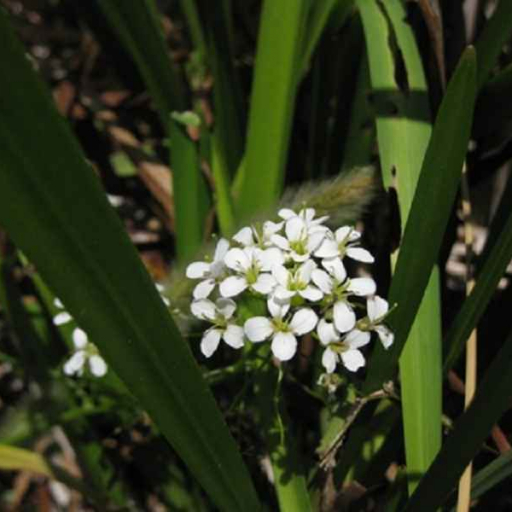
Plant Overview
Often called the "Ghost of the Marsh," Gambel’s Watercress is a rare treasure of the California coastline. This delicate aquatic perennial is more than just a salad look-alike; it is a critically endangered survivor that tells the story of disappearing coastal wetlands. Finding one in the wild is like spotting a botanical celebrity—it is one of the rarest plants in the mustard family.
🔍 How to Identify
- 🌿 The Leaflet Pattern: It features compound leaves with 3 to 9 oval-shaped leaflets. The terminal leaflet (the one at the very tip) is usually the largest, giving the foliage a lush, symmetrical look.
- 🌸 Cross-Shaped Blooms: Small, snow-white flowers grow in dense clusters. Each flower has four petals arranged in a "cross" shape, a signature trait of the Brassicaceae family.
- 💧 Hollow Stems: The stems are thick but hollow and succulent, allowing the plant to float gracefully on the surface of the water or creep along saturated mud.
🏡 Habitat & Ecology
- 🌊 Wetland Specialist: This is an "obligate" wetland plant, meaning it strictly requires a permanent source of fresh or brackish water. You will typically find it tucked away in marshes, sumps, or the edges of slow-moving springs.
- 📉 The Struggle for Space: It is currently facing a "double threat." Not only is its habitat being lost to urban development, but it is also being outcompeted and hybridized by its common cousin, the standard edible Watercress (Nasturtium officinale).
- 🌱 Rooting Strategy: It spreads primarily through rhizomes (underground stems). This allows it to form thick mats that provide essential cover for small aquatic insects and amphibians.
⚠️ Safety & Toxicity
- ✅ Status: Non-toxic. While biologically related to edible watercress, Gambel’s Watercress should never be harvested or eaten due to its critically endangered status.
- 🦠 Environmental Risk: In the wild, plants growing in water are prone to collecting bacteria or parasites like liver flukes. Additionally, because it is a protected species, picking it can carry heavy legal penalties.
- 🐾 Pets & Wildlife: It is safe for animals, though its fragile habitat is easily destroyed by trampling.
✨ Fun Fact
Gambel’s Watercress is undergoing a "genetic meltdown." Because there are so few plants left, they often breed with the common invasive Watercress. This creates "hybrid swarms," making the pure, original version of Gambel’s Watercress even harder for scientists to find!

Detailed Care Instructions








