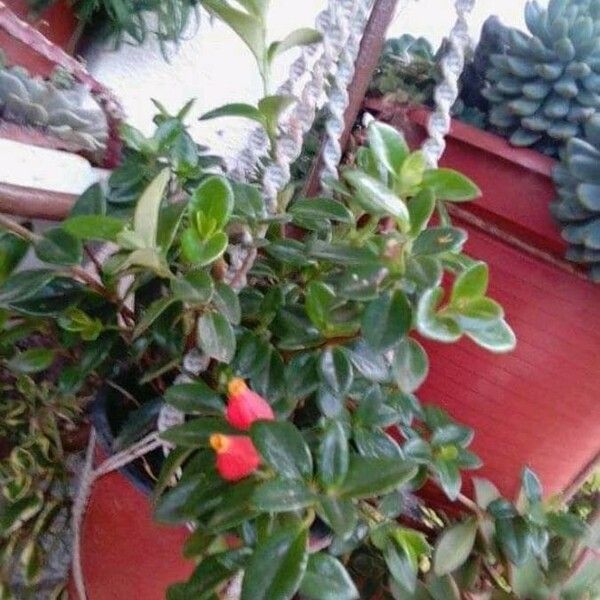
Plant Overview
Known affectionately as the Goldfish Plant, Nematanthus wettsteinii is a Brazilian beauty that looks as though a tiny school of glowing orange fish is swimming through a sea of emerald green. In its native rainforest home, it lives as an epiphyte, clinging to tree branches rather than growing in the soil. It is a long-lived, hardy houseplant that brings a sense of tropical movement to any room.
🔍 How to Identify
- 🍃 The Foliage: Small, thick, and incredibly glossy leaves that feel almost waxy or succulent to the touch. They grow densely along the stems in a neat, symmetrical pattern.
- 🧡 The "Goldfish" Bloom: The star feature! Tubular, vibrant orange flowers that are "pouched" or swollen in the center, perfectly mimicking the belly of a goldfish.
- 🌱 Growth Habit: It features a graceful trailing or cascading habit, with woody stems that spill beautifully over the sides of hanging baskets.
🏡 In Your Garden
- ☁️ Airy Roots: Because this plant is an epiphyte (an "air plant"), its roots require high oxygen. Avoid heavy, standard potting soil; it thrives best in a light, chunky mix containing orchid bark or perlite to prevent "wet feet."
- ☀️ The Bloom Secret: If your plant isn't flowering, it’s likely asking for more light. While it can survive in lower light, it needs bright, indirect sunshine—like the dappled light of a forest canopy—to trigger its colorful display.
- 💧 Humidity Needs: It loves a humid environment but prefers its soil to dry out slightly between waterings. Think of it as a tropical plant with the water-storage habits of a succulent.
⚠️ Safety & Toxicity
- 🐾 Pet Friendly: Great news for furry friends! The Goldfish Plant is considered non-toxic to both cats and dogs by the ASPCA, making it a "worry-free" addition to a pet-filled home.
- 👶 Safe for Humans: It is non-toxic to humans, though the small, shiny leaves can be a choking hazard for very small children if plucked.
✨ Fun Fact
The unique "pouched" shape of the flower isn't just for show—it is an evolutionary design called urceolate (urn-shaped). This specific shape is tailored perfectly to the beaks of hummingbirds, who act as the plant's primary pollinators in the wild!

Detailed Care Instructions
To grow a Nematanthus Wettsteinii plant, also known as goldfish plant, you can follow these steps:
- Choose a suitable location: Select a spot that receives bright but indirect sunlight. Avoid placing the plant in direct sunlight as it can scorch the leaves.
- Optimal temperature: These plants prefer temperatures between 60-85°F (15-29°C). Keep them away from drafts and extreme temperature fluctuations.
- Use well-draining soil: Prepare a potting mix that is rich in organic matter, such as peat moss or compost. Make sure the soil drains well to prevent root rot.
- Pot selection: Choose a pot that has drainage holes to allow excess water to escape. A pot with slightly larger size than the current root system is ideal.
- Watering: Water the plant thoroughly when the top inch of the soil feels dry. Avoid overwatering as it can lead to root rot. Keep the soil slightly moist but not waterlogged.
- Humidity: Nematanthus Wettsteinii plants prefer moderate to high humidity levels. Set a tray filled with water near the plant to increase humidity, or use a humidifier.
- Fertilizer: Feed the plant with a balanced, water-soluble fertilizer specifically formulated for houseplants. Follow the instructions on the fertilizer packaging for proper dosage and frequency.
- Pruning: Regularly remove any dead or damaged leaves or stems to maintain a tidy and healthy plant.
- Propagation: You can propagate Nematanthus Wettsteinii plants by stem cuttings. Take a cutting from a healthy plant, remove the lower leaves, and place it in a pot with moist soil. Keep the cutting in a warm and bright area until it establishes roots.
- Pests and diseases: Keep an eye out for common pests like aphids, spider mites, or mealybugs. Treat any infestations promptly using an appropriate insecticide or by wiping the leaves with a damp cloth. Watch for signs of diseases such as leaf spots or powdery mildew, and address them accordingly.
By following these guidelines, you should be able to grow a healthy Nematanthus Wettsteinii plant.

Place in a window with dappled sun or a spot in the middle of a room. Or directly in a window facing west or east.

To properly water this plant, ensure that the soil is dry to the touch before watering. Using a watering can or hose with a gentle flow, water the soil until it is evenly moist. Avoid getting water on the leaves as this can cause damage. Allow excess water to drain out of the bottom of the pot and empty the saucer underneath. Watering frequency will depend on the light and temperature conditions of the plant's environment. Check the soil regularly to ensure it is not too wet or too dry.
To fertilize this plant, mix a balanced fertilizer that has an equal ratio of nitrogen, phosphorus, and potassium. Apply the fertilizer to the soil every two weeks during the growing season, which typically occurs during the spring and summer months. Be careful not to over-fertilize the plant, as this can lead to fertilizer burn and damage to the roots. Dilute the fertilizer to half-strength if you are unsure of the plant's needs or if you have not fertilized it before. Additionally, avoid fertilizing during the dormant season, which occurs during the fall and winter months.
The preferred soil for this particular plant is a well-draining, rich soil that is slightly acidic with a pH level between 5.5 and 6.5. It should have good water retention properties, but the soil should not be too heavy or compact, as this can lead to root rot. A mixture of peat moss, perlite, and vermiculite is ideal for this plant's growth. It is also important to avoid using soil that has been treated with any pesticides or chemical fertilizers, as this can harm the Nematanthus Wettsteinii plant. Regular fertilization with a balanced, water-soluble fertilizer is important to ensure the plant's health and vitality.
To propagate this plant, steps should be followed:
- Take a healthy cutting of the stem with at least two nodes using a sharp and sterilized pruning shear.
- Remove the leaves on the bottom half of the cutting.
- Dip the cut end into a rooting hormone powder.
- Plant the cutting in a well-draining soil mix or a mixture of peat moss and perlite.
- Water the cutting until the soil mix is moist.
- Cover the cutting with a plastic bag or a plastic dome to create a humid environment.
- Place the cutting in a bright, indirect light location and maintain a temperature range of 65-75°F.
- After about 4-6 weeks, roots should start to form. Once the roots are visible on the bottom of the container, the cutting can be transplanted to a larger container filled with a suitable potting mix.
- Water the newly transplanted plant and place it in its permanent location with bright, indirect light, and proper humidity levels.
Note: Different varieties of this plant may require slightly different propagation methods. Be sure to research the specific needs of the variety you are propagating.
Common pests of the goldfish plant include Mealybugs, spider mites, aphids, thrips. Make a habit of checking your goldfish plant frequently for pests so that any infestations can be caught and managed early.








