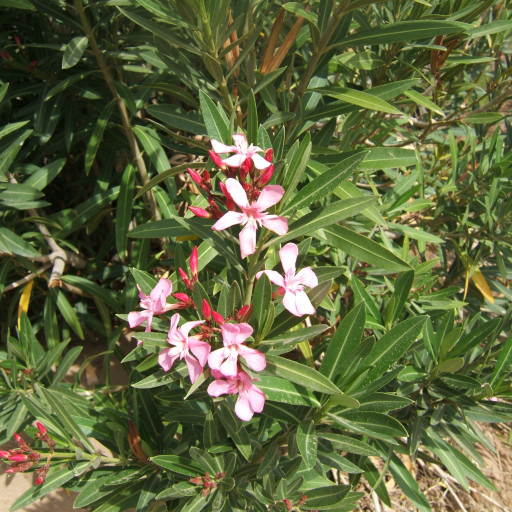
Plant Overview
The Nerium oleander, often called "Rose Bay" or simply "Oleander," is a Mediterranean icon that balances breathtaking beauty with a legendary, dark reputation. Thriving where other plants wither, it is favored for its vibrant clusters of blossoms and its ability to withstand intense heat and coastal salt. However, this evergreen beauty hides a potent secret behind its elegant, sun-loving facade.
🔍 How to Identify
- 🌿 The Foliage: Features long, narrow, lance-shaped leaves that are thick and leathery to the touch. They typically grow in pairs or whorls of three along the stems.
- 🌸 The Blooms: Showy, funnel-shaped flowers appear in heavy clusters at the ends of branches. They come in a variety of shades including pure white, soft peach, deep crimson, and candy pink.
- 🌳 Growth Habit: A vigorous, upright evergreen shrub that can be trained into a small decorative tree, often reaching heights of 6 to 12 feet.
🏡 In Your Garden
- ☀️ Sun Seeker: This plant is a true "sun worshiper." It requires full glare to produce its best blooms; a lack of light will result in leggy, spindly growth and very few flowers.
- 🌬️ Coastal Resilience: It is incredibly salt-tolerant and wind-resistant. This makes it a staple for seaside gardens and highway medians where it handles pollution and harsh conditions without complaint.
- ✂️ Pruning Nuance: While it responds beautifully to shaping, you must always wear gloves. The plant’s resilience means it can be "rejuvenated" by cutting it back hard, but the sap released during the process is the plant's primary defense mechanism.
⚠️ Safety & Toxicity
- 🚫 High Toxicity: CRITICAL WARNING. All parts of the Oleander plant—leaves, flowers, stems, and roots—are highly toxic if ingested.
- 🐾 Pets & Kids: It contains cardiac glycosides which can cause severe heart rhythm issues. Keep this plant away from curious pets and children.
- 🔥 Smoke Warning: Never burn Oleander clippings. Inhaling the smoke from a burning Oleander can cause severe respiratory distress and poisoning.
✨ Fun Fact
History suggests that Alexander the Great’s soldiers learned about Oleander's power the hard way. Legend says many fell deathly ill after using the straight, sturdy branches of the plant as skewers to roast meat over their campfires!

Detailed Care Instructions
Yes, highway departments often choose oleander for roadside plantings. Shrubs need only minimal care in the garden.
How fast does oleander grow?
They grow at a medium to fast pace, growing one to two feet or more per year. Even established plants that have been damaged by cold temperatures can regrow rapidly from the base.
What is the difference between oleander and rhododendron?
Oleander is native to southern Asia and the Mediterranean while rhododendron has a hybrid origin. Oleander grows in riverbanks and dry rocky watercourses, but rhododendron grows most prolifically in shaded forests. Oleander is hardy in USDA zones 8 through 10; rhododendron is hardy in zones 6 through 8.
| Color | Pink, Purple, Red, Yellow, White |
| Soil Ph | 6.5 - 7.5 |
| Humidity | Normal |
| Lighting | Part Sun |
| Toxicity | Poisonous |
| Soil Type | Almost Any Type Of Soil |
| Bloom Time | Spring Through Fall |
| Difficulty | Medium |
| Plant Type | Evergreen Shrub Or Small Tree |
| Mature Size | 1,5 To 2,5 M Tall On Average |
| Temperature | 18°C - 25°C |
| Sun Exposure | Partial To Full Sunlight |
| Hardiness Zones | 8 To 10 |
To grow a Nerium oleander plant, you can follow these steps:
- Choose a suitable planting location: Nerium oleander prefers full sun and well-drained soil. Select a spot in your garden that receives at least 6-8 hours of direct sunlight per day.
- Prepare the soil: Ensure the soil is well-draining by adding organic matter such as compost or well-rotted manure. This will help improve the soil structure and water drainage.
- Collect seeds or get a nursery-grown plant: You can grow Nerium oleander from seeds or purchase a young plant from a local nursery. If using seeds, soak them overnight in warm water to help with germination.
- Plant the seeds or young plant: If using seeds, sow them in a seed tray or small pots filled with seed-starting mix. Plant the seeds about ¼ inch deep and maintain a constant temperature of around 70°F (21°C). Once the seedlings have grown, transplant them into larger pots or directly into the ground.
- Water the plant: Water the plant regularly, especially during its initial growing phase. Keep the soil consistently moist but not waterlogged. After establishment, Nerium oleander is drought-tolerant and requires less frequent watering.
- Fertilize the plant: Feed the plants with a balanced slow-release fertilizer at the beginning of the growing season. This will provide essential nutrients for healthy growth. Avoid excessive nitrogen fertilizers, as they may promote excessive leaf growth and reduce flower production.
- Prune the plant: Prune the plant in early spring before new growth appears to shape it and remove any dead or diseased branches. Regularly snip off spent flowers to encourage more blooms.
- Protect from extreme cold: Nerium oleander is frost-tender and cannot tolerate freezing temperatures. If you live in a cold climate, consider growing it in containers that can be moved indoors during the winter or protect the plant with appropriate coverings.
- Watch for pests and diseases: Monitor your plant for common pests like aphids, whiteflies, and scale insects. Treat any infestations promptly with appropriate insecticides or natural remedies. Also, watch for signs of leaf spots or root rot and take steps to correct these issues if spotted.
Remember, Nerium oleander contains toxic compounds, so keep it away from children and pets, and always wash your hands after handling the plant.

Place in a window with dappled sun or a spot in the middle of a room. Or directly in a window facing west or east.

There are a few guidelines to follow when watering this plant. First, it is important to wait until the top inch of soil is dry before watering again. When watering, be sure to thoroughly saturate the soil until water runs out of the drainage holes at the bottom of the pot or planter. It is not recommended to let the plant sit in standing water, as this can cause root rot. Additionally, it is important to avoid getting water on the foliage, as this can lead to leaf spot and other fungal diseases. Overall, moderate and consistent watering is best for this plant.
To fertilize this shrub, use a slow-release granular fertilizer with a balanced ratio of nitrogen, phosphorus, and potassium. Apply the fertilizer in early spring before new growth appears, following the recommended application rates on the package. Water thoroughly after fertilizing. Avoid applying fertilizer during dry periods or to drought-stressed plants.
For optimal growth of this plant species, it is best to use a soil that is slightly acidic with a pH between 6.0 and 7.0. Additionally, the soil should be well-draining and loose, with good organic matter content to promote root development and nutrient retention. It is important to avoid using heavy or compacted soils as they can negatively impact the plant's growth and health. It is also recommended to incorporate a slow-release fertilizer into the soil before planting to ensure healthy growth and development.
To propagate this plant, one can take stem cuttings during the early summer months. The cuttings should be taken from the upper part of the plant and should be about 6 inches long. Remove the leaves from the lower half of the stem and dip the cut end in rooting hormone powder. Then, plant the stem cutting in a pot filled with moist potting soil. Keep the soil moist and place the pot in a warm and bright area, but out of direct sunlight. Within a few weeks, roots should start to form, and the plant can be transplanted to a larger pot or planted outdoors. It is important to note that this plant is toxic, and proper precautions should be taken when handling it.
Common pests of the oleander include Scale insect, mealybugs, spider mites, thrips. Make a habit of checking your oleander frequently for pests so that any infestations can be caught and managed early.








