Plant Overview
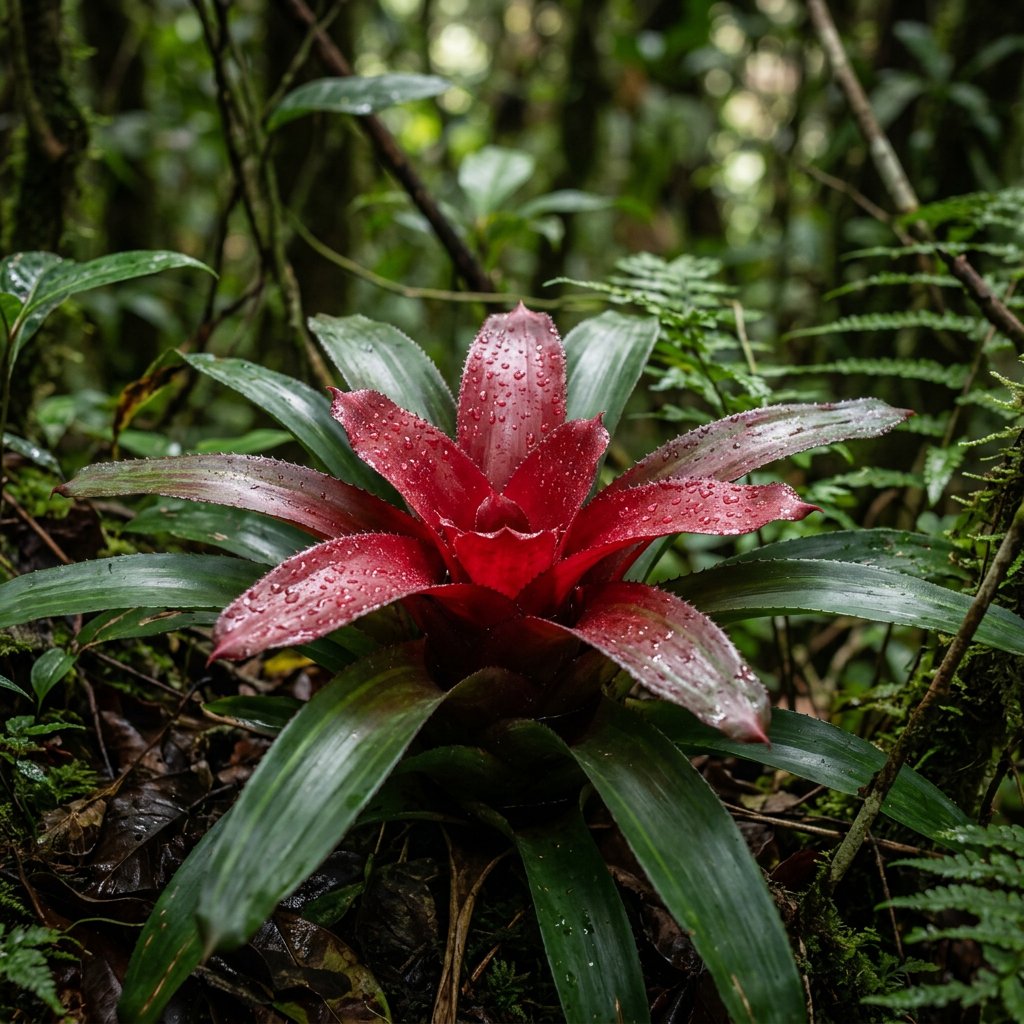
Known as the Bird’s Nest Bromeliad, this Brazilian rainforest native is a master of the "big reveal." While it spends most of its life as a lush, glossy green rosette, it earns its name when it prepares to bloom. The center of the plant transforms into a brilliant, fiery crimson "nest" that looks almost like a glowing ember tucked into the foliage.
🔍 How to Identify
- 🌿 The Rosette: Features wide, strap-shaped leaves that grow in a tight spiral, creating a central reservoir or "tank" designed to catch rainwater.
- 🎨 The "Blush": Before flowering, the short inner leaves (bracts) turn a vivid scarlet or orange-red, creating a dramatic contrast against the outer green leaves.
- 🪚 Serrated Edges: The leaf margins are lined with small, fine teeth. While not as sharp as a cactus, they have a distinct "saw-like" texture when touched.
🏡 In Your Garden
- 💧 The Central Tank: This plant is an epiphyte, meaning in the wild it grows on trees. It drinks primarily through its center. Keep the "nest" filled with fresh, distilled, or rainwater, but be sure to flush it out every few weeks to prevent salt buildup or stagnation.
- ☁️ Dappled Light: Mimicking the jungle canopy is key. It craves bright, indirect light; too much direct sun will bleach the vibrant red center, while too little will prevent the "blush" from appearing at all.
⚠️ Safety & Toxicity
- 🐾 Pet Friendly: Good news for pet parents! Nidularium fulgens is generally considered non-toxic to cats and dogs.
- 🩹 Mechanical Irritation: While not poisonous, the serrated edges of the leaves can cause minor scratches to curious toddlers or pets. It is best placed on a shelf or pedestal where it won't be brushed against frequently.
✨ Fun Fact
The name Nidularium is derived from the Latin word nidus, which means "little nest." This refers to the way the small, white-and-blue flowers stay tucked deep inside the red bracts, looking exactly like a clutch of tiny eggs waiting to hatch!

Detailed Care Instructions
To grow Nidularium fulgens, also known as the flamingo lily or painted feather bromeliad, you can follow these steps:
- Choose a suitable location: Nidularium fulgens thrives in bright, indirect light. Select a spot with good natural or artificial light but avoid direct sunlight, as it can burn the leaves.
- Select the right pot: Use a pot with good drainage to prevent waterlogging. A small to medium-sized pot is sufficient for this plant.
- Optimal soil: Nidularium fulgens prefers a well-draining, acidic soil mix. Use a mixture of potting soil, perlite, and peat moss to ensure good drainage.
- Watering: Keep the soil consistently moist but not waterlogged. Watering once a week is usually sufficient, but depending on the humidity levels, you may need to adjust the frequency. Avoid overwatering, as it can lead to root rot.
- Humidity: Nidularium fulgens prefers high humidity levels. You can increase humidity by misting the leaves regularly or placing the pot on a tray filled with water and pebbles. This helps to create a humid microclimate around the plant.
- Temperature: Maintain a temperature range between 65-80°F (18-27°C). Avoid exposing the plant to cold drafts or temperatures below 55°F (13°C).
- Fertilization: Feed Nidularium fulgens with a balanced, water-soluble fertilizer diluted to half strength every two weeks during the growing season (spring through summer). Reduce or stop fertilization during the dormant period (fall through winter).
- Propagation: You can propagate Nidularium fulgens by removing and replanting its offsets or pups. Wait until the pups are approximately one-third the size of the parent plant before detaching them. Plant the pups in a separate pot with well-draining soil and care for them as you would an adult plant.
- Pruning: Remove any wilted or dead leaves by gently pulling them away from the base of the plant. This helps to maintain the plant's overall health and appearance.
By following these care guidelines, you should be able to successfully grow Nidularium fulgens.

Place in a window with dappled sun or a spot in the middle of a room. Or directly in a window facing west or east.

Nidularium Fulgens is a tropical plant that requires regular watering to maintain its health and vitality. To water this plant, it is important to use clean and filtered water, as it is sensitive to chemicals and minerals in tap water.
The best way to water Nidularium Fulgens is to allow the soil to dry out slightly between watering. This can be determined by inserting your finger 1-2 inches into the soil to feel for moisture. If the soil feels dry, it is time to water.
When watering, pour the water slowly and evenly over the surface of the soil until it begins to drain from the bottom of the pot. Avoid getting water on the leaves or in the center of the plant, as this can lead to rot and pest infestations.
In addition to regular watering, Nidularium Fulgens also benefits from occasional misting to increase humidity levels. This can be done using a spray bottle filled with clean water, and should be done in the morning or early afternoon to allow the leaves to dry before nightfall.
Overall, proper watering is key to maintaining the health and beauty of Nidularium Fulgens, and should be done consistently and with care.
- Choose a balanced, slow-release fertilizer formulated for tropical plants.
- Dilute the fertilizer to half strength.
- Apply the diluted fertilizer to the base of the plant, taking care not to splash it onto the leaves.
- Fertilize the plant every 2-3 months, following the same dilution ratio.
- Water the plant thoroughly after fertilizing.
Nidularium Fulgens plant thrives in well-draining soil that is rich in organic matter. A high-quality potting mix that contains a blend of peat moss, perlite, vermiculite, and coco coir would be suitable for this plant. It is important to ensure that the soil has good drainage and does not become waterlogged, as this can lead to root rot. Additionally, the soil should be slightly acidic with a pH between 5.5 and 6.5. It is recommended to fertilize the plant with a balanced, water-soluble fertilizer every two to three months during the growing season. The plant should be kept in bright, indirect light and watered regularly but not excessively.
To propagate this plant, you will need to remove offsets that grow from the parent plant. These offsets are small plants that develop at the base of the parent plant and can be found growing in the soil around it.
Firstly, prepare a new pot with fresh soil mix and make a small hole for the offset to be planted in. Remove the offset using a sterile sharp blade and remove any old leaves or roots from the offset. Let the offset dry and callous for a few hours.
Then, insert the offset into the prepared hole in the new pot and gently press the soil around it to secure it in its new location. Water the plant well and place it in a bright, indirect light.
Keep the soil moist and check it regularly to ensure it is not too dry or too wet. After a few weeks, you should start to see new growth from the offset, indicating that it has successfully taken root and is growing into a new plant.
Common pests of the blushing bromeliad include Scale insect, mealybugs, spider mites. Make a habit of checking your blushing bromeliad frequently for pests so that any infestations can be caught and managed early.








