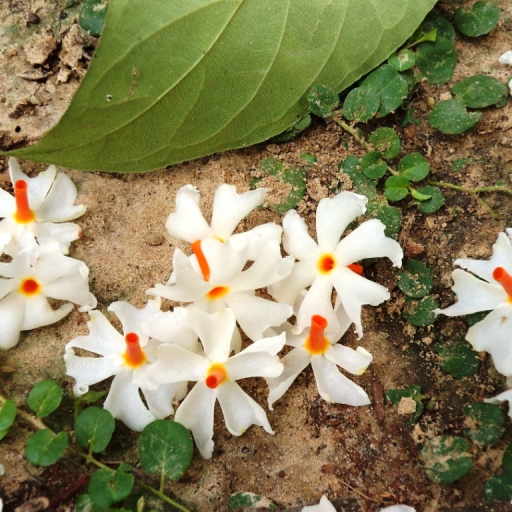
Plant Overview
Known as the "Night-flowering Jasmine" or the "Parijat," this mystical shrub is a cornerstone of South Asian folklore and spirituality. Its Latin name, Arbor-tristis, literally translates to "sad tree," because its fragrant blossoms lose their brightness and fall to the ground at the first light of dawn. In ancient myths, it is said to be a heavenly tree brought to Earth by Lord Krishna, and it remains one of the few flowers that can be offered in religious ceremonies even after falling from the branch.
🔍 How to Identify
- 🌼 The Contrast Flowers: Small, pinwheel-like blossoms with five to eight snowy white petals surrounding a vibrant, honey-orange central tube.
- 🍃 Rough Foliage: Large, heart-shaped green leaves that feel remarkably scratchy or sandpapery to the touch, arranged in opposite pairs along the stems.
- 🪵 Square Stems: Young branches often have a distinct four-angled or square-ish shape rather than being perfectly round.
🏡 In Your Garden
- 🌙 Strategic Placement: Since the flowers bloom only at night and release an intoxicating, honey-like scent, plant this near a bedroom window or a patio to enjoy its evening perfume.
- 💧 The "Feet" Rule: This plant is prone to root rot if left in standing water. It prefers well-draining soil and a sunny spot, but once established, it is surprisingly drought-tolerant.
- ✂️ Pruning Strategy: It tends to grow lanky and "leggy." Prune it back after the flowering season (typically late autumn) to encourage a bushier shape and more flower buds for the next year.
⚠️ Safety & Toxicity
- ✅ General Status: Nyctanthes arbor-tristis is generally considered non-toxic to humans and is widely used in traditional Ayurvedic medicine.
- 🐾 Pets & Kids: While not classified as a poisonous plant, the rough texture of the leaves can cause mild mechanical irritation if chewed, and the high essential oil content in the flowers might cause a mild stomach upset in curious pets.
- 🤧 Fragrance Sensitivity: The scent is extremely powerful at night; those with seasonal allergies or scent sensitivities should avoid placing it directly under air intake vents.
✨ Fun Fact
Unlike almost all other flowers used in Hindu worship, which must be plucked directly from the tree, the Parijat is the only flower considered "pure" even when gathered from the ground, symbolizing its divine origin and humble transition to Earth.

Detailed Care Instructions
To grow Nyctanthes Arbor-tristis, also known as the Night-flowering Jasmine or Parijat plant, follow these steps:
- Climate and Soil Requirements:
- Nyctanthes Arbor-tristis thrives in tropical and subtropical regions.
- It prefers well-draining soil with good organic matter and a pH level ranging from slightly acidic to neutral (6-7).
- Nyctanthes Arbor-tristis thrives in tropical and subtropical regions.
- Propagation:
- The plant can be propagated through seeds or cuttings.
- Seeds: Soak the seeds in water for 24 hours before planting. Sow them about 1/4 inch deep in a pot filled with moist soil.
- Cuttings: Take 6-8-inch stem cuttings from a healthy mother plant. Remove the lower leaves and plant the cutting in a pot filled with moist soil. Use rooting hormone to improve success rate.
- The plant can be propagated through seeds or cuttings.
- Sunlight:
- Nyctanthes Arbor-tristis requires full sunlight for at least 6-8 hours a day. Place the pot in a sunny location, preferably facing east or west.
- Nyctanthes Arbor-tristis requires full sunlight for at least 6-8 hours a day. Place the pot in a sunny location, preferably facing east or west.
- Watering:
- Water the plant regularly, keeping the soil moist but not waterlogged. Allow the soil to dry out slightly between watering. Over-watering may lead to root rot, so ensure proper drainage.
- Water the plant regularly, keeping the soil moist but not waterlogged. Allow the soil to dry out slightly between watering. Over-watering may lead to root rot, so ensure proper drainage.
- Fertilization:
- Apply a balanced, slow-release fertilizer during the growing season (spring and early summer).
- You can also supplement with liquid fertilizer every 4-6 weeks during this period.
- Apply a balanced, slow-release fertilizer during the growing season (spring and early summer).
- Pruning:
- Prune the plant after the flowering season to maintain its shape and remove dead or weak branches.
- Pinching off the growing tips regularly promotes bushier growth.
- Prune the plant after the flowering season to maintain its shape and remove dead or weak branches.
- Pest and Disease Control:
- Monitor the plant for common pests like aphids, mealybugs, or whiteflies. Use organic insecticidal soap or neem oil to control infestations.
- Provide good air circulation around the plant to prevent fungal infections.
- Monitor the plant for common pests like aphids, mealybugs, or whiteflies. Use organic insecticidal soap or neem oil to control infestations.
- Harvesting Flowers:
- The white flowers of Nyctanthes Arbor-tristis bloom at night and drop in the morning. Collect the fragrant flowers early in the morning for various purposes.
Remember to research specific care practices and adaptations, especially if you live in a region outside its native range.
- The white flowers of Nyctanthes Arbor-tristis bloom at night and drop in the morning. Collect the fragrant flowers early in the morning for various purposes.

Place in a bright room that is sun drenched almost all day. Or directly in a south-facing window.

To properly water this plant, you will want to first determine the soil moisture levels in the pot. To do this, stick your finger about 1 inch deep into the soil and assess how wet or dry it feels. If the soil feels dry, it is time to water the plant.
When watering, use room temperature watering water and pour slowly around the base of the plant until the water begins to drain out of the bottom of the pot. Be sure to avoid getting water on the leaves as this can cause damage or disease.
It is important not to overwater this plant, as it is susceptible to root rot. Allow the soil to dry out slightly between watering to prevent this from happening. In addition, be mindful of the humidity levels around the plant, as higher humidity can help prevent the plant from drying out too quickly.
During the winter months, the plant will require less watering due to decreased light and temperature levels. Adjust your watering schedule accordingly to avoid overwatering during this time.
To fertilize this plant, use a well-balanced fertilizer with equal amounts of nitrogen, phosphorous, and potassium. Apply the fertilizer to the soil around the base of the plant, taking care not to get any on the leaves or stem. Water the plant thoroughly after fertilizing to help distribute the nutrients evenly. Fertilize once a month during the growing season, which is typically from spring to fall.
Nyctanthes Arbor-tristis plant prefers a well-draining soil that is rich in organic matter. It requires soil that is porous and easily retains moisture without becoming waterlogged. The pH level of the soil should be slightly acidic to neutral, which can be achieved by adding organic materials such as compost or peat moss to the soil. It is recommended to use a mixture of garden soil, sand, and compost to create the perfect soil blend for this plant. This will provide the plant with all the necessary nutrients while allowing water to easily drain away, preventing root rot. Avoid using heavy clay soil as it can cause waterlogging and suffocate the roots of the plant. A regular top-dressing of organic fertilizers such as bone meal or fish meal will help to keep the plant healthy and thriving.
To propagate this plant, you will need to take cuttings from healthy and well-developed stems. Make sure to cut the stem at a 45-degree angle, which will allow more surface area for the cutting to root. Remove all the leaves from the bottom half of the cutting, ensuring that there are at least two or three nodes remaining.
Next, dip the cut end of the stem into hormone rooting powder, which will help the cutting to establish roots. Then, place the cutting in a pot or tray filled with moistened soil. Cover the pot or tray with a plastic bag, which will create a humid environment that encourages root growth.
Place the cutting in a warm and brightly lit area, but avoid direct sunlight as it may damage the cutting. Keep the soil damp and mist the cutting regularly to maintain humidity. After a few weeks, you should begin to see roots growing from the base of the cutting.
Once the roots are well-developed, you can transplant the cutting into a larger pot or into your desired location in the garden. Make sure to water the plant regularly and provide it with adequate sunlight and nutrients to encourage healthy growth.








